




















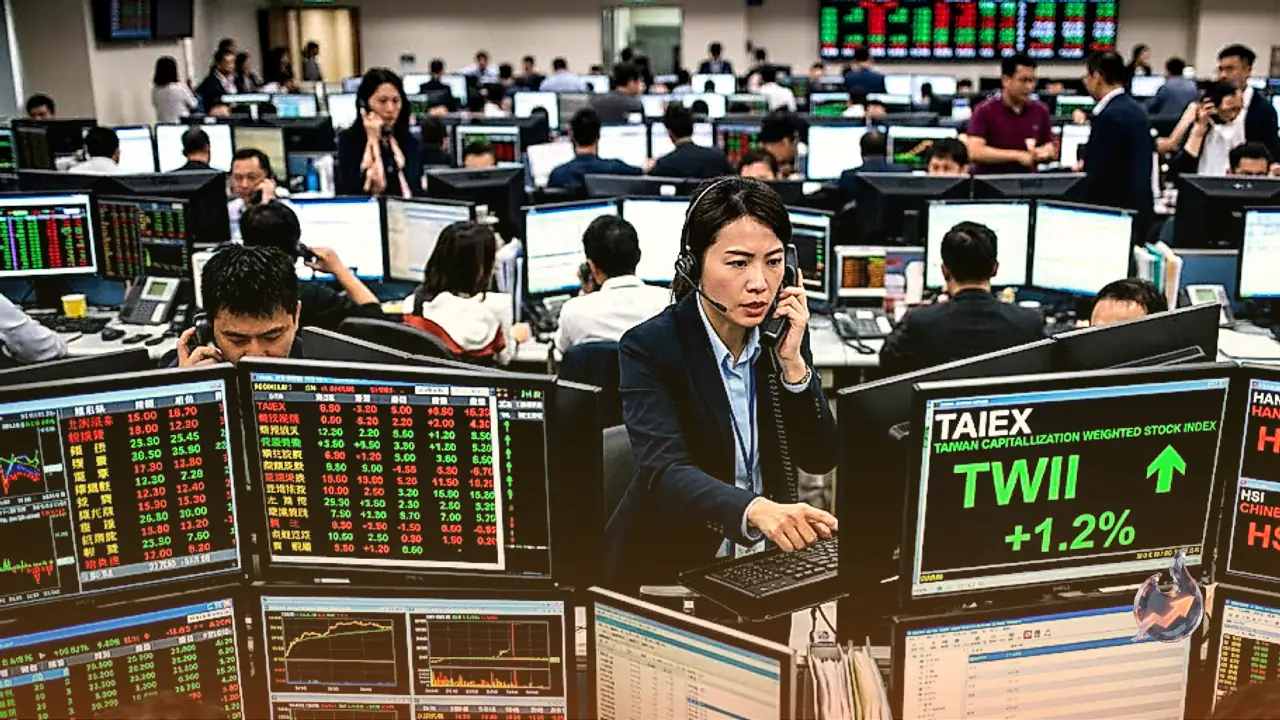

Asian equities exhibited a mixed performance on Wednesday as trading desks weighed localized corporate momentum against shifting global macro dynamics. Easing crude oil prices and softer United States Treasury yields supported general market sentiment, aided by improving oil flows across the Middle East. However, divergence across major regional trading hubs was evident, with technology-heavy exchanges in South Korea and Taiwan extending recent gains on artificial intelligence enthusiasm, while mainland Chinese and Hong Kong benchmarks surrendered ground.
Taiwan and South Korea Advance on Artificial Intelligence Momentum
Technology counters spearheaded the advance across Northeast Asian markets during Wednesday's trading. In Taiwan, the benchmark Taiex surged 0.80% to settle at 48,181, lifted by persistent capital inflows into semiconductor makers and allied hardware suppliers. South Korea's benchmark Kospi index registered a modest gain of 0.03%, closing at 7,020. Market sentiment in Seoul was anchored by evidence of enduring consumer demand for AI-driven software and applications, which provided steady support to key tech heavyweights.
Chinese and Hong Kong Benchmarks Pull Back
Conversely, equity markets in mainland China and Hong Kong struggled to maintain upward momentum on Wednesday. China's primary domestic equity gauge, the Shanghai Composite, dropped 0.25% to end at 3,942. The Shenzhen Stock Exchange experienced similar pressure, declining 0.42% to finish at 13,665. In Hong Kong, the benchmark Hang Seng index slid 0.85% to 24,875, as market participants engaged in profit-taking across selected consumer and property counters amidst broader economic caution.
Japanese Bourses Remain Shuttered for Extended Holiday
Major financial markets across Japan remained closed from Monday through Wednesday in observance of a national holiday. Normal trading operations on the Tokyo Stock Exchange are scheduled to resume on Thursday, 24 September. During the closure, international market participants continued to digest the Bank of Japan's recent monetary policy adjustment. The Japanese central bank raised its short-term interest rate target from 1.00% to 1.25% in a 7-2 vote, marking a further step in monetary policy normalization that aligned with broad market expectations.
Asia's Central Role in Global Growth and Primary Indices
The Asian continent contributes roughly 70% of global economic growth and hosts several of the world's most heavily capitalized stock market indices. Within the region's advanced economies, prominent benchmarks include Japan's Nikkei 225, representing leading enterprises listed on the Tokyo Stock Exchange, alongside South Korea's Kospi. Greater China features three major indices: the Hong Kong Hang Seng, the Shanghai Composite, and the Shenzhen Composite. Meanwhile, India's expanding emerging market footprint has captured institutional capital, with global and domestic investors steadily increasing allocations to firms listed on the benchmark Sensex and Nifty indices.
Structural Sectoral Differences Across Key Regional Economies
Asia's primary economies feature varied industrial structures, with distinct sectors driving individual exchanges. Technology enterprises dominate benchmark weights in Japan, South Korea, and increasingly across China. In contrast, financial services form the backbone of equity bourses in Hong Kong and Singapore, both established as premier regional banking and asset management hubs. Industrial manufacturing remains a critical pillar in China and Japan, particularly across automotive manufacturing and consumer electronics. Furthermore, the expansion of the middle class across India and China is driving significant market capitalization growth for retail, consumer goods, and e-commerce enterprises.
Core Catalysts Influencing Asian Equity Benchmarks
Multiple economic and corporate factors dictate the trajectory of Asian stock indices, though the primary driver remains the aggregate operational results published in quarterly and annual earnings reports. Country-specific macroeconomic fundamentals, domestic central bank rate decisions, and government fiscal policy measures also exert heavy influence. On a broader plane, political stability, domestic rule of law, and technological innovation shape long-term equity valuations. Regional exchanges also frequently take cues from overnight trading patterns across Wall Street. Finally, overall global risk sentiment plays a major role, given that equity investments carry inherent risk relative to fixed-income assets.
Region-Specific Risks, Geopolitics, and Currency Movements
While equity investments inherently carry capital risk, allocating to Asian markets entails distinct regional considerations. Political structures across Asia range from established democracies to authoritarian systems, leading to wide variations in regulatory transparency, legal frameworks, and corporate governance standards. Geopolitical developments, including bilateral trade disputes and regional territorial friction, frequently generate market volatility, as do natural disaster risks. Foreign exchange fluctuations also significantly affect corporate valuations; export-heavy economies often face headwinds from currency appreciation, while currency depreciation can bolster international competitiveness by making exports cheaper abroad.
Commodities, Currencies, and Geopolitical Developments
Beyond equity benchmarks, related asset classes navigated evolving geopolitical and macroeconomic headlines on Wednesday. Energy prices dropped as crude shipments through the Middle East showed operational improvement, easing inflation worries and keeping United States bond yields restrained. On the diplomatic front, a senior Iranian official indicated that Tehran could reopen the Strait of Hormuz within seven days provided the United States eases military pressure and lifts port blockades. In foreign exchange, the AUD/USD pair remained confined around 0.7100 during the Asian session, pressured by flash PMI data indicating Australian manufacturing contracted while services growth slowed for a second consecutive month. The US Dollar maintained strength ahead of Thursday's anticipated summit between Donald Trump and Xi Jinping. Concurrently, USD/JPY traded around the mid-157.00s, supported by the Federal Reserve's hawkish policy stance and the Bank of Japan's rate hike posture, though potential currency intervention by Japanese authorities limited further upside. Gold struggled to extend an overnight rebound from below $4,300, remaining defensive as the strong US Dollar capped bullion prices.