






















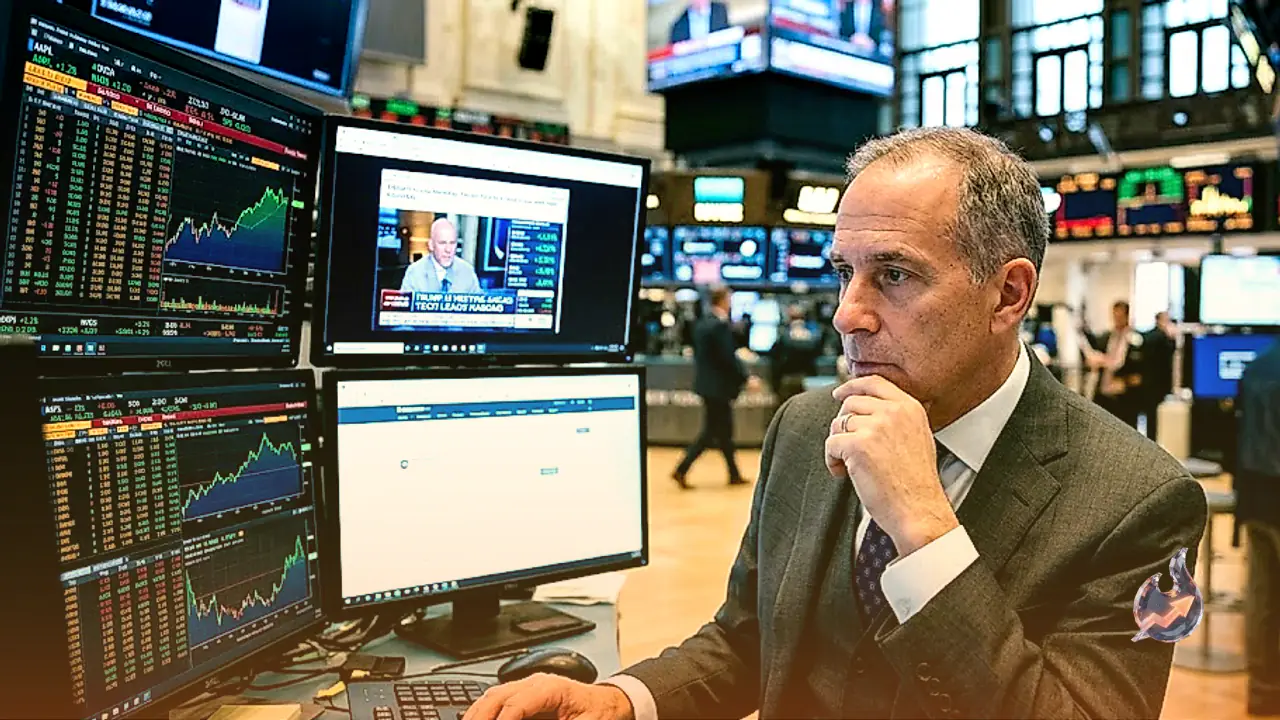

Financial markets across the United States maintained a restrained posture during the early trading hours of September 23, with equity index futures moving within a narrow corridor following an uneven overnight session. An earlier run of gains on Wall Street lost steam as energy commodities pulled back and traders adjusted their exposure to developing international events. While ongoing momentum across enterprise technology shares shielded the Nasdaq Composite and pushed it into positive territory, cyclical components weighed down both the Dow Jones Industrial Average and the broader S&P 500. Market participants are now recalibrating their portfolios in anticipation of a high-stakes meeting between US President Donald Trump and Chinese President Xi Jinping scheduled for the following day.
Review of Cash Session Closures and Morning Futures Positioning
Trading in New York concluded with diverging trajectories across key asset classes during the preceding trading day. The 30-share Dow Jones Industrial Average dropped 185.14 points, or 0.4 percent, ending the session at 51,863.69. Similarly, the benchmark S&P 500 gave up ground, registering a fractional decline to finish at 7,764.64. In contrast, the heavily tech-weighted Nasdaq Composite advanced by 122.18 points, or 0.45 percent, settling at 27,244.28.
The cautious stance carried directly into Wednesday morning's pre-bell trade. Dow Jones futures managed a modest uptick of 29 points, or 0.06 percent, hovering around 52,309. Simultaneously, Nasdaq 100 futures slipped 12.50 points, or 0.04 percent, closing in near 31,015.75, while contracts tied to the S&P 500 hovered virtually unchanged at 7,831.75. This subdued activity reflected widespread unwillingness among institutional desks to take aggressive directional bets prior to major geopolitical clarity.
Geopolitical Stakes: Trump and Xi to Address Trade, Minerals, and AI
Cross-border diplomacy currently stands at the forefront of market catalysts. A pivotal face-to-face dialogue between Donald Trump and Chinese leader Xi Jinping is slated for September 24. Discussions are expected to encompass multi-faceted friction points, including bilateral trade terms, regional friction involving Iran, regulatory trajectories for artificial intelligence architecture, and secure access to global critical mineral reserves. Any tangible breakthroughs or fresh policy friction emerging from this high-level forum could promptly redefine supply chain dynamics and margin expectations across multinational corporations.
Simultaneously, active diplomatic engagement is underway in New York at the United Nations General Assembly, where Trump is participating in discussions with Middle Eastern leaders from the Gulf states to explore frameworks for de-escalation. Michael Townsend, managing director of legislative and regulatory affairs at Charles Schwab, noted that this period is turning into one of the most consequential foreign policy weeks of Trump's administration. Investors remain hopeful that diplomatic progress might alleviate regional risks, helping stabilize energy transit lanes.
Central Bank Rhetoric Under the Microscope
Macroeconomic uncertainty surrounding borrowing costs remains another primary concern for equity strategists. Market observers are preparing to parse scheduled public remarks from a trio of Federal Reserve officials in search of clues regarding the rationale behind last week's interest rate increase and the path ahead. The lineup features Federal Reserve Vice Chair Philip Jefferson, Richmond Fed President Tom Barkin, and New York Fed President John Williams.
Comments from Williams are viewed with particular sensitivity by institutional trading desks, given the New York Fed's direct proximity to open market operations. Clear guidance regarding monetary tightening persistence or potential policy plateaus could rapidly sway Treasury yield curves and overall equity valuations.
Technology Sector Resilience Driven by AI Innovation
Despite broader macro hesitation, technology assets have continued to provide an essential cushion for the equity landscape. Figures compiled by Trading Economics illustrated that the Nasdaq Composite notched a fresh all-time high in the previous session, propelled by relentless capital commitments toward AI infrastructure providers. Equities also drew support from moderating crude oil valuations and easing bond yields, which benefited from expanding optimism regarding a de-escalation in tensions between Washington and Tehran.
Enthusiasm within the technology ecosystem was further buoyed by favorable market reception for Meta's Muse AI agent. Adding to the momentum, AI developer Anthropic is preparing to release an advanced model designed to execute complex enterprise workflows while significantly reducing operating expenses, coming just ahead of the firm's anticipated Wall Street debut. These innovations continue to validate capital expenditures throughout the enterprise software and computing hardware pipelines.
Imminent Corporate Balance Sheets and Macroeconomic Indicators
The Wednesday calendar brings a heavy slate of earnings releases alongside significant macroeconomic data points, offering real-time insight into corporate balance sheets and broad consumer activity. Quarterly corporate results from prominent bellwethers will take center stage, including updates from Cintas Corporation (CTAS), Paychex Inc. (PAYX), General Mills Inc. (GIS), Cracker Barrel Old Country Store Inc. (CBRL), and H.B. Fuller Company (FUL). Analysts will closely examine their disclosures for hints of margin compression or changes in consumer discretionary outlays.
On the macroeconomic front, traders will digest multiple high-impact economic prints, including the weekly EIA Crude Oil Inventories report, the MBA Mortgage Applications Index, and flash surveys from S&P Global covering both US Manufacturing PMI and US Services PMI. Together, these reports will supply vital evidence on whether commercial activity and hiring sentiment are maintaining resilient momentum amid ongoing monetary tightening.