























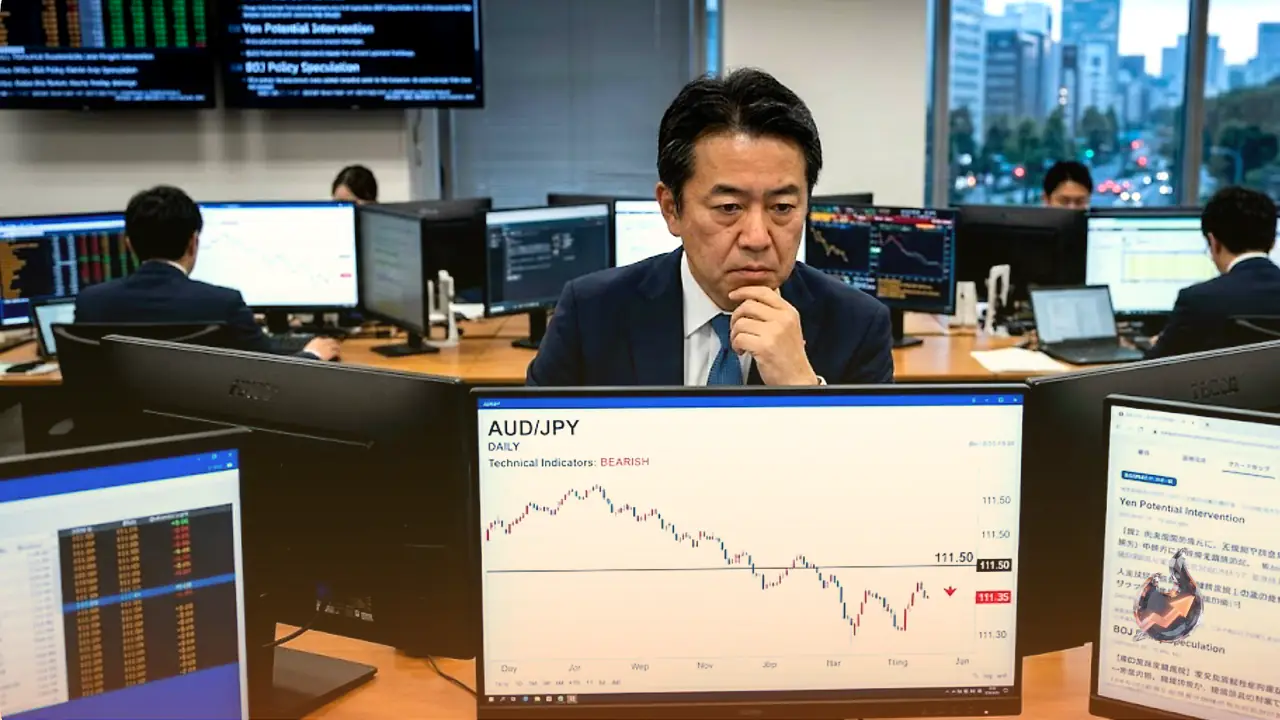

The AUD/JPY currency pair is currently facing a persistent downtrend, maintaining its position below the 111.50 threshold. Market participants remain on high alert regarding potential currency intervention by Japanese authorities, as such measures could strengthen the JPY and cap further gains for the cross. On Tuesday, Japan’s Chief Cabinet Secretary Minoru Kihara stated that the government is prepared to take appropriate action against foreign exchange movements if the situation necessitates it.
Technical Indicators and Market Analysis
Looking at the daily chart, AUD/JPY exhibits a bearish tone in the near term. The price currently trades at 111.40, marking a 0.17 percent decline from its previous close of 111.59. The pair is holding below the 100-day moving average (MA) and the 20-period Bollinger middle band. The Relative Strength Index (14) stands at 34, suggesting that downside momentum remains dominant, though it is approaching oversold territory.
Key Support and Resistance Levels
On the upside, a firm daily close above the 100-day MA at 112.25 could pave the way for a move toward the Bollinger middle band at 112.95, while the upper Bollinger band near 114.77 acts as a further resistance barrier. On the downside, immediate structural support is located near the Bollinger lower band at 111.15. A decisive break below this floor would likely trigger a deeper corrective phase, whereas maintaining this level could encourage a short-term rebound toward the moving average cluster.
The Role of the Japanese Yen and Central Bank Policy
The Japanese Yen (JPY) remains one of the world's most liquid currencies. Its valuation is heavily influenced by Japan's economic performance, the Bank of Japan (BoJ) monetary policy, the interest rate differential between US and Japanese bonds, and general trader risk sentiment. Currency control is a core mandate for the BoJ. While direct intervention to lower the Yen's value has occurred in the past, the central bank frequently avoids this due to political sensitivities with international trading partners.
Between 2013 and 2024, the BoJ’s ultra-loose monetary policy contributed to the Yen's depreciation against major peers due to policy divergence. However, the recent gradual unwinding of these measures has provided some support to the currency. The significant policy gap between the BoJ and the US Federal Reserve over the last decade favored the US Dollar. Now, with the BoJ’s 2024 policy shift and interest rate cuts by other major central banks, this yield differential is beginning to narrow. Historically, the Yen acts as a safe-haven asset, drawing investor capital during periods of global market turbulence.