























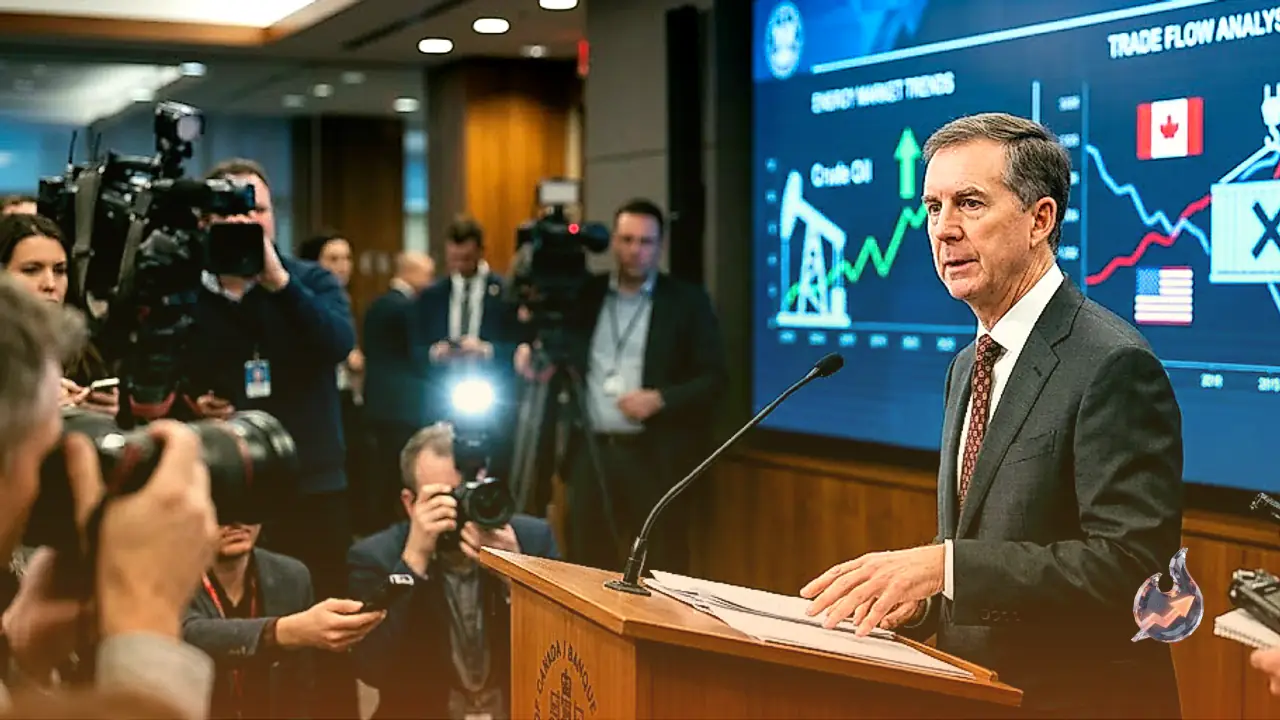

Global economic conditions face a delicate balance as central bankers evaluate persistent inflation against slowing growth indicators. The Bank of Canada recently outlined a complex environment where subdued demand for labor, sustained excess economic supply, and heightened uncertainty surround the ongoing recovery. Policymakers are keeping a close watch on external pressures, notably fresh import tariffs from the United States and broader international trade friction that threaten economic expansion. Concurrently, escalating tensions in the Middle East have sustained elevated energy costs, making price stabilization increasingly difficult for central banks across major economies.
Bank of Canada Governor Tiff Macklem emphasized that consumer price gains remain uncomfortably high, noting that the inflationary pressure is heavily concentrated in essential energy markets, particularly gasoline and refined crude oil products. A critical dilemma for monetary authorities centers on the duration and extent of elevated energy costs. Governor Macklem highlighted that the central bank possesses limited tolerance for persistent inflation and stands ready to adapt its monetary policy stance if risks continue to shift away from long-term targets.
In discussing prospective policy actions, Macklem stated explicitly that multiple interest rate increases could become necessary if inflationary pressures broaden across the wider economy. However, he clarified that consecutive rate hikes do not represent the primary baseline scenario. Future interest rate adjustments will depend strictly on incoming macroeconomic forecasts and an assessment of surrounding risks. Adding context to the central bank's strategy, Senior Deputy Governor Carolyn Rogers pointed out that monetary policy decisions cannot be driven by isolated data releases or single risk factors, necessitating a broader approach to financial stability.
Record Diesel Margins and Crude Oil Dynamics
Energy commodity markets are displaying significant divergence across different refined products. While crude oil benchmarks appear relatively calm compared to previous months, the diesel market is signaling acute tightness. The United States diesel crack spread, which measures the margin between ultra-low sulphur diesel futures and West Texas Intermediate crude oil, recently breached $100 per barrel for the first time in history. During intraday trading, this premium reached a record level of just over $102.00, reflecting severe supply constraints and elevated refining margins.
At the same time, West Texas Intermediate crude oil continued its upward trajectory, advancing for a third consecutive trading session. This gain marks the fifth positive session within the last six trading days for the benchmark crude. Prices rose to their highest level since July 24 during Asian trading hours on Wednesday. The persistent strength in petroleum prices reinforces concerns among policymakers regarding energy driven inflation and its pass-through effects on transportation and consumer goods.
Foreign Exchange Volatility and Precious Metals Rally
Foreign exchange markets navigated choppy conditions on Wednesday as major currency pairs responded to shifting US Dollar momentum and global risk sentiment. The British Pound staged a partial recovery against the US Dollar, bouncing off four-week lows near 1.3470. Despite this intraday rebound, the GBP/USD pair continues to contend with an extended multi-day negative streak. The currency correction occurred even as the US Dollar experienced overall tepid performance and geopolitical uncertainty persisted across global markets.
Meanwhile, the Euro exhibited two-way price action against the US Dollar, alternating between gains and losses around the 1.1600 level following the close of European equity markets on Wednesday. The EUR/USD pair managed to rebound from earlier two-week lows near 1.1560, drawing support as the US Dollar index lost upward momentum. Foreign exchange traders remain cautious, weighing central bank policy differentials against broader economic headwinds.
In precious metals, gold demonstrated sustained buying interest, continuing to recover recent losses and setting its sights on the $4,400 per troy ounce threshold. The metal's upward movement was supported by modest weakness in the US Dollar, persistent geopolitical anxieties, and mixed movement across US Treasury yields, which provided a favorable backdrop for safe haven demand.
Cryptocurrency Retrenchment and Asset Consolidation
Digital asset markets experienced broad selling pressure on Wednesday as market participants adopted a defensive posture. Major cryptocurrencies pulled back as investors evaluated macroeconomic uncertainty and shifting risk appetite across global markets. The retreat led to widespread consolidation across prominent digital tokens, with trading activity reflecting heightened caution among institutional and retail traders alike.
Bitcoin led the market consolidation, holding near key short-term support around $77,000 as selling pressure stabilized. Meanwhile, Ethereum faced continued downside momentum, sliding toward the $2,400 mark. Ripple also traded lower in tandem with the broader digital asset space. The pullback highlights how cryptographic assets remain sensitive to shifting liquidity conditions, interest rate expectations, and global market sentiment.