






















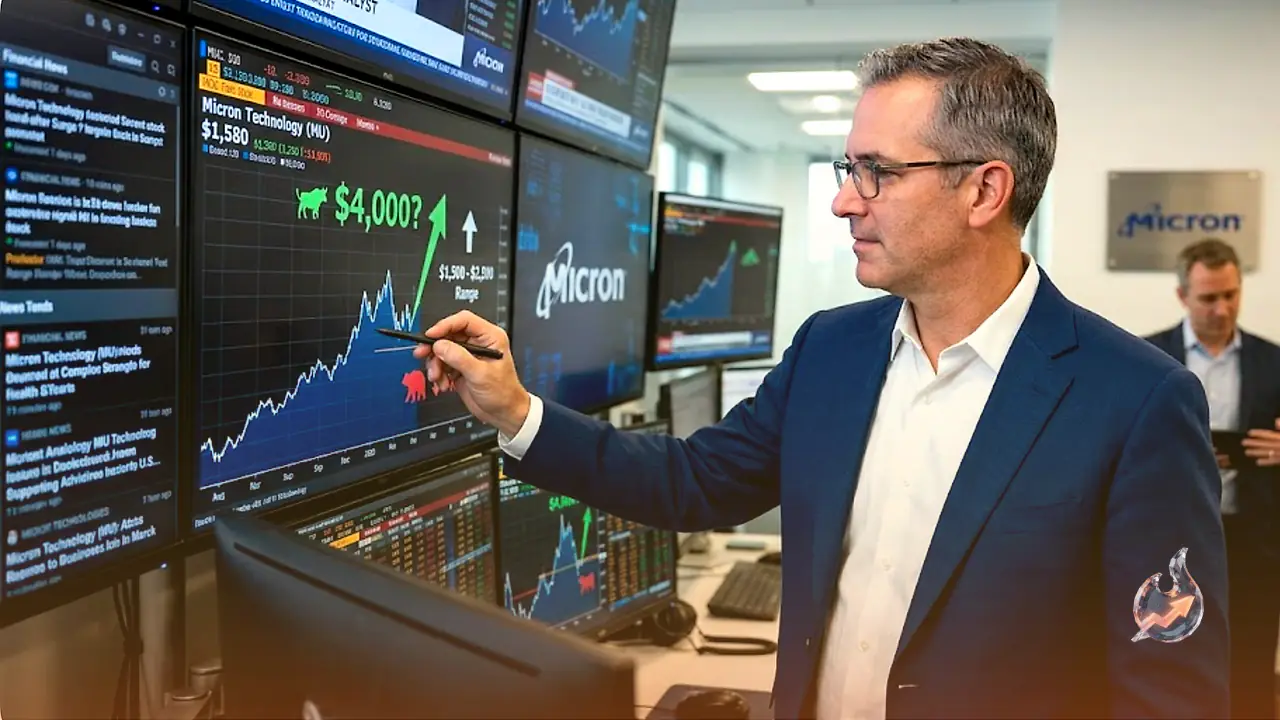

Will Micron stock reach the $4,000 threshold? It is a question that continues to occupy the minds of many traders, even if the number sounds ambitious at first glance. Currently, most valuation models suggest a more realistic ceiling in the $1,500 to $2,500 range per share. This discrepancy is precisely what fuels the ongoing debate. Updated 2027 forecasts from Wall Street place the fair value near $975, while the most optimistic price targets peak closer to $1,750. The split between bulls and bears regarding the MU target remains significant, largely driven by optimism surrounding AI demand.
Forecasts, AI Demand, and Market Analysis
Surging interest in AI memory has propelled shares to approximately $1,043, following a substantial climb. A panel of nine analysts holds an average MU target price closer to $637, with few expecting a move into four-figure territory soon. Bullish firms like Aletheia Capital and RBC Capital have raised their targets to $1,600 and $1,200, respectively, arguing that structural AI demand is decoupling memory chips from their historical boom and bust cycles. While TD Cowen’s 2027 forecast assumes that pricing power will endure, reaching $4,000 would require a level of performance that even the most aggressive Wall Street desks consider a long shot.
Insights from the CEO
Addressing the company’s performance, CEO Sanjay Mehrotra stated, "Micron set new records across revenue, gross margin, EPS, and free cash flow." While these robust figures support the case for growth, they do not provide a clear answer on whether the stock can reach the $4,000 milestone in the coming years.
The Road to $4,000
Reaching $4,000 would require years of consistent AI-driven demand and the avoidance of the cyclical pricing crashes that typically plague the memory chip industry. Much of this outcome hinges on hyperscalers committing to multiyear supply agreements rather than the short-term orders they have historically favored. While some analysts suggest that if AI demand compounds aggressively into the early 2030s, the odds might improve, the general consensus remains that $4,000 is a speculative scenario rather than a near-term expectation. Ultimately, the future of the stock depends on how long the current AI memory cycle can sustain momentum before a correction occurs.