
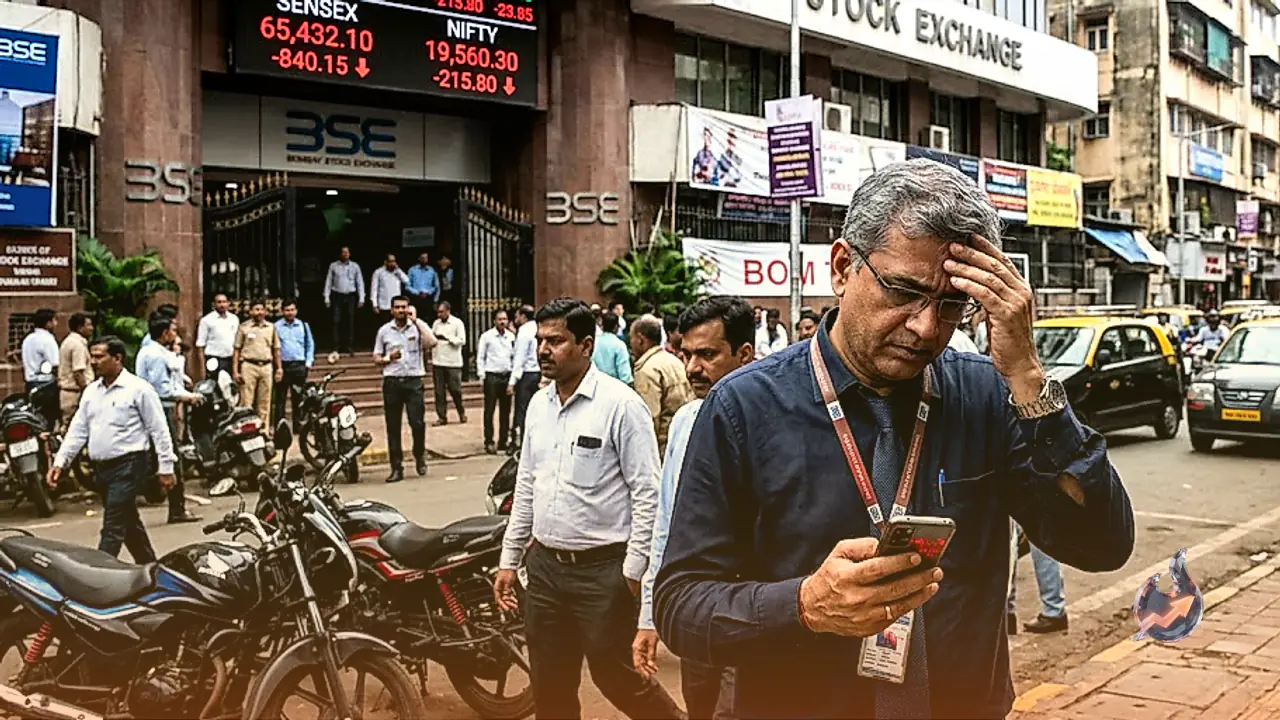






















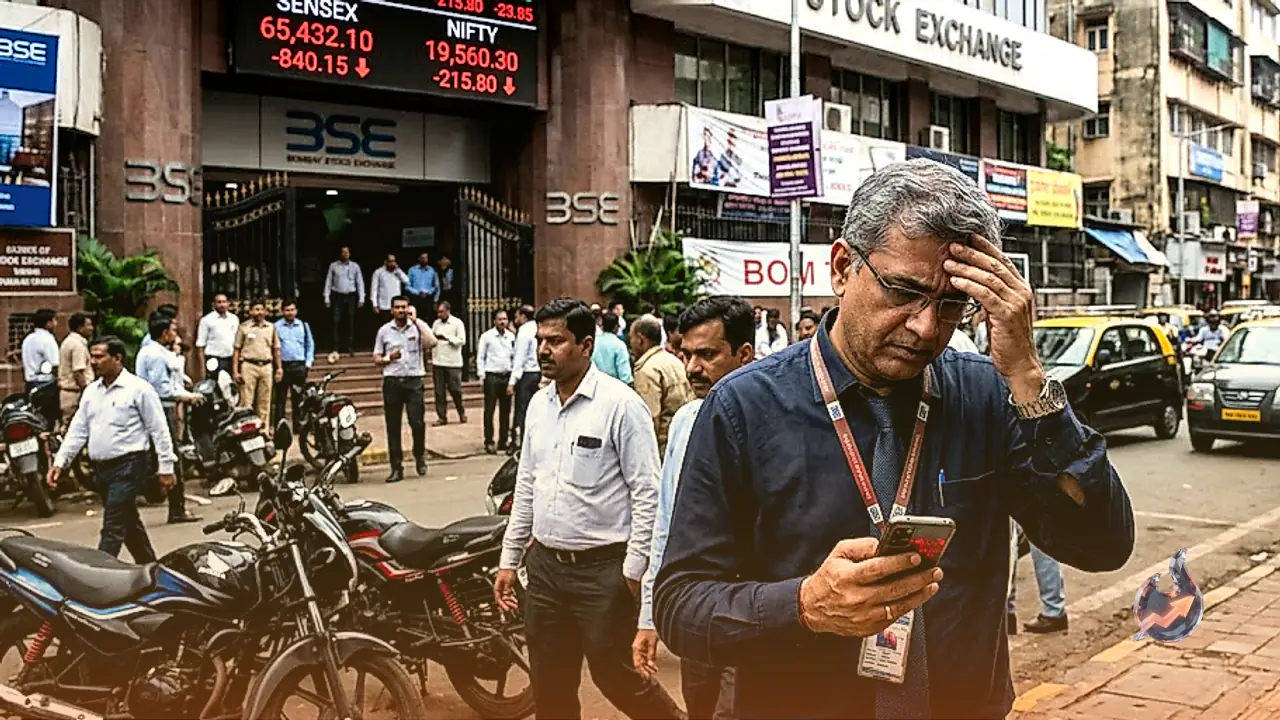

Domestic stock benchmarks remained on the back foot on the morning of Thursday, October 1, with benchmark indices trading lower as heavy foreign capital withdrawals dampened risk appetite across Dalal Street. By 9:50 AM, the BSE Sensex had retreated 102 points while the Nifty 50 was down 61 points. Earlier at the opening bell, the Nifty 50 dropped 0.34 percent to 22,543.7, and the Sensex shed 0.4 percent to 72,192.89, extending an ongoing rout that puts both gauges on track for their eighth consecutive weekly decline, the longest losing streak witnessed in 25 years.
Relentless Foreign Outflows Weigh On Benchmarks
The primary catalyst behind the persistent market slump remains relentless divestment by foreign portfolio investors. In Wednesday's trading session, foreign institutional players disposed of Indian equities worth Rs 10,148 crore, equivalent to roughly $1.06 billion. That single-day liquidation brought their cumulative divestments over the preceding five sessions to around $3.6 billion, pushing total net foreign sales for the calendar year to date to an eye-watering $27.8 billion. The selloff was equally intense throughout September, during which foreign institutions acted as net sellers across 15 out of 20 trading sessions.
Surging US Yields And Volatile Crude Oil Dynamics
An unfavorable global interest rate backdrop is compounding pressure on emerging market equities. The US 10-year Treasury yield finished at 5.17 percent on September 25. Elevated returns on safe-haven American sovereign paper reduce the attractiveness of emerging market equities for international fund managers, spurring capital reallocation toward dollar-denominated assets and mounting sustained depreciation pressure on the Indian rupee.
Energy markets have provided an additional layer of complexity. Brent crude futures eased to around $98 per barrel following statements from Tehran indicating it had received Washington's response regarding its latest ceasefire proposal. However, earlier declarations from US President Donald Trump rejecting the proposal have subdued expectations of any imminent diplomatic resolution, leaving broader geopolitical uncertainties unresolved.
Weekly And Annual Losses Mount
So far this week, the Nifty 50 has shed roughly 2.6 percent, while the Sensex has contracted by 2.3 percent. These weekly retreats follow a challenging September in which the Nifty dropped approximately 5.7 percent. On an annual comparison, the Sensex is down 10.5 percent year on year, and the Nifty has retreated around 8.9 percent over the same span, highlighting the protracted nature of the market correction.
Sector And Stock Movements Across The Bourse
Prominent heavyweight stocks exhibited weakness immediately from the opening bell on Thursday. Bajaj Auto and Max Healthcare fell by as much as 3 percent during initial trades. This followed Wednesday's subdued finish, where the Sensex closed down 48.78 points at 72,480.29 and the Nifty fell 95.75 points to 22,620.45. Top laggards on the Nifty in that session included Apollo Hospitals, Max Healthcare, and BSE. Broad sectoral performance saw healthcare, pharmaceuticals, consumer durables, and metals lead the declines, whereas real estate, private banking counters, and media managed modest advances.
Global Markets Deliver Mixed Signals
International equity benchmarks offered divergent cues for domestic market participants. On Wall Street, the Dow Jones Industrial Average dropped about 0.9 percent, and the S&P 500 declined 0.3 percent, marking its third monthly loss within the past four months. Conversely, the tech-heavy Nasdaq Composite gained approximately 0.2 percent.
In Asia, trading mood was generally constructive on Thursday, underpinned by buying interest in technology and semiconductor counters linked to artificial intelligence. Japan's Nikkei 225 surged 2.4 percent, South Korea's Kospi advanced 0.5 percent, Hong Kong's Hang Seng added 0.4 percent, and the Shanghai Composite in mainland China edged up 0.3 percent. In contrast, Australia's ASX 200 bucked the regional trend, skidding 1.7 percent.
Technical Setups And Key Levels To Track
Analyzing technical formations across index charts, Shrikant Chouhan, Head Equity Research at Kotak Securities, noted that after a muted opening, indices encountered strong resistance near 22,800 and 73,000. That resistance triggered a sharp intraday turnaround, seeing the Nifty and Sensex tumble nearly 200 points and 650 points respectively from their session highs. Chouhan highlighted that the Nifty formed a bearish candle on the daily chart, while intraday timeframes continue to display a lower-top pattern that justifies a cautious near-term outlook.
Outlining immediate price thresholds, Shrikant Chouhan said, "For day traders, the 22,600-22,550 / 72,400-72,200 levels remain an important support zone." He added that holding above this threshold could trigger a technical bounce toward 22,750-22,800 on the Nifty and 72,800-73,000 on the Sensex. Conversely, a decisive breakdown below 22,500 or 72,000 could accelerate institutional selling, potentially pulling the indices down to 22,300-22,150 and 71,400-71,000 respectively.
Thursday's session wraps up trading for the week, as Indian financial markets will observe a holiday on Friday in observance of Gandhi Jayanti. Regular market activity will resume on Monday, October 5.