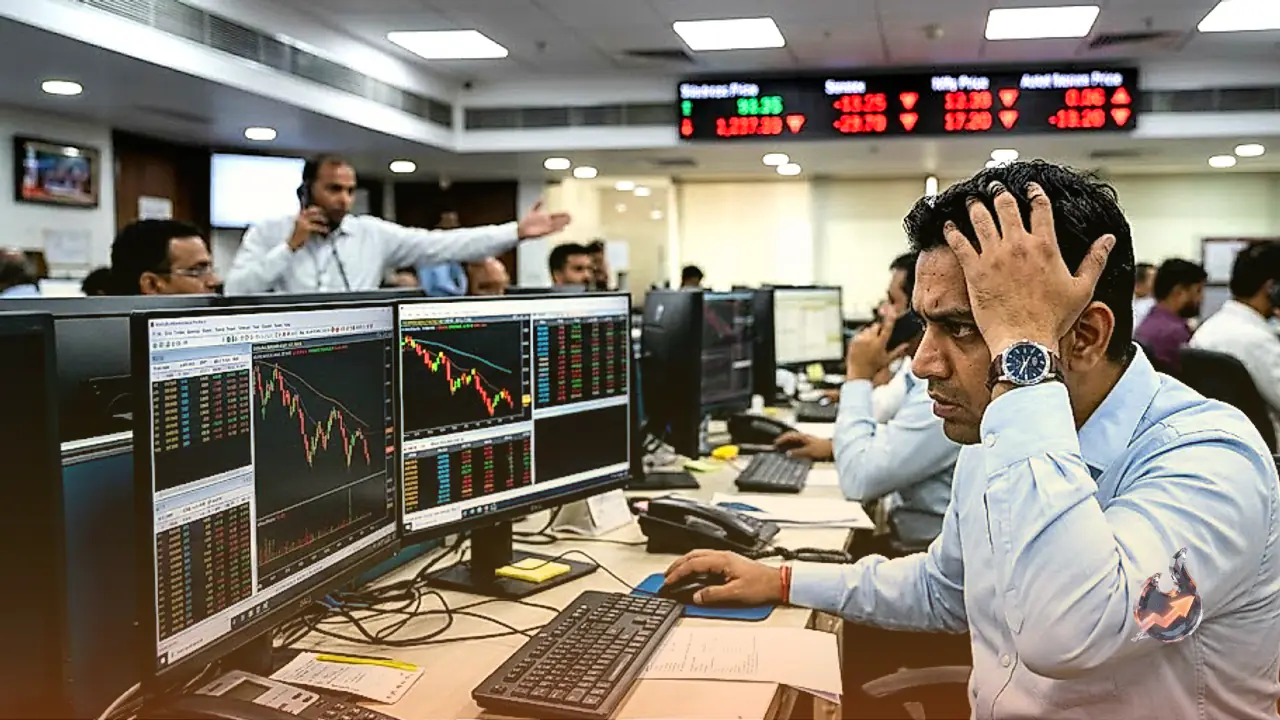

























The Indian Rupee is navigating a treacherous path, losing significant ground against the US Dollar as a confluence of macroeconomic headwinds batters the domestic currency. A rapid resurgence in global crude oil prices, coupled with an uninterrupted exodus of Foreign Institutional Investors (FIIs), has created a perfect storm for the Indian forex market. As a developing economy that relies heavily on overseas markets to satisfy its massive energy requirements, India is fundamentally vulnerable to sudden spikes in energy costs. Whenever crude oil prices climb in the international market, currencies of energy-importing nations historically tend to underperform, and the Rupee is currently exhibiting this classic symptom of macroeconomic distress. The sheer scale of India's import bill means that every dollar increase in crude oil prices necessitates a larger outlay of the domestic currency, thereby flooding the market with Rupees and driving down its relative value.
Geopolitical Turmoil: US, Iran, and the Strait of Hormuz
At the heart of the current crude oil rally is a severe escalation in geopolitical hostilities in the Middle East. The fragile ceasefire between the United States and Iran has entirely collapsed, leading to a dangerous and continuous exchange of military attacks. According to the latest situational reports from the region, Iranian military forces have aggressively escalated their tactics, consistently targeting and attacking energy tankers attempting to navigate through the Strait of Hormuz. This narrow waterway is arguably the most critical chokepoint on the planet for energy logistics, facilitating the transit of nearly one-fifth of the entire global energy supply. Any disruption here sends immediate shockwaves through global commodities markets.
Late Sunday, the United States Central Command (CENTCOM) confirmed a significant escalation from the American side. CENTCOM officials stated that the US military had just concluded its ninth consecutive night of targeted strikes against Iranian assets. The command clarified that this sustained military aggression is a direct retaliation for the recent killing of at least three American service members. Earlier that same day, US President Donald Trump publicly confirmed the motivation behind the military campaign, stating unequivocally that the latest waves of American strikes on Iran were being executed specifically in honor of the US service members who lost their lives in recent days. This tit-for-tat escalation has effectively dismantled the region's fragile energy supply chain, forcing traders to price in a substantial geopolitical risk premium.
Oil Price Dynamics and Live Market Technicals
The immediate consequence of this military escalation is visible on the trading floor. In early domestic trading, the Multi Commodity Exchange (MCX) Crude Oil contract, which is set to expire on July 20, registered a sharp upward gap, trading 2.6% higher at approximately Rs. 8,150. This surge represents the highest price level witnessed in the domestic commodities market in over a month.
Looking at current real-time live market data for global Crude Oil (CL=F), the commodity is trading firmly at $82.54 per barrel, up 0.06% from its previous close of $82.49. The asset is navigating a wide 52-week range between $54.98 and $119.48, and recent price action confirms a solid long-term uptrend. Technical indicators highlight a golden cross scenario, with the 50-day Exponential Moving Average (EMA) at $81.81 having crossed above the 200-day EMA at $75.17, while the near-term 20-day EMA sits at $77.42. The Relative Strength Index (RSI) stands at 58, indicating healthy bullish momentum without being overbought, and the MACD histogram prints at 2.13 (bullish), with the MACD line at -0.76 against a signal line of -2.89. Furthermore, the price action is currently positioned comfortably inside the Bollinger Bands (which range from $64.45 to $82.96). For traders managing risk, the Average True Range (ATR) points to a daily volatility of 3.64, setting a 20-day support base around $67.04 and formidable resistance near $82.76, while key pivot levels to watch include $82.56, with support S1 at $82.38 and resistance R1 at $82.72.
Furthermore, trading volume is currently extremely thin, registering at just 0.01x the 20-day average, which suggests that institutional traders might be waiting on the sidelines for further geopolitical clarity before committing to large new positions. The Stochastic oscillator also flashes a warning for late buyers, with the fast line maxed out at 99 against a signal line of 94, reflecting extreme short-term overbought conditions that warrant caution. The broader market sentiment is captured perfectly by a recent news headline noting that crude oil spent Monday selling the war, then buying the revenge post.
The FII Exodus and Domestic Market Sentiment
The soaring cost of crude oil and the renewed conflicts in the Middle East have severely dented the sentiment of overseas investors regarding the Indian stock market. Foreign Institutional Investors (FIIs) have aggressively shifted into a risk-off mode, turning out to be net sellers over the past several trading sessions. The sheer volume of this capital flight is alarming for domestic liquidity. Last week alone, FIIs remained consistent net sellers on every single trading day, collectively offloading domestic equities and clearing their stakes worth a staggering Rs. 9,119.76 crore. This massive withdrawal of foreign capital simultaneously drains dollar liquidity from the Indian system and puts additional selling pressure on the Rupee. When FIIs sell Indian stocks en masse, they receive their proceeds in Rupees. To repatriate these funds back to their home countries, they must aggressively sell these Rupees in the open forex market to buy US Dollars. This massive mechanical conversion process directly depletes India's dollar liquidity and exerts immense downward pressure on the Rupee's exchange rate. Consequently, domestic importers face higher costs, which can inadvertently stoke domestic inflation, creating a complex cycle of economic friction that is difficult to break without a shift in global macroeconomic conditions.
US CPI Data and the Federal Reserve Outlook
While geopolitical factors dominate the energy sector, shifting macroeconomic data in the United States is rewriting the narrative for the US Dollar. The latest US Consumer Price Index (CPI) data for June delivered a significant surprise, falling by 0.4% on the month. This marks the largest single-month decline recorded since April 2020. This substantial drop dragged the annual inflation rate down to 3.5%, a noticeable deceleration from May's 4.2%, and effectively snapped a worrisome three-month streak of accelerating prices. Core consumer prices were equally soft, remaining completely flat on a month-over-month basis and dropping to 2.6% year-over-year, with both metrics coming in well under market consensus expectations. For everyday consumers and businesses, this steady cooling of prices suggests that the aggressive monetary tightening cycle initiated by the central bank over the past two years is finally permeating the broader economy. Rent, used vehicle prices, and broad services saw notable pullbacks, providing tangible relief to household budgets.
This unexpectedly soft inflation data has forced fixed-income traders to drastically reconsider their expectations regarding the US Federal Reserve's next interest rate move. According to the CME FedWatch tool, the odds of the Fed leaving interest rates completely unchanged at the upcoming July meeting have skyrocketed to 85.6%. This is a massive leap from the 65.8% probability recorded just last week. Typically, a dovish Fed outlook would weaken the dollar and provide some relief to emerging market currencies like the Rupee. However, the overpowering demand for safe-haven dollars amidst the Middle East conflict is currently neutralizing any potential weakness stemming from the inflation data.
Technical Outlook for the Rupee and RBI Mechanics
On the technical front, the USD/INR currency pair continues to exhibit strong upward momentum, indicating a weaker Rupee. The Relative Strength Index (RSI) for the pair currently stands at 64.13. This metric stays decisively in positive territory but remains just below the critical overbought threshold, suggesting that the pair's upward momentum remains highly constructive and is not signaling immediate exhaustion yet. On the downside, initial technical support is located at the 20-day EMA near the 95.66 level. A decisive break below this support zone would hint at a deeper corrective phase, potentially driving the pair toward prior price congestion levels that are not immediately visible in the current short-term indicator set. Looking upwards, the bullish trajectory aims to revisit the pair's all-time high, hovering around the 97.10 mark.
Understanding the Indian Rupee requires acknowledging its extreme sensitivity to a triad of external and internal factors. The primary drivers are the international price of Crude Oil, the prevailing value of the US Dollar, and the aggregate level of foreign capital investment. To mitigate extreme volatility, the Reserve Bank of India (RBI) actively intervenes in the foreign exchange markets. By deploying its massive forex reserves, the central bank buys or sells dollars to keep the exchange rate stable, an essential function to help facilitate seamless international trade.
Simultaneously, the RBI utilizes its monetary policy tools, primarily adjusting baseline interest rates, in an ongoing effort to maintain the domestic inflation rate at its mandated 4% target. In the realm of currency valuation, higher interest rates usually act to strengthen the Rupee. This dynamic is primarily driven by the mechanics of the carry trade, a popular strategy in which global investors borrow capital in countries with ultra-lower interest rates specifically to place their money in countries offering relatively higher interest rates, allowing them to neatly profit from the yield difference. A wide array of macroeconomic factors further influences the Rupee's baseline value, including overall inflation, the national economic growth rate, the balance of trade, and continuous inflows from foreign investment. A robust economic growth rate naturally attracts more overseas investment, organically pushing up demand for the Rupee. Similarly, a less negative balance of trade will eventually lead to a structurally stronger domestic currency. Furthermore, higher interest rates, especially real rates, are decidedly positive for the Rupee. A broader global risk-on environment generally leads to greater inflows of Foreign Direct and Indirect Investment, which act as a powerful tailwind for the currency.
Conversely, higher domestic inflation is generally viewed as a profound negative for the currency, as it inherently reflects a devaluation of purchasing power through money oversupply. Elevated inflation also drastically increases the baseline cost of producing exports, leading to a scenario where more Rupees must be sold on the open market simply to purchase vital foreign imports, a fundamentally Rupee-negative dynamic. At the same time, it is crucial to recognize that higher inflation usually forces the RBI to respond by actively raising interest rates. Ironically, this reactionary policy tightening can ultimately be positive for the Rupee, primarily due to the subsequent increased demand from yield-hungry international investors. Naturally, the exact opposite effect holds true in an environment characterized by lower inflation. For businesses operating in this environment, currency hedging becomes an absolute necessity. Corporate treasurers must constantly monitor these macro variables to protect their profit margins from sudden adverse movements in the exchange rate. When the Rupee weakens significantly, companies that rely on imported raw materials, such as electronics manufacturers and heavy industries, see their input costs surge overnight. Conversely, the Information Technology (IT) sector and major exporters often cheer a weaker Rupee, as their dollar-denominated global earnings translate into significantly higher Rupee revenue when brought back to India. This dichotomy highlights how broad macroeconomic forces ultimately create distinct winners and losers within the domestic corporate landscape.
Crypto Markets Diverge: Ethereum Outperforms While Pepe Recovers
While traditional fiat currencies and commodities grapple with geopolitical stress, the cryptocurrency market is painting a slightly different picture beneath its surface. Over the past week, Ethereum has demonstrated notable outperformance, proving that it is steadily gaining relative strength against a host of other top-tier cryptocurrencies. Between last week and Wednesday, ETH successfully recorded impressive double-digit gains. During this window, the smart-contract platform clearly outperformed fellow crypto majors including Bitcoin, XRP, and Solana, before the broader digital asset market inevitably began to experience a minor correction on Thursday. Despite these gains, analysts note that under the surface, certain key on-chain metrics indicate that Ethereum's rapid rise remains somewhat fragile and susceptible to sudden shifts in momentum.
In the meme coin sector, Pepe is currently edging higher, successfully maintaining a near-term recovery tone that has been evident over the last three weeks. Market data suggests that the overall risk appetite among large wallet investors, commonly referred to as whales, for PEPE is steadily rising. This accumulation phase is occurring amid a noticeable backdrop of declining token supply currently available on centralized exchanges, hinting at a potential supply squeeze. Furthermore, retail demand is also actively increasing alongside institutional interest; data reveals that PEPE futures Open Interest shot up by a remarkable 11% in just 24 hours, signaling a massive influx of speculative capital betting on further upside.