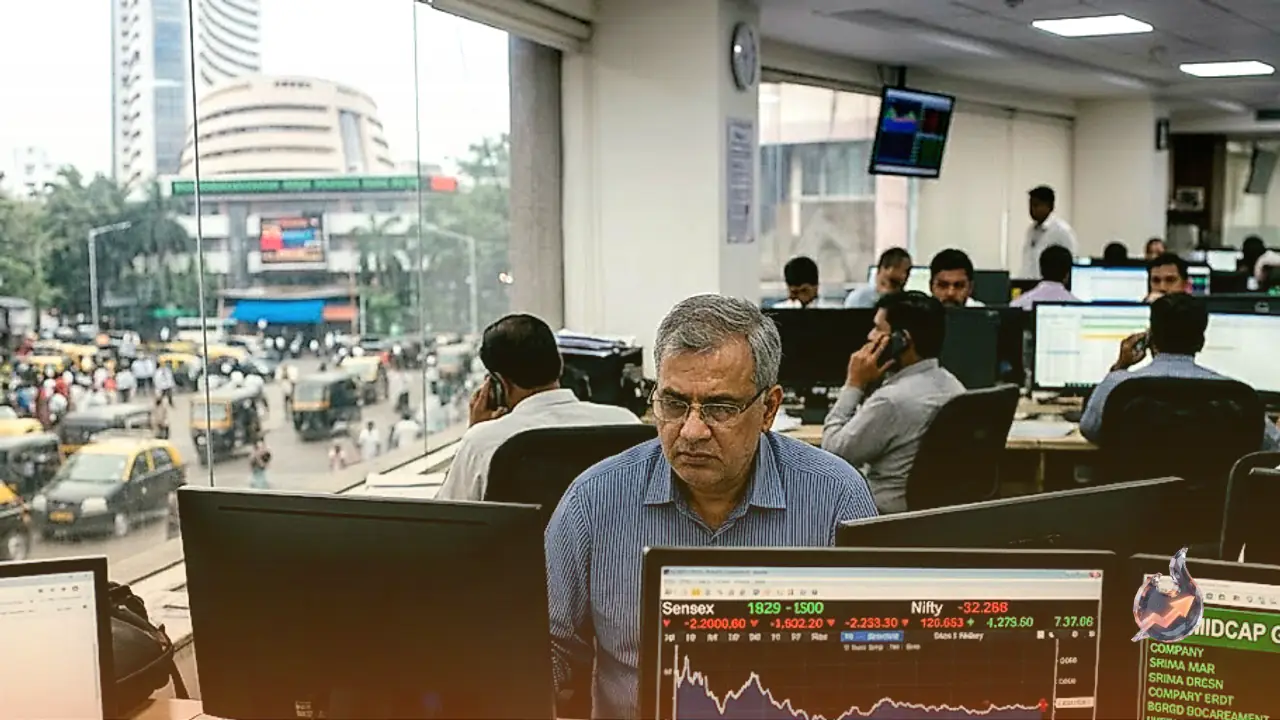

























Global equity markets witnessed significant turmoil as a sudden and heavy selloff impacted technology and semiconductor equities across the globe. Analysis provided by market strategists at Deutsche Bank indicates that a dual wave of anxiety over massive artificial intelligence capital expenditure and intensifying rivalry from low-cost Chinese manufacturers triggered widespread investor hesitation. Although technology benchmarks experienced severe drops, broader stock indices across Western economies demonstrated remarkable resilience, backed by gains in non-tech sectors.
Asian Benchmarks Hit Hardest by Chip Market Downturn
Asian trading hubs bore the heaviest brunt of the technology rout, with South Korea experiencing an exceptionally steep market pullback. The KOSPI index plummeted by 10.11%, marking its most severe single-day decline since the early March market disruption associated with the conflict between the United States and Iran. The sudden wave of selling was so intense that automated circuit breakers were activated during early market hours to temporarily pause trading activities. Prominent semiconductor producers led the retreat, with SK Hynix dropping by as much as 13% and Samsung Electronics sliding roughly 12%.
In Japan, the Nikkei index also posted sharp losses, retreating 4.10% to hit its lowest valuation level since May 22. Japanese chip manufacturer Kioxia Holdings suffered an 18% decline during the trading session, extending its aggregate losses to approximately 60% compared to its peak recorded in late June. The broader regional weakness highlights growing market skepticism regarding the immediate profitability of aggressive corporate spending on AI infrastructure.
Chinese Tech Landscape Presents Contrasting Pictures
Equity indices in mainland China were not immune to the cautious trading mood, though their declines remained relatively contained compared to regional peers. The CSI 300 index fell by 2.12%, while the Shanghai Composite index edged down by 0.90%. Despite the overall negative sentiment across global tech, the domestic Chinese financial market witnessed a notable milestone with the debut of CXMT Corp. on the Shanghai stock exchange.
The memory maker executed a blockbuster stock market debut over the preceding 24-hour period. Shares of CXMT Corp. skyrocketed by an extraordinary 466% following its initial public offering (IPO), reflecting strong domestic enthusiasm for local semiconductor capabilities despite headwinds faced by international tech conglomerates.
ASML Slump Triggers Wall Street Volatility Amid DUV Advances
In North America, stock markets initially mounted a rally driven by a pull-back in international crude oil prices. However, early gains quickly evaporated as high-profile semiconductor equities reversed course. The primary catalyst for the US market selloff was European lithography giant ASML, whose shares tumbled by 8.41%. The drop followed news reports indicating that a Chinese tech enterprise had successfully initiated mass production of deep ultraviolet (DUV) lithography machinery, a vital technology necessary for fabricating advanced semiconductor microchips.
Despite the tech sector's retreat, wider equity market breadth in the United States remained surprisingly positive. Nearly two-thirds of the individual constituent companies within the S&P 500 index closed the trading session higher. Simultaneously, the small-cap Russell 2000 index gained 0.62%, indicating that selling pressure was largely isolated to mega-cap tech and hardware manufacturers rather than the broader economic ecosystem.
European exchanges displayed a similarly split performance. Core benchmark indices closed in positive territory, with Germany's DAX advancing 1.04%, France's CAC 40 rising 0.40%, and the UK's FTSE 100 gaining 0.42%. However, the region-wide Stoxx 600 managed only a modest 0.02% gain, as substantial weakness in ASML and allied semiconductor suppliers dragged down the broader European market performance.
Foreign Exchange, Precious Metals, and Crypto Suffer Losses
Cross-asset markets also reflected heightened caution as investors braced for key economic catalysts. In foreign exchange, the British Pound remained on the back foot, with GBP/USD trading near the 1.3300 level during European trading hours. The Euro similarly consolidated near its monthly low, trading around the mid-1.1300 region against the US Dollar. Persistent demand for the US Dollar kept pressure on major currency pairs, with traders remaining cautious ahead of the upcoming two-day Federal Reserve monetary policy meeting.
Precious metals experienced downward momentum as Gold declined 0.85% during Asian trading hours, falling just below $4,050 per ounce. This pullback followed a failed attempt in the preceding session to sustain trading above the $4,100 threshold, signaling lingering selling pressure in bullion markets.
In the digital asset space, major altcoins posted notable declines. Ripple and Stellar remained under sustained pressure after registering losses exceeding 4% and 5% respectively in previous trading. Technical momentum indicators and softening derivatives data point to ongoing seller control, maintaining downside risks for both digital tokens.