























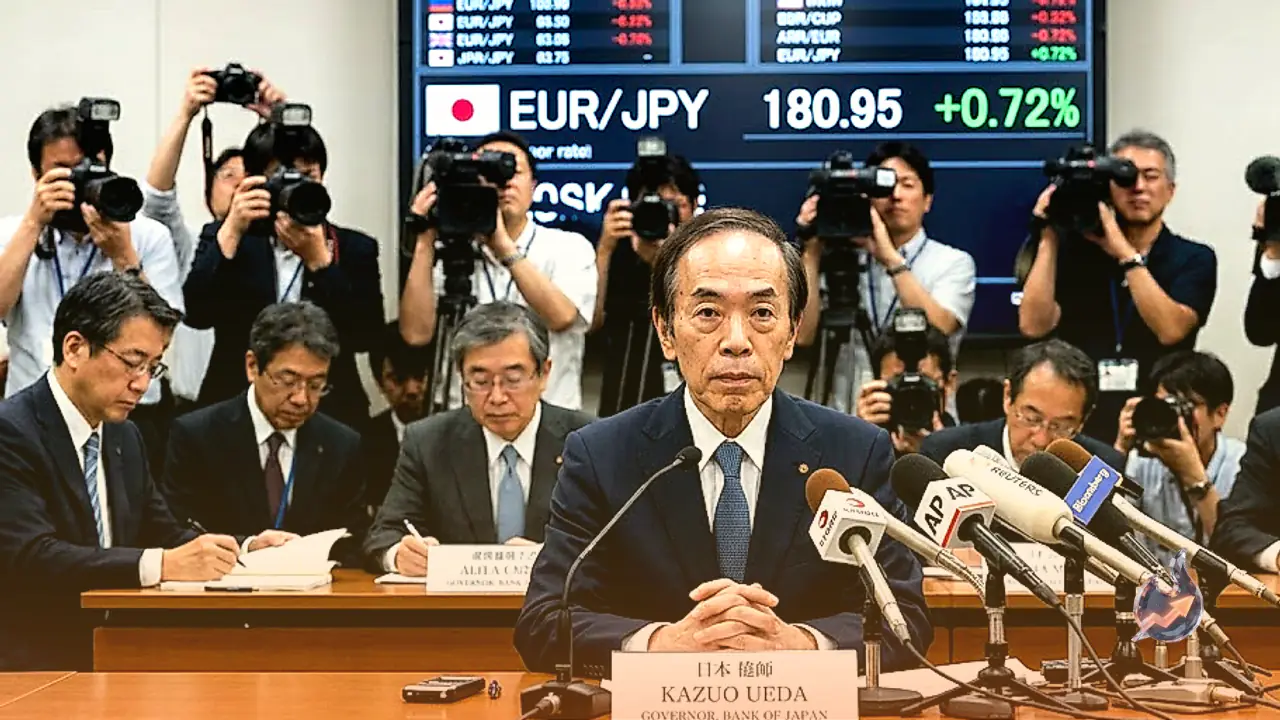

The Japanese Yen encountered broad-based downward pressure across global currency markets, propelling the EUR/JPY cross toward the 181.00 threshold as market participants remained unpersuaded by the Bank of Japan's latest monetary tightening move. Despite central bank Governor Kazuo Ueda adopting an assertive tone, expressing confidence in the domestic economy, and pledging further rate hikes to rein in price pressures, internal discord within the monetary policy board undermined investor conviction in the central bank's tightening trajectory.
Policy Discord and Persistent Market Skepticism
The Bank of Japan fulfilled broader market expectations by raising interest rates, deviating from its conventional semi-annual pace following an earlier tightening action delivered in June. However, the decision met formal opposition from three committee members, casting significant doubt over the institution's capability to sustain its monetary tightening momentum over the longer term. A deep rift among board members frequently indicates to foreign exchange traders that future rate increases will face substantial domestic friction, limiting subsequent policy steps.
Market commentary from Deutsche Bank emphasized that Japan's August inflation readings showed price pressures holding largely steady and remaining close to the central bank's target. This statistical reality gave policy doves on the board additional ammunition to argue against aggressive future tightening. When core price gauges demonstrate relative stability rather than accelerating out of control, central bank officials face a higher threshold to justify successive policy rate adjustments that could curtail broader economic activity.
Governor Ueda Reaffirms Hawkish Commitment
In his post-meeting communications, Bank of Japan Governor Kazuo Ueda emphasized that domestic financial conditions have remained accommodative, declaring that the foundational stage for policy conduct has fundamentally changed. He reiterated a firm commitment to continue lifting interest rates in direct response to evolving trends in economic output and broader price movements, seeking to guide the economy away from excessive policy support.
While Ueda sought to establish an unambiguous policy anchor, trading desks focused heavily on the underlying voting dynamics. The dissenting votes from three policymakers, paired with inflation readings that did not demand emergency action, encouraged institutional traders to resume selling the Japanese currency, driving the Euro higher and pushing the currency pair near fresh multi-month milestones.
The Long Legacy of Monetary Accommodation
As Japan's premier monetary authority, the Bank of Japan operates under an official mandate to issue legal tender and direct monetary and currency policy to secure domestic price stability, historically quantified as an annual inflation objective of approximately 2%. Following prolonged periods of deflationary stagnation, the central bank initiated a comprehensive ultra-loose monetary regime in 2013 designed to stimulate credit creation, domestic spending, and sustained price increases.
This framework relied extensively on Quantitative and Qualitative Easing (QQE), utilizing note issuance to purchase government securities and corporate debt to inject abundant liquidity directly into the financial system. In 2016, the central bank expanded its toolkit by adopting negative benchmark interest rates alongside explicit yield curve control over 10-year government bonds. This prolonged stimulus was formally scaled back only in March 2024, when the Bank of Japan commenced raising rates and exited negative territory.
Widening Rate Differentials and Global Carry Dynamics
The aggressive monetary stimulus sustained over more than a decade significantly weakened the Yen against major foreign currencies. This depreciation intensified sharply throughout 2022 and 2023 as major central banks worldwide delivered aggressive rate-hiking cycles to counter decades-high inflationary pressures, while Japanese authorities preserved ultra-low interest rates. The resulting interest rate divergence drained demand from the Yen, establishing it as one of the world's premier funding currencies for carry trades.
Japanese borrowing terms financed trillions of dollars in worldwide investments, making the Yen an indispensable global liquidity conduit. Although the initial exit from ultra-loose policy in early 2024 provided brief appreciation, ongoing uncertainty regarding subsequent rate moves has prevented the currency from sustaining decisive recoveries against major peers like the Euro.
Domestic Price Factors and Broader Asset Trends
The cumulative effects of a devalued Yen and global energy shocks pushed Japan's headline inflation above the central bank's 2% benchmark. Concurrently, broader momentum behind rising domestic wages played a central role in sustaining price pressures, providing the fundamental backdrop for policymakers to adjust borrowing costs. In parallel monetary developments, the central bank also lifted its benchmark interest rate to 1.25% through a surprise 7-2 vote during recent policy adjustments.
Cross-asset dynamics exhibited notable volatility across Friday sessions. In Asian trading, AUD/USD preserved upward momentum for a second consecutive session, holding above 0.7100 as softer US Treasury yields limited Dollar gains, supported additionally by hawkish guidance from Reserve Bank of Australia Governor Michele Bullock. Meanwhile, USD/JPY retreated from two-week highs near 157.30 during the European session as Ueda's press conference comments offered temporary respite to the Yen. Concurrently, gold sustained consecutive daily gains to reach weekly highs ahead of the European session, benefiting from lower US bond yields and easing oil prices that moderated short-term inflation fears.