
























Selling pressure surrounded the New Zealand Dollar across international currency markets as the US Dollar erased its intraday losses following aggressive monetary policy remarks from Federal Reserve Chair Kevin Warsh. The resurgence in demand for the greenback highlighted how sensitive risk-correlated and commodity-linked assets remain to shifts in American interest rate expectations, leaving higher-beta currencies struggling to sustain momentum against an increasingly dominant dollar.
Federal Reserve Stance and Rising Rate Hike Bets
Federal Reserve Chair Kevin Warsh underlined that persistent price pressures remain an ongoing challenge for the world's largest economy. He explicitly noted that inflation remains uncomfortably high and pointed out that economic data collected over the summer months failed to show any substantive structural progress toward price stability. In his assessment, these developments demonstrate that the central bank requires a tighter monetary policy posture to prevent price expectations from becoming entrenched.
Financial markets reacted swiftly to these observations by recalibrating their trajectory for borrowing costs. Pricing on the CME FedWatch tool revealed that investors have moved to assign a 53.1% probability to a rate hike at the Federal Reserve's upcoming October gathering, reflecting a notable jump from the 44% probability seen just a day earlier. A prolonged era of elevated interest rates in the United States typically widens the yield advantage enjoyed by dollar-denominated debt instruments, steering global capital toward American assets and complicating conditions for competing foreign currencies.
New Zealand Trade Balance Reflects Mixed Progress
Economic indicators released in Wellington offered a mixed reading on the trajectory of New Zealand's external sector. The country's monthly merchandise trade deficit narrowed to NZD 1.35 billion in August, marking a clear contraction when measured against July's deficit of NZD 2.12 billion. However, the result proved disappointing when judged against market forecasts, which had anticipated a steeper compression toward a shortfall of NZD 1.275 billion.
The details beneath the headline deficit painted an expanding picture of cross-border commerce. August exports jumped 15.4% on a year-on-year basis to achieve NZD 6.66 billion, demonstrating resilient foreign demand and improving on the downwardly revised 10.8% increase seen in July. On the other side of the ledger, outbound shipments were countered by imports that rose 13.1% annually to NZD 8.0 billion. While import growth remained substantial, it signaled meaningful deceleration compared to the violent 28.4% spike documented in the prior monthly print.
Energy Fluctuations and Geopolitical Influences
Cross-asset dynamics also played a role in guiding foreign exchange flows. Strategists at ING observed that moderating crude oil prices helped strip some momentum from the US Dollar following the latest Federal Open Market Committee communications. Energy markets appeared to derive stability from political developments on the international diplomatic stage, with investors awaiting potential clarity from discussions scheduled during the United Nations General Assembly.
Market strategists at ING pointed out that energy benchmarks drew optimism from the prospective meeting between US President Donald Trump and representatives from the Gulf States. In addition, broader market attention was captured by media speculation suggesting Donald Trump is approaching a momentous decision regarding whether to expand military action or actively negotiate a conclusion to regional confrontation. Such a binary geopolitical turning point carries substantial implications for international risk appetite and near-term foreign exchange volatility.
Monetary Tightening Prospects at the Reserve Bank of New Zealand
Despite facing external headwinds, the New Zealand Dollar retains potential domestic support stemming from heightened local interest rate expectations. Traders are currently pricing in a 60% likelihood that the Reserve Bank of New Zealand will raise its official cash rate to 3.0% when policymakers convene for their scheduled October interest rate review.
The Reserve Bank of New Zealand operates with a primary mandate to keep inflation within a target band of 1% to 3% over the medium term, anchoring policy around the 2% midpoint. When inflationary forces intensify, the monetary authority turns to interest rate hikes to dampen demand, a mechanism that drives domestic bond yields higher and enhances the relative appeal of holding local assets. The dynamic rate differential between borrowing costs determined in Wellington and those dictated by the Federal Reserve in Washington remains one of the most critical structural drivers of the NZD/USD exchange rate.
Structural Drivers of the Kiwi and Global Economic Linkages
Colloquially known as the Kiwi, the New Zealand Dollar functions as a benchmark commodity currency whose performance reflects broader investor appetite for cyclical growth. While domestic fundamentals, employment levels, and sovereign balance sheets shape its valuation, external dependencies play an equally powerful role in establishing its price trend.
China's domestic macroeconomic health serves as an indispensable external driver for the Kiwi, given that Beijing represents Wellington's single largest trading partner. A slowdown in Chinese consumer demand or manufacturing throughput directly diminishes orders for New Zealand's export base, eroding terms of trade and softening currency demand. Simultaneously, global dairy auction values dictate the fortune of New Zealand's dominant agrarian export sector. Strong dairy prices expand national export revenues, enhancing the nation's trade balance and lending consistent backing to the currency during favorable phases of the commodity cycle.
Developments Across Foreign Exchange and Bullion Assets
Related global currency pairs and precious metals exhibited pronounced reactions to the broader macro environment. In Asian trading on Friday, AUD/USD maintained an upward bias for the second consecutive session, preserving its position above 0.7100 as retreating US Treasury yields capped greenback sentiment. Australian Dollar bulls drew further encouragement from hawkish guidance provided by Reserve Bank of Australia Governor Bullock regarding prospective interest rate hikes, though overarching Fed hawkishness prevented an unhindered breakout.
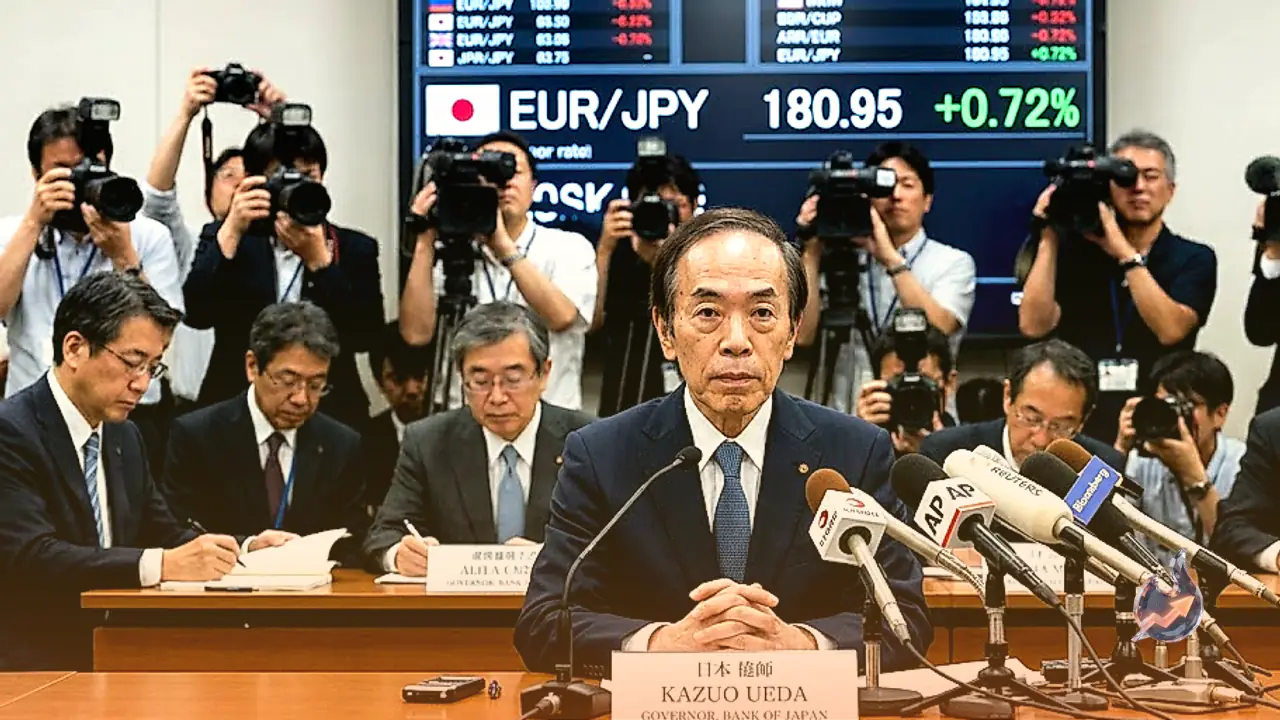
Concurrently, USD/JPY relinquished its ascent to two-week peaks near 157.30 during European trading hours on Friday. The Japanese Yen managed to gain ground following commentary delivered by Bank of Japan Governor Ueda in his post-meeting address. The Japanese central bank surprised financial observers by delivering an interest rate increase to 1.25% through a 7-2 vote. For over a decade, Japan's zero-rate architecture anchored global carry trades and served as the world's preeminent low-cost funding vehicle; the ongoing shift toward policy tightening indicates that this long-standing dynamic is entering a transformational chapter.
Meanwhile, physical gold recorded sustained bids for a second straight session, touching fresh weekly peaks ahead of the European open. Diminished fears of immediate runaway inflation, driven by softer oil prices, pulled US sovereign yields away from multi-year peaks, suppressing dollar gains and offering solid footing to the yellow metal.