




















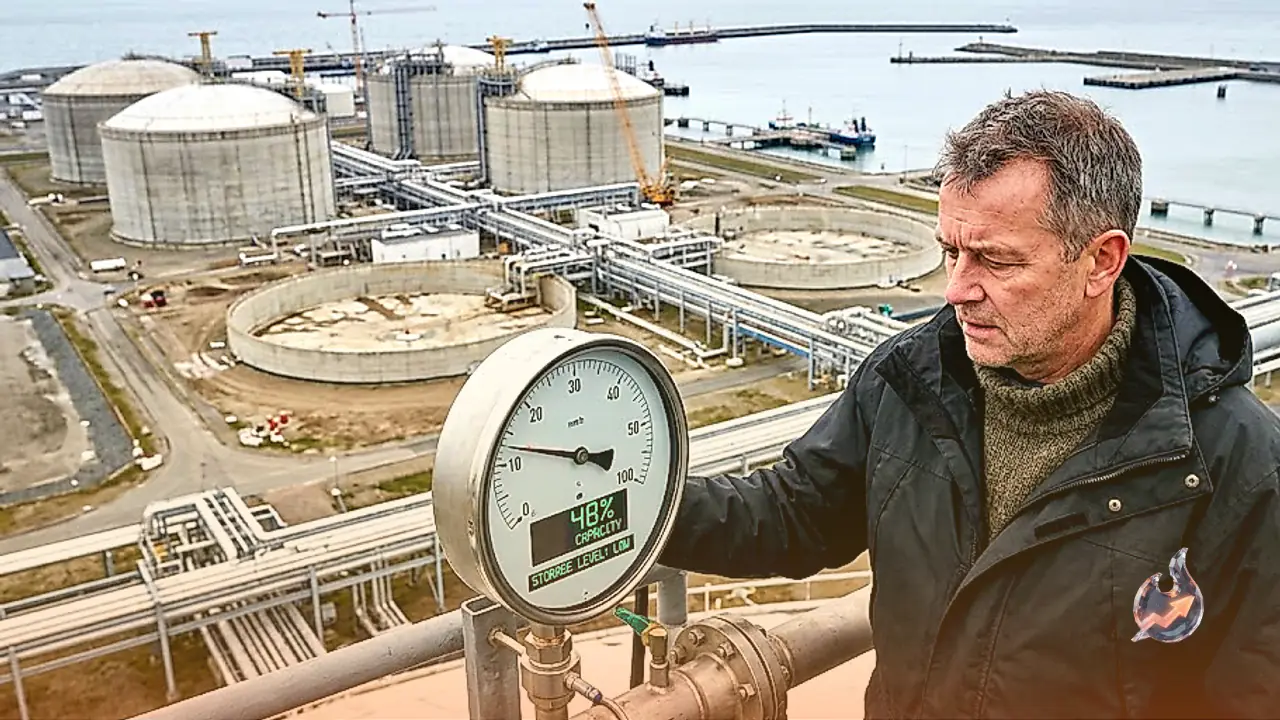

Geopolitical turbulence continues to reverberate across international energy markets, leaving European natural gas benchmarks with very little room for downward movement despite recent brief price corrections. While diplomatic headlines involving the United States and Iran recently triggered a fleeting 8 percent slide in European gas rates, the underlying physical fundamentals tell a far more strained story. The official closure of the Strait of Hormuz has severely disrupted maritime supply chains, suppressing Qatari liquefied natural gas outflows to just 20 percent of their pre-war baseline. With Asian import prices remaining elevated and European underground gas inventories tracking significantly below historical norms, the continent faces an elevated probability of sudden emergency restocking and sharp upward price shocks.
Strait of Hormuz Closure Strangles Qatari LNG Outflows
The strategic maritime choke point of the Strait of Hormuz remains entirely inaccessible to standard commercial traffic, choking off one of the world's most critical energy delivery pipelines. Because the waterway is officially shut, only a minimal volume of Qatari LNG is successfully reaching global import terminals. According to figures compiled by Bloomberg, Qatari cargo movements stand at merely 20 percent of their volumes recorded prior to the outbreak of hostilities. This structural bottleneck arrives at a delicate moment for European utilities, which have become heavily reliant on seafaring gas shipments to satisfy baseline power generation and heating requirements.
Transatlantic Price Spreads and Asian Competition for US Cargoes
The pricing dynamic between Europe and Asia is directly determining where flexible Atlantic Basin fuel supplies are directed. Whenever regional price differentials expand, traders naturally divert tankers toward destinations offering superior netbacks after adjusting for shipping distances. Outlining this dynamic, Norman Liebke of Commerzbank noted that once the difference reaches 6 euros per MWh, shipping LNG to Asia becomes more attractive for US suppliers due to additional transportation expenses. As the continent approaches the high-demand winter heating season with depleted storage infrastructure, European gas contracts cannot afford to trade at a deep discount to Asian benchmarks without risking severe shipment diversions to Pacific buyers.
Foreign Exchange Dynamics: Yen, Dollar, and Australian Currency
Macroeconomic adjustments and diverging central bank postures are generating clear moves across the currency landscape. In early Asian trading on Tuesday, the AUD/USD currency cross found solid bids above the 0.7100 handle, underpinned by hawkish policy commentary delivered by Reserve Bank of Australia Assistant Governor Sarah Hunter alongside Governor Michele Bullock. Nevertheless, persistent military frictions throughout the Middle East and a disciplined policy stance from the Federal Reserve have kept the US Dollar broadly supported, capping extensive upside moves for the Australian currency.
Concurrently, the USD/JPY pair registered modest gains to hover near the 157.50 zone during Tuesday's Asian hours, as market wariness regarding official currency intervention helped put a floor under the Japanese Yen. The Bank of Japan advanced its monetary normalization trajectory by lifting its short-term interest rate target from 1.00 percent to 1.25 percent through a 7-2 committee vote, reaching a 31-year high. While this policy adjustment aligned with prevailing consensus forecasts, the central bank's dovish forward guidance left yen bulls cautious, while the broader strength of the US greenback provided steady upward momentum for the currency cross.
Gold Retreats Toward Key Support as Washington Prepares for Trump-Xi Talks
In precious metals trading, spot gold extended its downward correction for a second consecutive session, retreating toward the 4,300 dollars per troy ounce threshold on Tuesday. The pullback in bullion valuations was primarily driven by refreshed investor demand for the US Dollar, alongside mixed fluctuations in US Treasury yields and lingering geopolitical jitters that prompted market participants to trim exposed positions.
Global investors are now turning their attention toward Washington, where US President Donald Trump and Chinese President Xi Jinping are scheduled to convene on Thursday for a high-stakes bilateral summit. The outcome of this pivotal encounter is widely seen as a defining catalyst for global markets, holding the potential to determine whether the world's two economic superpowers sustain their fragile trade truce or initiate a fresh period of commercial instability and market turbulence.