























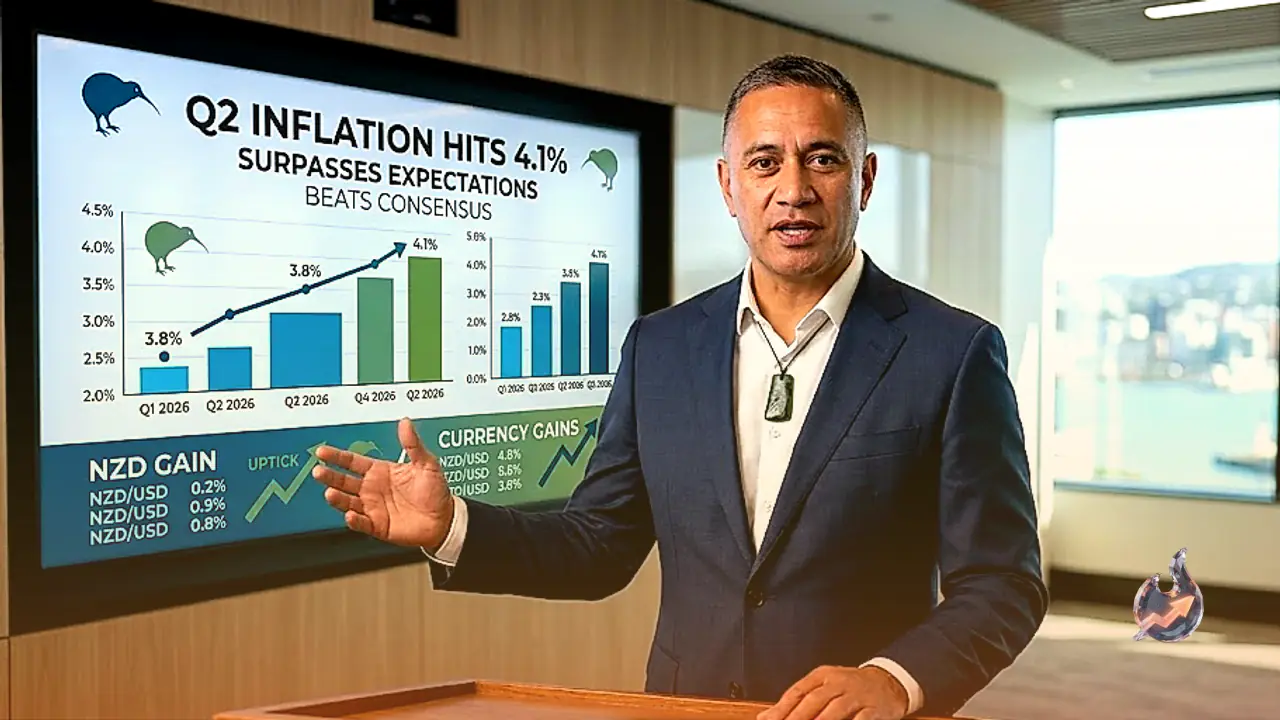

In a significant development for global financial markets, consumer prices in New Zealand have accelerated at a pace that has completely surpassed expert predictions. During the second quarter of 2026, the nation's Consumer Price Index (CPI) registered a robust 4.1% increase on a year-on-year basis. This latest economic snapshot, officially published by Statistics New Zealand on Tuesday, highlights a marked escalation in inflationary pressures compared to the 3.1% growth recorded in the preceding first quarter. The financial sector had established a consensus expectation of a 4.0% increase for this reporting period, making the actual print a clear upside surprise that immediately caught the attention of institutional traders and central bank observers.
Quarterly Momentum and Immediate Currency Response
The acceleration of consumer costs is equally evident when examining the data on a shorter timeline. The quarterly CPI inflation rate took a dramatic leap, surging to 1.5% in the second quarter. This is a substantial jump from the rather subdued 0.9% figure reported in the prior quarter. Much like the annual metric, this quarterly reading easily outpaced the broader market consensus, which had forecasted a more modest 1.4% expansion. In the immediate aftermath of these hotter-than-expected inflation numbers crossing the wires, the currency markets reacted swiftly. The New Zealand Dollar caught a fresh wave of buying interest. At the time of the data release, the NZD/USD currency pair moved 0.06% higher on the day, elevating its trading position to 0.5845 as market participants began recalibrating their expectations for future monetary policy.
Decoding the Consumer Price Index and Central Bank Mandates
To fully grasp the implications of this data, it is crucial to understand what these metrics represent. Inflation fundamentally measures the persistent rise in the price of a broadly representative basket of everyday goods and services. The most common way economists express this headline inflation is through percentage changes evaluated on both a month-on-month and a year-on-year basis. However, policy makers often look deeper into the numbers. Core inflation is a refined metric that deliberately excludes highly volatile pricing elements, specifically food and fuel. These specific commodities are notoriously susceptible to wild fluctuations driven by sudden geopolitical crises or seasonal weather shifts. Consequently, core inflation provides a much clearer picture of underlying economic trends. It is this core figure that economists scrutinize most intensely, and it serves as the primary target for central banks around the world, which are universally mandated to manage inflation and maintain it at a stable, manageable level that typically hovers around the 2% threshold.
The Counter-Intuitive Relationship Between Inflation and Forex
The mechanics of how inflation dictates currency valuation can often seem counter-intuitive to casual observers. The Consumer Price Index essentially acts as the trigger for central bank action. When inflation runs hot, and particularly when core CPI begins to climb dangerously above the target 2% zone, it usually forces central banks to implement tighter monetary policy, which means hiking interest rates. Conversely, when inflation falls below that critical 2% mark, central banks have the leeway to cut rates. Because higher interest rates yield better returns on cash and fixed-income assets, they are inherently positive for a nation's currency. Therefore, rising inflation usually sets off a chain reaction that results in a stronger currency, while falling inflation tends to produce the opposite effect.
Capital Flows and the Global Hunt for Yield
The core reason that high domestic inflation pushes up the value of a national currency lies in the dynamics of global capital flows. To combat rising prices, the domestic central bank will almost certainly raise benchmark interest rates. In the interconnected global financial system, capital constantly roams in search of the highest possible safe return. When a country raises its interest rates, it immediately attracts massive inflows of capital from international investors who are eager to find a lucrative and relatively secure place to park their funds. This sudden influx of foreign investment creates high demand for the local currency, driving its exchange rate upward.
The Evolving Dynamics of Gold Investments
This intricate dance between inflation and interest rates also profoundly impacts the commodities market, particularly precious metals. In previous eras, Gold was universally regarded as the ultimate asset that investors would turn to during periods of rampant inflation, primarily because it reliably preserved purchasing power. While it is true that modern investors will still reflexively buy Gold for its safe-haven properties during moments of extreme global market turmoil, it is no longer the default inflation hedge most of the time. The reason is tied directly to central bank behavior. When inflation spikes, central banks will aggressively raise interest rates to suppress it.
Opportunity Cost and the Pressure on Precious Metals
These higher interest rates act as a massive headwind for Gold. Because Gold is a physical commodity that yields no interest or dividends, higher interest rates dramatically increase the opportunity cost of holding it. Investors must weigh the choice of holding a static metal against the lucrative option of placing their capital in an interest-bearing asset or a high-yield cash deposit account. On the flip side, an environment of lower inflation tends to be highly positive for Gold prices. Lower inflation gives central banks the room to bring interest rates down, which drastically reduces the opportunity cost and makes the bright metal a far more attractive and viable alternative for investment portfolios.
Broader Forex Markets: GBP and EUR Under Geopolitical Pressure
While the New Zealand Dollar enjoys localized support from domestic data, the broader foreign exchange market is currently dominated by risk aversion and a robust greenback. The GBP/USD pair has recently come under intense and sustained selling pressure, driving it down to revisit the territory of multi-day lows situated near the 1.3420 mark in what has been a decisively bearish start to the trading week. This notable decline in the Cable is occurring against the backdrop of a firmer US Dollar. Global investors are heavily favoring the safety of the American currency as they continue to carefully assess the escalating and unpredictable developments stemming from the US-Iran conflict. Looking ahead, market attention regarding the Pound will pivot sharply to the United Kingdom's upcoming employment report scheduled for release on Tuesday.
European Sentiment and Safe-Haven Trading
The situation is remarkably similar for the Euro. The EUR/USD pair is keeping its bearish bias firmly intact, steadily slipping back toward the critical 1.1400 regional floor, where some initial technical support appears to have finally materialized. The highly auspicious and strong start to the week for the US Dollar has kept the entire risk complex under severe pressure. Financial participants remain on edge, continuously and closely following the latest developments arising from the broader Middle East conflict. On the domestic economic calendar, European traders are now bracing for the impending release of the ZEW Economic Sentiment surveys for both the Eurozone and Germany, which will provide the next major catalyst.
Gold's Tug-of-War at Historic Levels
Amidst these currency fluctuations, the precious metals sector is experiencing significant volatility. Gold prices have reversed the upward momentum seen on Friday, currently gyrating nervously around the psychologically massive $4,000 mark per troy ounce as the new week begins. The asset is caught in a fierce fundamental tug-of-war. On one side, the escalating and broadening military action across the Middle East is providing undeniable underlying support to the ultimate safe-haven metal. However, on the other side, the sticky expectations of higher, prolonged US interest rates continue to fundamentally bolster the US Dollar, keeping Gold under a strict microscope and capping its ability to break out further.