























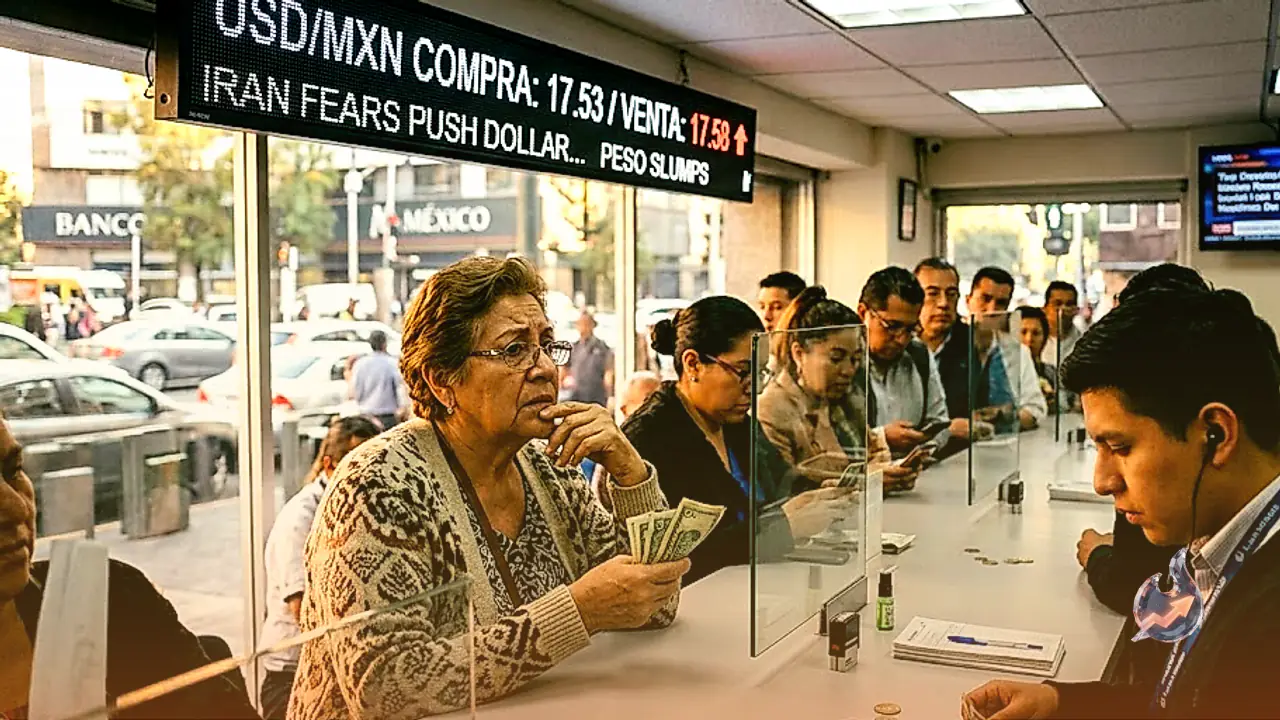

The Mexican peso lost its footing on Friday, sliding against a resurgent US dollar as investors, rattled by the still-simmering conflict between the United States and Iran, rushed back toward the safety of the greenback. During the North American trading session the peso shed more than 0.65%, pushing USD/MXN up to around 17.53 after the pair had earlier bounced off a daily low of 17.41. Live market data confirm the move, showing USD/MXN changing hands near 17.53, up roughly 0.69% from the previous close of 17.41.
Why the dollar is back in demand
At the heart of Friday's move is fear. The war between the United States and Iran shows no sign of a clean ending, and even though the two sides have sat down for talks aimed at halting the fighting, markets are not convinced a resolution is close. Whenever geopolitical risk climbs, big money tends to flow toward assets seen as shelters in a storm, and the US dollar remains the first port of call. That flight to safety is exactly what has been pinning the peso down and lifting USD/MXN.
Adding to the anxiety is the flashpoint of the Strait of Hormuz. Washington and Tehran appear set to keep clashing over this strategically vital waterway, through which a huge share of the world's oil passes. Any serious disruption there could send crude prices sharply higher, and the mere threat of that is enough to keep traders on edge. A fresh spike in oil would ripple through inflation expectations and risk appetite worldwide.
Inflation data cools Fed rate-hike bets
Curiously, the backdrop for the dollar is not entirely one-directional. Softer than expected US inflation figures were welcomed by investors this week, and that data has trimmed the odds that the Federal Reserve will raise interest rates at its September meeting. The June Consumer Price Index actually fell 0.4% on the month, the steepest single-month drop since April 2020, and that pulled the annual rate down to 3.5% from 4.2% in May, snapping a three-month streak of accelerating prices. Core prices, which strip out volatile items, went nowhere, staying flat on the month and easing to 2.6% year over year. Both the headline and core readings came in below what economists had penciled in.
Softer inflation would normally ease pressure on the dollar, yet the safe-haven bid tied to the Middle East has been the stronger force, keeping the greenback firm against the peso even as rate-hike expectations fade.
The dollar index and the Fed's hawkish voices
The US Dollar Index, which tracks the greenback against a basket of six major currencies, edged up 0.05% to 100.76, giving USD/MXN a modest tailwind. Meanwhile, comments from Federal Reserve officials kept traders alert. Cleveland Fed President Beth Hammack struck a distinctly hawkish tone, putting stubbornly high inflation at the very top of her worry list. "Inflation is too high," she said bluntly. Hammack also argued that the jobs market remains solid, describing growth figures as good and consumer spending as stable, a combination that in her view leaves little room for complacency on prices.
USD/MXN technical picture
On the daily chart the pair is trading around 17.53, holding above a tight cluster of the 50, 100 and 200-day simple moving averages near 17.3856. That perch above the moving-average base points to a constructive near-term bias, with the broader trend floor still offering support. Price is now probing a downward-sloping resistance line drawn from the 18.1651 high, a barrier that currently sits at 17.5456.
Momentum indicators paint a mildly positive picture. The 14-period Relative Strength Index is hovering near 54.8, and live readings put the RSI around 55, hinting at gentle upside momentum without yet stretching into overbought territory.
If buyers push through, the first hurdle is that near-term descending trend line at 17.5456, followed by a higher structural ceiling drawn from the 21.0808 peak, currently near 18.1200. On the way down, the first cushion is the triple moving-average cluster at 17.3856. As long as the pair holds above that base, the bullish leaning stays intact; a daily close back beneath it, however, would flag fading upward pressure and open the door to a deeper corrective slide. Live data also flag longer-term caution, with the 200-day averages sitting above the shorter ones, a sign the pair is still inside a broader downtrend.
What drives the Mexican peso
The peso is the most heavily traded currency in Latin America, and a web of forces shapes its value. Chief among them is the health of the Mexican economy itself, the policy stance of the country's central bank, the volume of foreign investment flowing in, and even the remittances sent home by Mexicans living abroad, especially those in the United States.
Geopolitics matters too. Nearshoring, the trend of companies relocating factories and supply chains closer to their home markets, is widely viewed as a boon for the peso, since Mexico is regarded as a key manufacturing base on the American continent. Oil is another major lever, because Mexico is an important exporter of the commodity, which is one reason the current crude-price risk cuts so close to home for the currency.
Banxico, interest rates and economic data
Mexico's central bank, known as Banxico, has one overriding mission: keeping inflation low and stable, at or close to its 3% target, the midpoint of a tolerance band running from 2% to 4%. To do that it adjusts interest rates. When inflation runs hot, Banxico lifts rates, making borrowing costlier for households and businesses, cooling demand and the wider economy. Higher rates tend to be good news for the peso because they lift yields and make Mexico a more appealing destination for investors; lower rates do the opposite and tend to weaken the currency.
Macroeconomic releases are the yardstick markets use to judge the economy's health, and they can swing the peso sharply. Strong growth, low unemployment and high confidence all support the currency, drawing in foreign capital and potentially nudging Banxico toward higher rates, particularly if that strength arrives alongside elevated inflation. Weak data, by contrast, usually sends the peso lower. That is why the upcoming batch of Mexican inflation, jobs and retail sales figures looms as the next big catalyst for the currency.
Risk appetite and the road ahead
As an emerging-market currency, the peso tends to thrive when investors are in a risk-on mood and comfortable reaching for higher-yielding, higher-risk assets. When turbulence or uncertainty grips markets, the opposite happens: traders dump riskier positions and retreat to safer ground, and the peso suffers. Right now the mood is defensive. A selloff in chip stocks and the ever-present risk of an oil shock are weighing on sentiment, and US equity markets are bracing for a pivotal test as attention turns to technology earnings. For the peso, the path forward hinges on whether Middle East tensions cool or flare, how oil behaves, and what Mexico's own data reveal in the days ahead.