






















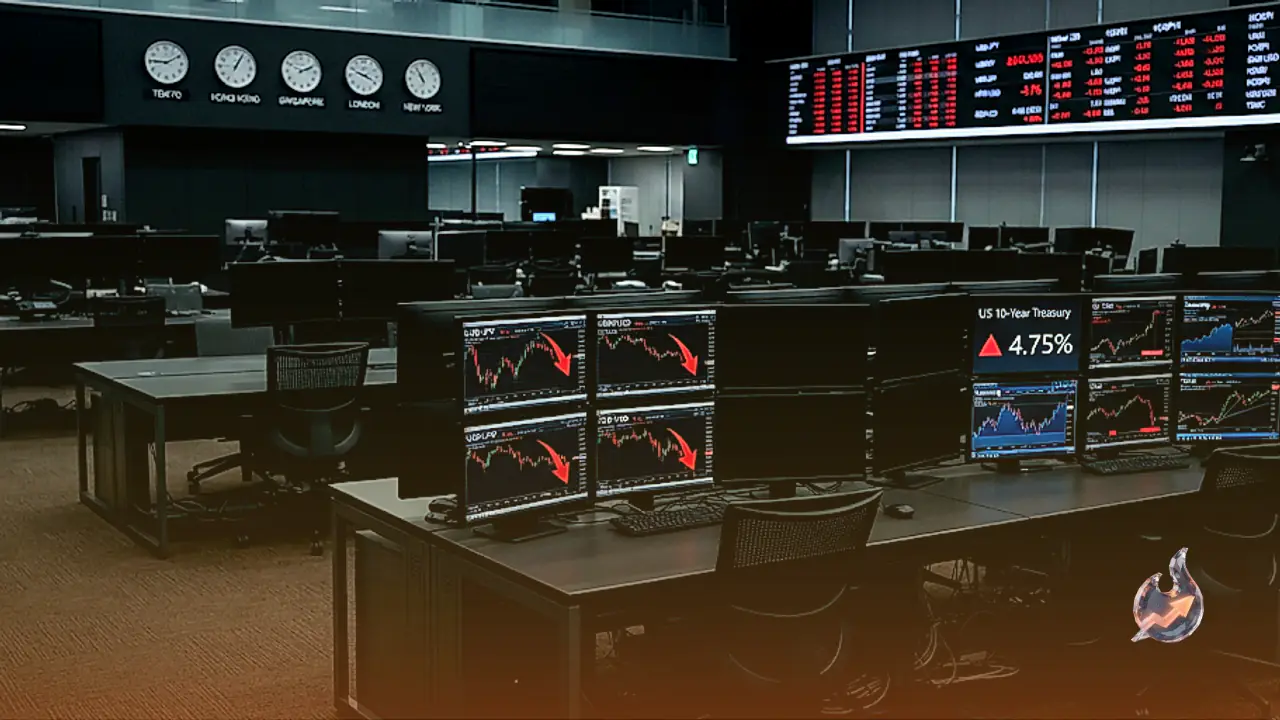

Global financial markets remain under defensive pressure as Asian currencies, including the South Korean Won (KRW), contend with elevated US Treasury yields and persistent weakness in the technology sector. Choppy trading conditions and a sudden resurgence in foreign equity liquidations have limited recent recovery efforts for the Korean currency. Market strategists point to high borrowing costs in the United States and persistent caution around semiconductor equities as key factors constraining regional currency gains.
South Korean Won Navigates Volatility as Tech Sector Weakens
The South Korean Won mounted a brief recovery over the past week but surrendered notable gains heading into Friday as international investors resumed equity liquidations. Foreign institutional investors net sold approximately USD 467.5 million worth of South Korean shares on Friday, abruptly snapping a three-session streak of net capital inflows. The sell-off was heavily driven by renewed weakness in semiconductor stocks, which dragged South Korea's benchmark KOSPI index down by 0.98% at the market close after eroding earlier gains.
According to OCBC strategists Sim Moh Siong and Christopher Wong, the outflow of foreign capital combined with sector-wide tech vulnerability continues to create headwinds for the Won. The strategists noted that two-way price action is likely to persist until there is broader clarity regarding global interest rate trajectories and semiconductor demand dynamics.
Technical Indicators and Key Levels for USD/KRW
From a technical standpoint, daily momentum and Relative Strength Index (RSI) indicators for USD/KRW remain relatively neutral without showing a clear directional bias. Market participants expect range-bound, two-way trading in the immediate term. Technical support levels are identified at 1330 followed by 1321, which represents the October low. On the upside, technical resistance is positioned at 1346, aligning with the 50-day moving average (DMA), with further resistance near the 1355 level.
Live market data shows USD/KRW trading around 1,335, slightly above its previous close of 1,334. The pair's 14-day RSI sits at 46, reflecting range-bound conditions, while the 50-day Simple Moving Average (SMA) stands at 1,345 and the 50-day Exponential Moving Average (EMA) sits at 1,353. Key pivot levels place immediate Resistance 1 at 1,337 and Resistance 2 at 1,340, with Support 1 at 1,332 and Support 2 at 1,329. Over the past 52 weeks, the exchange rate has moved within a range of 1,320 to 1,588.
Australian Dollar Struggles Following Weak Economic Data from China
Broad weakness across Asia-Pacific currencies is also evident in the performance of the Australian Dollar (AUD/USD). The pair began the trading week on a subdued note, consolidating heavy losses near its lowest point since January. Staying defensive below the 0.6800 threshold, the Australian Dollar, often viewed as a liquid proxy for Chinese economic health, was undermined by disappointing October Retail Sales and Industrial Production data out of China. Persistent US Dollar strength and heightened US-Iran geopolitical tensions further suppressed risk appetite for the Aussie.
Japanese Yen and US Dollar Dynamics Amid Economic Contraction
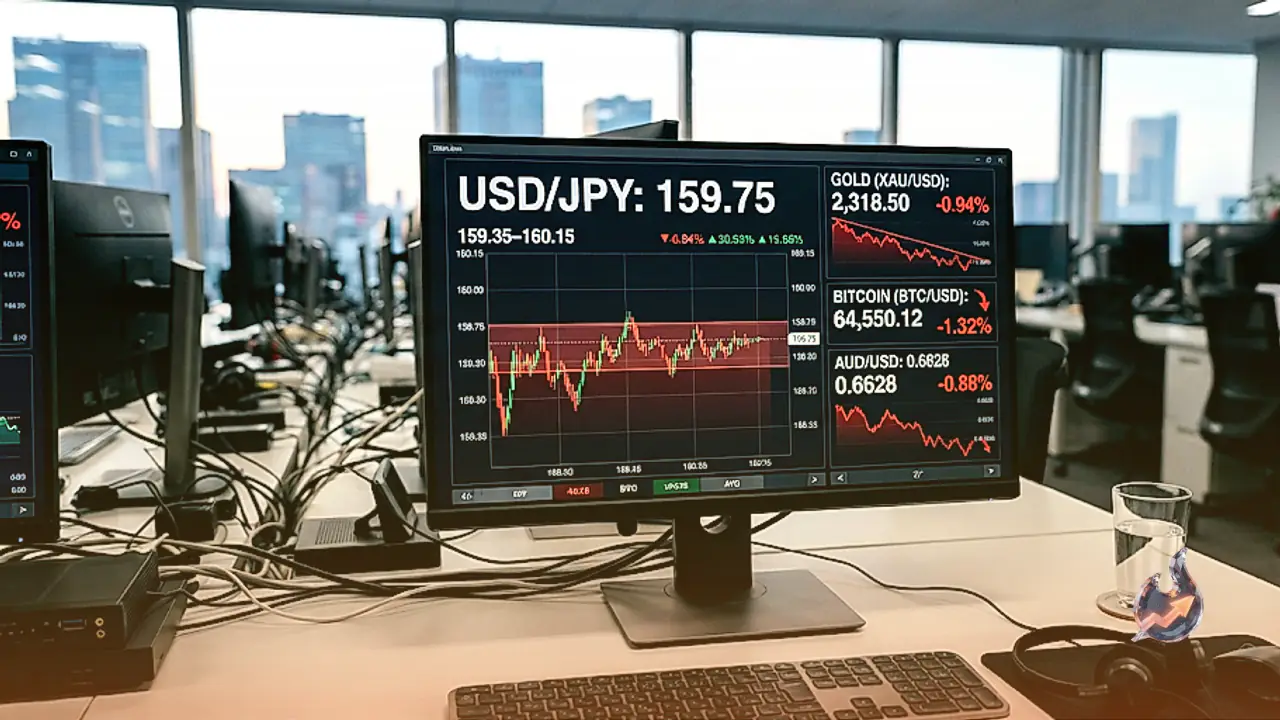
In foreign exchange markets, the Japanese Yen (USD/JPY) drifted lower toward 159.50 at the start of the week. This movement came as market participants digested unexpected economic contraction data showing that Japan's economy shrank by 0.1% in the third quarter. Despite the dismal GDP growth figures, the Yen found underlying support from potential intervention risks by Japanese authorities. Meanwhile, the US Dollar hovered near a 19-month high, backed by expectations surrounding Federal Reserve policy and safe-haven demand generated by geopolitical risks.
Precious Metals and Cryptocurrency Markets Experience Risk-Off Sentiment
Risk-off sentiment extended beyond traditional foreign exchange into precious metals and digital assets. Gold (XAU/USD) experienced dip-buying interest on Monday after dropping to an early Asian session low of $3,832, marking its lowest valuation since October 2025. The metal stabilized to trade flat near $3,872, holding below its intraday peak of $3,901.
Cryptocurrency markets painted a similarly cautious picture as broader selling pressure built up. Bitcoin traded lower below the $65,000 level, while Ethereum slid near $1,800. Ripple (XRP) remained constrained below $0.95 as digital asset investors curbed risk exposure amidst macroeconomic uncertainty.
Nvidia Earnings Report Takes Center Stage for Tech Sentiment
Market participants are turning their attention toward Nvidia's earnings announcement scheduled for 17 November after the close of US markets. Analysts hold a consensus expectation of approximately US$109 billion in quarterly revenue alongside adjusted earnings of US$2.47 per share. A strong financial performance from the AI chipmaker could help restore confidence in semiconductor equities, though investors remain cautious ahead of the official release.