






















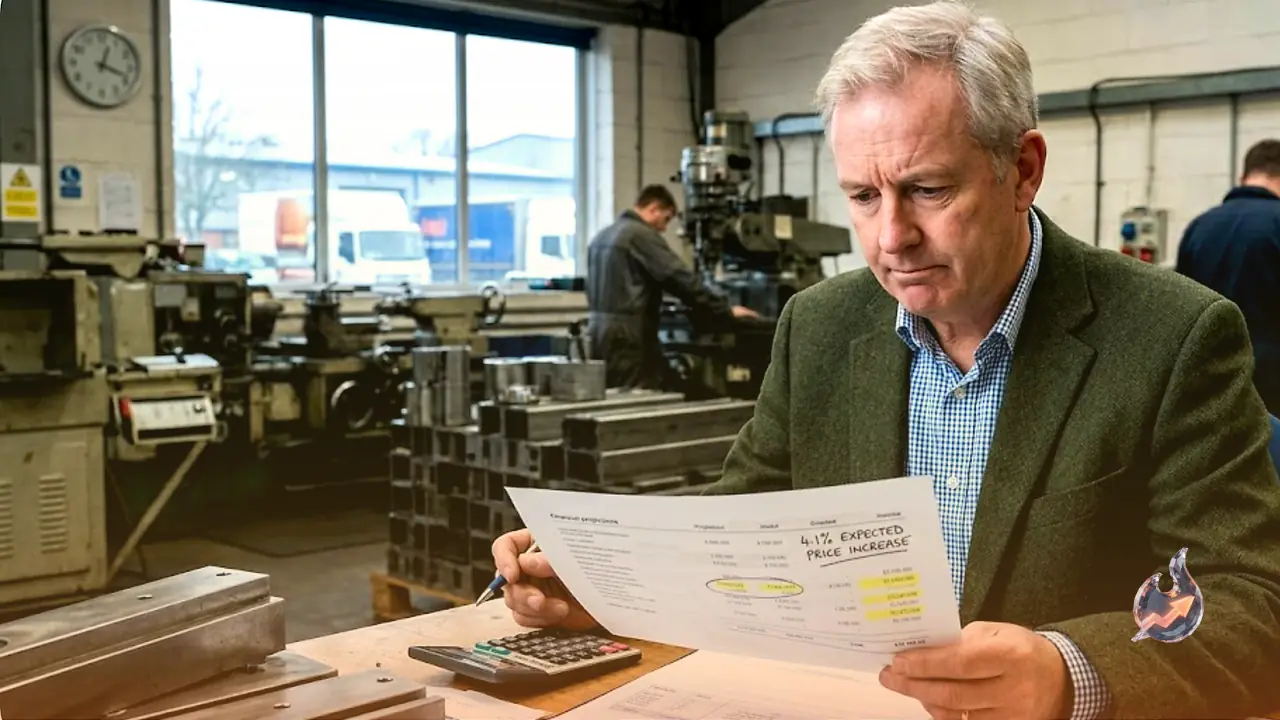

British companies expect to raise their own prices at a faster clip over the coming year, according to the latest Decision Maker Panel (DMP) survey published by the Bank of England (BoE). In the three months to June, firms pencilled in year-ahead own-price inflation of 4.1%, a touch higher than the reading in the three months to May, a signal that cost pressures inside the corporate sector have not fully cooled.
The uptick was small, but it pointed in the wrong direction for policymakers. Expected own-price inflation rose by 0.1 percentage point versus the three months to May, nudging the gauge up to 4.1%. Alongside it, businesses reported firmer pay plans: year-ahead expected wage growth edged up 0.1 percentage point to 3.5% in the three months to June, from 3.4% in May.
Why the Bank of England watches these numbers
The BoE sets monetary policy for the United Kingdom, and its central mission is price stability, defined as a steady inflation rate of 2%. Its main lever is the base lending rate, the rate at which it lends to commercial banks and at which banks lend to one another. That single benchmark filters through the entire economy, shaping borrowing costs for households and firms, and, in turn, moving the value of the Pound Sterling.
How rates steer the Pound
When inflation runs above the 2% target, the Bank typically lifts interest rates. Dearer credit cools spending, and it also tends to lift the Pound, because higher rates make Britain a more appealing place for global investors to park their money. The reverse holds when inflation slips below target: softer price growth usually flags a slowing economy, prompting the BoE to weigh rate cuts that cheapen credit and, it hopes, coax businesses into borrowing for growth-generating projects. Lower rates generally weigh on Sterling.
QE and QT explained
In extreme situations the Bank can reach for Quantitative Easing (QE), a tool designed to force credit through a jammed financial system. It is a last-resort policy, used when cutting interest rates alone cannot deliver the required result. Under QE, the BoE prints money to buy assets, typically government bonds or AAA-rated corporate debt, from banks and other financial institutions. The side effect is usually a weaker Pound.
Quantitative Tightening (QT) runs the other way, and comes into play as the economy strengthens and inflation begins to rise. Instead of buying government and corporate bonds to encourage lending, the Bank stops adding to its holdings and stops reinvesting the principal it receives as existing bonds mature. That gradual withdrawal of support tends to be positive for Sterling.
Where the Pound and rival markets stand
GBP/USD held in positive territory on Friday, though the advance stalled below 1.3400 during the European session. Live pricing puts the pair around 1.34, up roughly 0.61% from the previous close near 1.33 and inside a 52-week band of 1.30 to 1.38, with the 14-day RSI at a neutral 54. The US Dollar has been sliding after a weaker-than-expected US Nonfarm Payrolls report, which trimmed bets on further Fed rate hikes and took the pressure off the Pound.
EUR/USD stayed firm near 1.1450 in European trade on Friday, on course for its first weekly gain in three weeks as fading US Federal Reserve rate-hike expectations kept the Dollar on the back foot.
Gold kept its bullish tone for a third straight day, trading near a one-and-a-half-week high in the early European hours. The metal looked set for its first weekly gain in five weeks, though buyers were still waiting for a push beyond the $4,200 mark before betting on an extension of this week's rebound from the lowest level since November 2025.
In crypto, Hyperliquid (HYPE) pushed above $66, holding a longer-term uptrend underpinned by a rising 50-day EMA around $60. Near-term retail appetite picked up, with Open Interest climbing about 5% over 24 hours and funding rates staying above zero, even as institutional demand stayed subdued through the week.
The Fed wildcard
Attention now shifts to next week's FOMC minutes, which traders will comb for any hint of what might tip a divided Committee from holding rates toward hiking them. The dot plot from the last meeting laid bare the split over whether hikes are warranted. With forward guidance being dialled back under Chair Kevin Warsh, the Fed's reaction function remains murky, and it is unclear what exactly would rally broader support for tighter policy.
Markets that gathered at Sintra hunting for clues on the Fed's next step largely came away with a single takeaway: Warsh intends to make those clues far harder to find.