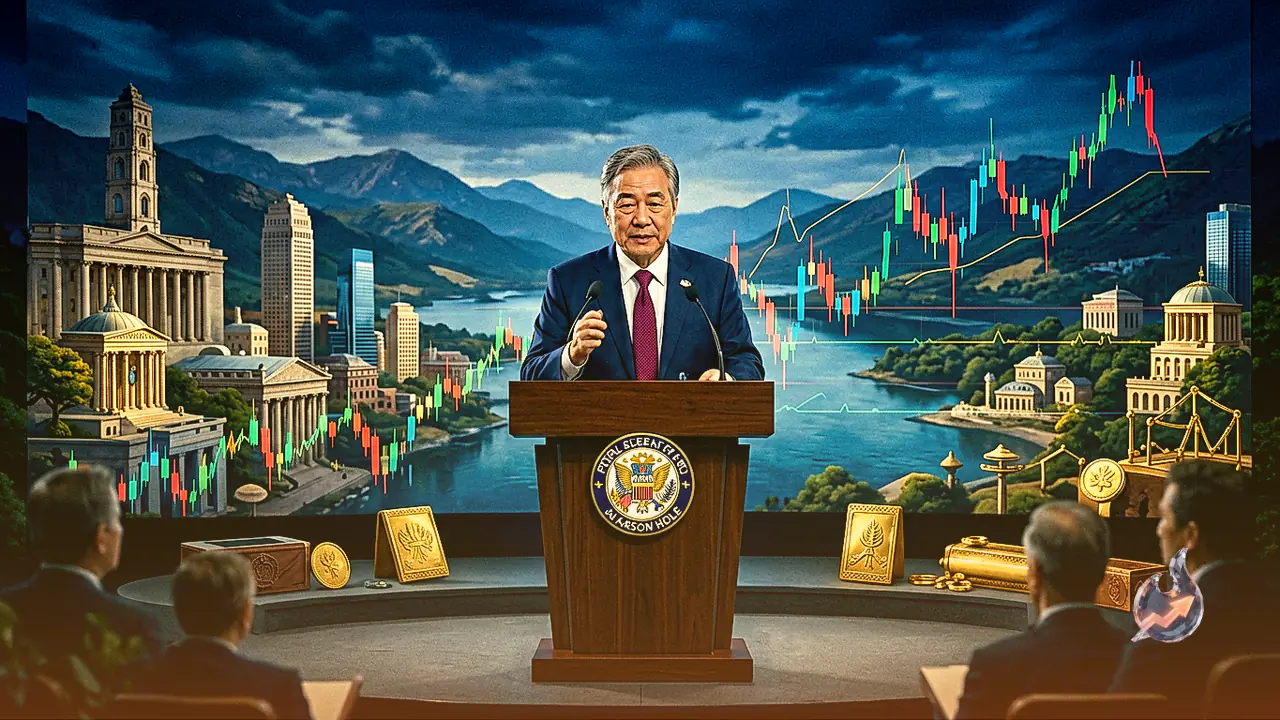

























Market participants are keeping a close watch on the US Dollar as macroeconomic data and central bank signals point toward ongoing policy resilience. Ahead of Federal Reserve Chair Kevin Warsh's highly anticipated address at the Jackson Hole Symposium on Friday, foreign exchange markets are experiencing a period of consolidation. Financial institution OCBC noted that despite recent announcements regarding US Treasury buybacks, a sustained or meaningful decline in the US Dollar remains improbable without direct intervention or supportive signals from the central bank to suppress bond yields.
Economic Data and Inflation Trajectory
Recent economic indicators from the United States underscore persistent inflationary pressures alongside durable macroeconomic growth. The latest July core Personal Consumption Expenditures (PCE) price index, which serves as the Federal Reserve's preferred metric for gauging underlying inflation, recorded a 0.2% month-over-month increase and a 3.3% year-over-year rise. These figures aligned with consensus expectations, confirming that while inflation has decelerated from its peak levels, annual price increases remain elevated above the central bank's long-term target.
Because core PCE inflation continues to hover at 3.3% annually, policymakers at the Federal Reserve retain a hawkish bias. The persistence of elevated price pressures limits the central bank's scope for rapid policy easing. Consequently, market expectations of aggressive rate cuts have been tempered, providing underlying fundamental support for the US Dollar across global currency markets.
Treasury Buybacks and Yield Dynamics
Attention has recently focused on the US Treasury Department's buyback program, leading some market analysts to speculate about potential downward pressure on the US Dollar. However, analysts at OCBC emphasize that for the currency to experience a substantial depreciation, financial markets would require clear evidence that the Federal Reserve is actively cooperating to cap government bond yields. According to OCBC's assessment, such policy coordination is unlikely in the current economic environment.
Without explicit commitment from Fed officials to assist in yield containment, the impact of Treasury buybacks on the greenback is expected to be constrained. As a result, market strategists at OCBC maintain a neutral stance on the US Dollar, advising against chasing short-term movements or betting heavily on sustained weakness in the greenback.
Jackson Hole Symposium and Fed Chair Policy Signals
Investors and policy observers are directing their focus toward Chair Kevin Warsh's upcoming speech at the annual Jackson Hole Symposium on Friday. This marks Warsh's inaugural Jackson Hole address as Federal Reserve Chair, raising market anticipation regarding the central bank's future monetary policy stance and reaction function. Market participants are seeking clarity on whether the central bank will prioritize strict inflation control over potential market stabilization efforts.
Should Chair Warsh and fellow Fed officials push back against currency debasement concerns and firmly reiterate their commitment to reducing inflation to the 2% target, the US Dollar could receive renewed upward momentum. Financial markets are closely scrutinizing whether the Fed will signal further interest rate adjustments or maintain current borrowing costs at its September policy meeting.
Global Foreign Exchange Movements: EUR/USD and GBP/USD
In foreign exchange trading on Thursday, major currency pairs traded within narrow ranges as investors hesitated to take aggressive positions prior to the Jackson Hole address. The GBP/USD currency pair consolidated near the lower boundary of its weekly range, remaining under the 1.3600 threshold during European trading hours. Downside momentum for the British Pound remained restricted, supported by market caution ahead of the US central bank guidance.
Meanwhile, the EUR/USD pair held steady around the 1.1650 level throughout Thursday's European session. The Euro found underlying support from hawkish expectations surrounding European Central Bank (ECB) policy, counterbalancing the US Dollar's recent gains following the US PCE inflation report. Traders in the Eurozone are also closely monitoring ongoing geopolitical developments in the Middle East as well as upcoming US initial jobless claims data for further market direction.
Gold Prices Hold Near Weekly Lows
Precious metals markets mirrored the broader sentiment of restraint observed across foreign exchange channels. Spot gold prices remained subdued around the $4,600 per ounce level during the first half of Thursday's European trading session, staying close to the weekly lows recorded in the prior session. The non-yielding asset faced headwind pressures from firm US Dollar valuations and steady Treasury yields.
However, further losses in bullion appeared limited as market participants adopted a wait-and-see approach ahead of Chair Warsh's Friday presentation. Because gold is highly sensitive to interest rate expectations and dollar strength, the policy cues delivered at Jackson Hole are expected to dictate the immediate directional trend for precious metals.