























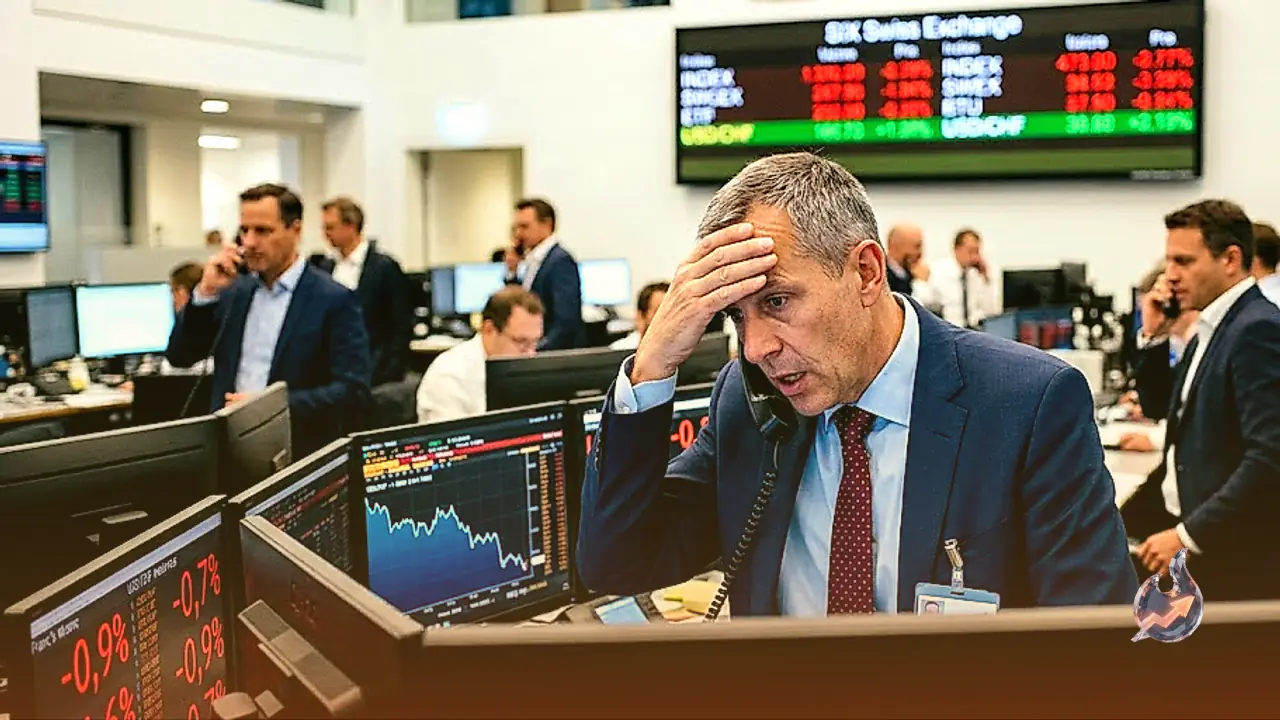

The US Dollar extended its winning streak against the Swiss Franc for the sixth consecutive trading day, hovering near its 16-month high of 0.8358 during Wednesday's Asian trading session. The USD/CHF currency pair continued its upward trajectory as the greenback gained broad support from intensifying market expectations that the Federal Reserve will implement further interest rate hikes in the final quarter of the year. According to live market data, the pair is currently trading at 0.8354, representing a 0.44 percent gain over the previous close of 0.8317, with trading volume matching its 20-day average.
Mounting Market Bets on Federal Reserve Policy and Jobs Data
Market pricing from the CME FedWatch Tool shows that interest rate traders are pricing in aggressive tightening by the US central bank. The latest figures indicate that market participants are assigning nearly a 68 percent probability to an interest rate hike in October, alongside a 95 percent probability of an additional 25-basis-point increase in December. This relentless rise in yield expectations has continued to attract capital inflows into the greenback at the expense of lower-yielding currencies.
Investors and market analysts are now directing their attention to the upcoming US Nonfarm Payrolls report scheduled for release on Friday. Consensus projections among economists indicate an addition of 90,000 jobs in September, with the national Unemployment Rate anticipated to hold steady at 4.1 percent. The outcome of this labor market data is viewed as critical in validating whether the US economy remains strong enough to absorb further borrowing cost increases without tipping into contraction.
USD/CHF Technical Structure and Key Price Indicators
On the daily technical charts, USD/CHF is consolidating around 0.8350, maintaining an advance positioned comfortably above both the nine-period and 50-period Exponential Moving Averages (EMAs). This alignment of the shorter-term moving average running above the longer-term line reinforces an underlying bullish momentum. However, technical gauges signal that the sustained upward movement is reaching stretched conditions, as the 14-day Relative Strength Index (RSI) stands at 74.21, pushing well into overbought territory.
Live technical readings confirm that the RSI has touched 76, which typically alerts traders to heightened risks of near-term consolidation even as upside pressure persists, bolstered by an elevated FXS Fed Sentiment Index reading near 143.70. Over the past 52 weeks, the currency pair has traded within a range between 0.7629 and 0.8355. Additional live indicators show the Moving Average Convergence Divergence (MACD) line at 0.01 above the signal line of 0.00, confirming positive momentum. The 20-day, 50-day, and 200-day EMAs are positioned at 0.8215, 0.8144, and 0.8014, respectively, displaying a golden cross pattern where the 50-day EMA sits above the 200-day EMA. The 20-day Bollinger Bands span between 0.8032 and 0.8357 around a middle band of 0.8194. The Average Directional Index (ADX) is at 28, confirming a defined trend, while the Stochastic fast and signal lines stand at 99 and 92. For intraday technical reference, the central pivot rests at 0.8343, with resistance levels marked at 0.8366 (R1) and 0.8378 (R2), and immediate support levels identified at 0.8331 (S1) and 0.8309 (S2).
Swiss Economic Data and KOF Leading Indicator
Even as the Swiss Franc faces broad external depreciation against the dollar, domestic macroeconomic indicators from Switzerland continue to demonstrate notable resilience. The Swiss KOF Leading Indicator climbed to 109.1, marking its highest reading in six years. Historically, robust macroeconomic performance characterized by solid growth, tight employment, and elevated business confidence provides support to the domestic currency, whereas decelerating fundamentals typically accelerate Franc weakness.
Safe-Haven Dynamics and Global Appeal of the Swiss Franc
The Swiss Franc (CHF) serves as Switzerland's official currency and regularly ranks among the top ten most traded currencies across global financial markets, with transaction volumes far surpassing the physical size of the Swiss economy. Traditionally, international investors treat the Franc as a prime safe-haven asset, frequently buying the currency during episodes of systemic risk, economic instability, or geopolitical turmoil. Switzerland's enduring political neutrality, established trade surpluses, expansive central bank reserves, and political reliability provide confidence to global capital seeking shelter from risk.
During periods of severe market turbulence, the Franc typically appreciates against higher-beta and risk-sensitive currencies. However, in the current macroeconomic climate, the widening interest rate differential in favor of the United States has overshadowed safe-haven demand, leading institutional capital to favor higher yields available in dollar-denominated debt.
Swiss National Bank Policy Framework and Eurozone Ties
Monetary policy decisions for Switzerland are governed by the Swiss National Bank (SNB), which meets once per quarter, amounting to four times per year. This schedule is less frequent than most other major central banks. The SNB's explicit policy mandate targets an annual inflation rate below 2 percent. Whenever price growth exceeds this boundary or forecasts indicate persistent inflation pressures, the central bank moves to raise its policy interest rate. Higher borrowing costs generally bolster the Franc by attracting cross-border capital searching for improved yields, whereas rate reductions weigh on currency performance.
The currency's historical context remains heavily shaped by its structural connection to neighboring European economies. Between 2011 and 2015, the Swiss Franc was formally pegged to the Euro (EUR). The unexpected and sudden removal of this peg by the SNB in early 2015 prompted a violent surge of over 20 percent in the Franc's value, destabilizing global currency markets. While the formal peg was abandoned, Switzerland's intense economic integration with the European Union means that the fortunes of the Euro and the Swiss Franc maintain a correlation exceeding 90 percent in standard financial tracking models.
Broader Foreign Exchange Movements and Gold Trends
The prevailing market dynamics also reverberated across other major currency pairs and commodities. The Australian Dollar traded near two-month lows around 0.6950 during Asian trading on Wednesday, pressured by cooler-than-expected August underlying Consumer Price Index data in Australia that diminished expectations for further Reserve Bank of Australia rate hikes, alongside uninspiring Chinese Purchasing Managers Index metrics.
Concurrently, USD/JPY maintained losses below the 157.00 threshold, as hawkish expectations surrounding the Bank of Japan and persistent risks of official currency intervention supported the Japanese Yen despite weak domestic industrial production and retail sales figures. In the commodities sector, gold consolidated below 4,200 dollars per ounce following a modest rebound from an eight-week low of 4,110 dollars, as metals traders awaited the US ADP employment report and the upcoming core Personal Consumption Expenditures Price Index data.