























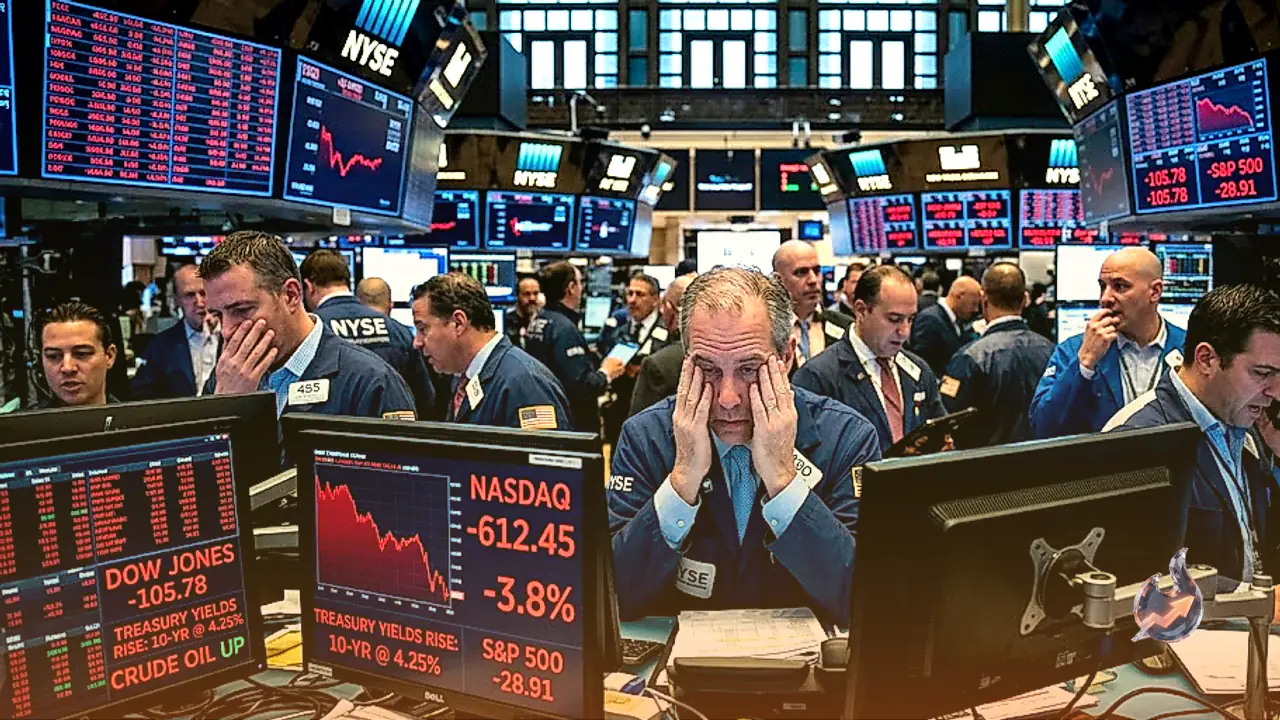

The US stock market experienced a turbulent trading week between August 17th and 21st, with the tech-heavy Nasdaq Composite bearing the brunt of a severe sell-off. Major stock indices across Wall Street recorded weekly declines ranging between 1% and 1.5%, driven by mounting geopolitical tensions in West Asia, elevated crude oil prices, and rising Treasury yields. Although all major indices witnessed robust buying interest on the final trading session of the week, it was not enough to pull them out of negative territory for the period. Market participants remain cautious as they evaluate the broader macroeconomic impacts on the wider economy, compounded by the US national debt crossing the $40 trillion threshold.
Equities Rally on Friday Despite Weekly Blues
On August 21st, the Nasdaq Composite advanced 113.29 points, or 0.43%, to settle at 26,180.46. Meanwhile, the S&P 500 index climbed 33.21 points, or 0.43%, concluding the session at 7,674.37. Outperforming its peers, the Dow Jones Industrial Average gained 517.80 points, or 0.98%, to close the week at 53,277.01. According to Trading Economics data, Friday's market advance was supported by a report indicating that US business activity expanded at its fastest pace in over four years. Nevertheless, financial markets continued to digest the recent surge in bond yields fueled by inflation concerns and fiscal policy developments. Long-dated Treasury yields held near levels observed prior to the Treasury's announcement of an expanded bond buyback program, while the US dollar extended its downward trend.
Sector Performance and Corporate Earnings Impact
Among individual equities, major hyperscalers experienced buying momentum on Friday, with Alphabet gaining 1.1%, Microsoft edging up 0.4%, and Meta rising 0.8%. Conversely, semiconductor stocks traded mixed, as Nvidia dropped 1.0%, Micron slipped 0.8%, and Intel plunged 2.2%. In the retail sector, Walmart shares crashed more than 10% over the week following a rare earnings miss that adversely affected its corporate outlook and raised fresh concerns regarding consumer spending habits in the United States. Despite the late-week rally, US indices finished the weekly period firmly in negative territory.
Broad Market Declines Across Indices and Sectors
Between August 17th and 21st, the Dow Jones Industrial Average dropped 386.10 points, or 0.72%, while the S&P 500 plummeted 116.31 points, or 1.49%. The Nasdaq Composite suffered the steepest retreat, crashing 604.20 points, or 2.3%. The Morningstar US Total Market Index fell by 1.48%. Sector-wise, Morningstar data indicated that industrials were the worst performers, down 4.23%, closely followed by utilities, which declined 3.65%. Market capitalization categories also retreated, with large-cap stocks falling 1.48%, mid-caps dropping 1.82%, and small-caps declining 1.46%. Style categories showed growth stocks tumbling 2.03%, blend stocks falling 1.48%, and value stocks shedding 0.76%. Out of 882 US-listed companies tracked by Morningstar, 380 firms, or 43%, advanced, none remained unchanged, and 501 firms, or 57%, recorded losses.
Driving much of this downward pressure was a sharp rebound in benchmark Treasury yields.
Treasury Yields and Federal Reserve Policy Dynamics
The 10-year benchmark US Treasury yield tested a 20-month high after touching 4.74% on Friday. These yields rebounded from earlier weekly declines despite the US Treasury Department's plans to double its quarterly bond buybacks to $4 billion from the previous $2 billion. Furthermore, the 30-year Treasury yield surged back to its highest level since 2007 at 5.2%, reflecting growing concerns over long-term inflationary pressures. The upward movement in long-term yields followed discussions surrounding monetary policy and inflation responses. Underlying US inflation gauges ticked higher during the second quarter as tariffs and soaring energy costs drove up operating expenses across multiple industries, according to Trading Economics data. Meanwhile, the US dollar index maintained a 1% weekly gain to hover around 98.8 despite experiencing considerable volatility throughout the week.
Crude Oil Surge and Global Market Sentiment
Crude oil prices remained elevated, surging over 5% across the week. US WTI crude oil futures climbed more than 5% for the second consecutive week, briefly surpassing the $94 per barrel mark on Friday before settling above $87 per barrel. Brent crude touched highs of $97 per barrel before closing strong above $94 per barrel, marking a second straight week of gains for both major energy benchmarks. On the global front, Ajit Mishra, Senior Vice President of Research at Religare Broking, noted that geopolitical developments and elevated crude oil prices remained the primary drivers of market sentiment. Ongoing tensions in West Asia continued to fuel anxieties regarding potential disruptions to global energy supplies. He added that rising global bond yields diminished expectations for aggressive monetary easing, encouraging a cautious stance toward risk assets as investors await further guidance from upcoming central bank platforms such as the Jackson Hole symposium.