




















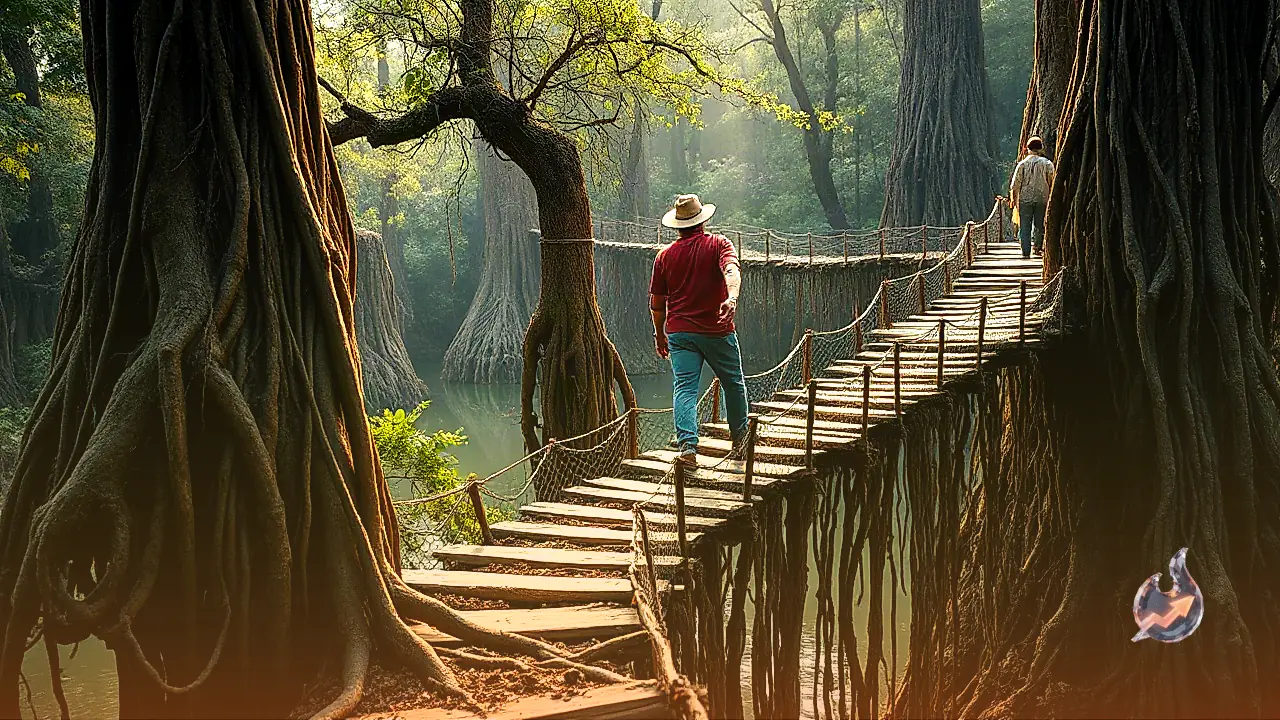

Nestled across the rugged hills and deep river valleys of Meghalaya, an extraordinary testament to human ingenuity and natural synergy continues to defy conventional construction practices. Known as living root bridges, these living architectural marvels are formed by guiding the aerial roots of rubber fig trees across streams and gorges. While this ancient botanical engineering cannot compete with the swift timelines of contemporary steel and concrete infrastructure, it embodies an intimate ecological understanding that modern conservationists and urban planners increasingly view as vital for sustainable living. A visiting media delegation from Uttar Pradesh recently had the unique privilege of exploring this living heritage and understanding the traditional ecological knowledge embedded within it.
A Dialogue on Indigenous Wisdom in Siej Village
As part of the ‘Ek Bharat, Shreshtha Bharat’ initiative, the visiting media delegation travelled to Siej village in the East Khasi Hills district. There, they interacted with eminent local environmentalist Hally War, who was honoured with the Padma Shri. During the discussion, War emphasized that for the indigenous Khasi community, living root bridges represent far more than practical crossings over gushing streams and steep ravines. At their core lies a deep-seated philosophy of deciphering nature, collaborating with living ecosystems, and safeguarding essential natural resources for generations yet unborn.
The creation of these bridges is a testament to immense human patience and generational continuity. Local inhabitants carefully train the pliable aerial roots of the rubber fig tree, guiding them across water bodies using temporary supports. Over the years, roots travelling from opposite banks are woven, braided, and knotted together. Villagers consistently nurture, monitor, and prune the structure. Through this sustained care over decades, the supple root fibres gradually thicken and solidify into robust pathways capable of supporting significant foot traffic.
Living Structures That Grow Stronger Over Time
Unlike artificial steel or masonry bridges that steadily degrade when exposed to torrential rains, humidity, and constant weathering, living root bridges possess the self-healing and self-reinforcing properties of living organisms. As time passes, the cellular structure of the roots continues to expand, weave deeper into the surrounding riverbanks, and solidify into bedrock-firm anchors. Maintenance and reinforcement are built into the tree's natural metabolic processes, requiring no industrial chemicals, cement, or external steel reinforcements. While crafting a single bridge demands years and occasionally several decades of community dedication, the resulting lifeline remains functional for centuries.
War explained to the delegation that this generational craft is rooted directly in ancestral Khasi lore. The unforgiving topography of the hills, combined with some of the highest rainfall volumes on the planet, made conventional wooden or bamboo bridges vulnerable to rotting and flash floods. Rather than attempting to subjugate or clear the forest to forge roads, the ancestors chose to teach the forest how to become the road. Locally known as ‘Jingkieng Jri’, these bridges stand not merely as structural marvels, but as practical demonstrations of indigenous bio-engineering that integrate trees, soil, river systems, and human survival into an indivisible whole.
National Honours for Community Stewardship and Conservation
A resident of Siej village in East Khasi Hills, Hally War has dedicated decades to safeguarding this fragile heritage and transferring ancient know-how to younger villagers. His relentless efforts have centered on organizing indigenous communities to actively tend to the root bridges, manage local watersheds, and take pride in traditional conservation ethics. In recognition of his impactful work in environmental stewardship and community service, he was conferred the prestigious Padma Shri in 2026. This national accolade brought widespread recognition to the Khasi community's traditional bio-engineering practices and the urgent necessity of protecting living root bridges.
Alongside his public service, War leads the life of an active cultivator, farming betel nuts, betel leaves, black pepper, and diverse seasonal fruit crops. His harmonious lifestyle, which integrates agricultural livelihood with hands-on nature preservation, demonstrates that indigenous and rural wisdom holds actionable answers to the planet's pressing environmental dilemmas.
Beyond Tourism: A Living Symbol of Coexistence
Today, living root bridges across Cherrapunji, Nongriat, and remote corners of the Khasi Hills attract global sightseers, architects, and botanical researchers seeking to unravel the biological secrets of structural root training. However, their true value transcends aesthetic and tourism appeal. Each bridge remains a living chronicle of collective labor, social cohesion, and the intimate kinship between a tribe and its forest habitat.
The paramount message emerging from the dialogue with Hally War is that economic progress and environmental preservation do not have to be positioned as mutually opposing forces. Meghalaya's living root bridges demonstrate that human utility can be achieved in profound partnership with nature. Ultimately, these biological wonders bridge more than physical waterways: they connect humanity to the earth, link ancestral tradition with contemporary thought, and forge an unbreakable bond across successive generations.