
























Crude oil prices have maintained a relentless upward trajectory over the past several sessions, pushing both US West Texas Intermediate (WTI) and Brent crude to three-month highs and bringing them uncomfortably close to the psychological $100-per-barrel threshold. This sharp appreciation is primarily driven by renewed military exchanges between the United States and Iran. Despite heightened security risks and geopolitical friction in the vital Strait of Hormuz, an estimated 7 million barrels per day of crude oil and refined products continue to transit through the chokepoint.
Nevertheless, soaring crude valuations present a formidable threat to the global macroeconomic landscape, with India standing particularly vulnerable. India's crude oil import dependency touched a staggering 88.7% in the previous fiscal year, and the first half of 2026 has witnessed further upward momentum. A detailed examination reveals how elevated crude prices are poised to ripple across the Indian equity markets and essential petroleum derivatives, including petrol, diesel, liquefied petroleum gas (LPG), piped natural gas (PNG), and compressed natural gas (CNG).
Crude Oil Price Nears $100 Per Barrel Threshold
During the early hours of September 8, 2026, US WTI crude futures breached the $92.4-per-barrel mark, hovering near its highest valuation in three months. Concurrently, Brent crude remained firmly entrenched above $97 per barrel, sitting merely $3 shy of the coveted $100 milestone while trading at a six-week high. Over two consecutive trading sessions, crude contracts have registered gains of nearly 2%. On a month-over-month basis, US WTI and Brent have advanced by 13% and 11%, respectively. Since the inception of the US-Iran conflict in late February 2026, international oil benchmarks have appreciated by 30%. Because the vast majority of these gains stem from the ongoing West Asia war, year-on-year performance figures show an astronomical surge of 48% for US WTI and over 46% for Brent.
Among the most recent geopolitical developments, Iran is reportedly looking to finalize a shipping agreement with Oman regarding transit through the Strait of Hormuz. Such a pact has intensified global concerns regarding Tehran's expanding strategic control over the pivotal waterway, through which at least 20% of the world's petroleum and natural gas supplies are transported. Conversely, the United States, whose naval forces have maintained an aggressive blockade of Iranian ports to choke off exports from the regime, remains steadfastly focused on restoring maritime traffic through Hormuz to pre-conflict levels.
Market participants have also closely monitored potential American countermeasures following the striking of Iranian tankers within the strait over the preceding weekend. Oil prices rallied by nearly 10% in the prior week as renewed hostilities stoked deep-seated fears regarding prolonged disruptions to Middle Eastern energy supplies. According to Trading Economics, both belligerents intensified operations over the weekend, targeting naval and commercial vessels in and around the Hormuz corridor. Among corporate entities caught in the crossfire, Saudi Aramco's facilities in Jazan near the Red Sea sustained minor impact, though damage reports indicate the disruption was contained. Despite these severe hazards, maritime energy transportation through the Persian Gulf persists, with approximately 7 million barrels of crude and refined products moving daily via Hormuz.
Implications of High Oil Prices for India
For an energy-hungry nation like India, persistently elevated oil valuations represent a critical macro risk, capable of widening the current account deficit, inflating the import bill, and triggering inflationary spirals, noted Ponmudi R, CEO of Enrich Money. Amidst the broader global oil rally, India's average crude basket cost surpassed the $100-per-barrel mark by the preceding week. Data released by the Petroleum Planning and Analysis Cell (PPAC) under the Ministry of Petroleum and Natural Gas indicated that the Indian crude basket stood at $101.07 per barrel as of September 4, 2026. While this remains below the severe peaks of $114.48 and $106.23 per barrel recorded in April and May, respectively, it remains at an elevated plane capable of exerting severe pressure on national import expenditures.
Ever since the conflict erupted, India's crude import expenditures have escalated dramatically. Freight rates along critical maritime corridors, such as Saudi Arabia's Ras Tanura to India, have skyrocketed by 400% since late February. Specifically, the cost of transporting crude via Very Large Crude Carriers (VLCCs) along this route surged by 411% to $4.34 per barrel in August, up sharply from $0.85 per barrel prior to the outbreak of hostilities. Similarly, freight expenses for shipments originating from Russia's Ust-Luga port to India aboard Suezmax tankers jumped by 137% to reach $19.90 per barrel last month, compared to $8.40 in February. Furthermore, war-risk insurance premiums for a single transit voyage through the Strait of Hormuz escalated exponentially, ranging between $7.5 million and $10 million, a staggering increase from the nominal $250,000 fee required before the geopolitical crisis.
In tandem with rising freight and insurance overheads, India reportedly disbursed 60% more for its crude oil imports during the first quarter of fiscal year 2027 (spanning April through June). Moreover, the import expenditure recorded for the month of July stands 41% higher than the corresponding figure from the previous year.
Impact on the Indian Stock Market
Indian equity markets are anticipated to maintain a cautious posture as elevated crude oil valuations continue to dictate the prevailing macroeconomic narrative. Escalating geopolitical friction has kept global energy exchanges on edge, with WTI crude briefly testing the $93-per-barrel threshold before consolidating within the $92 to $93 band, observed Ponmudi. He emphasized that the overarching geopolitical backdrop remains precarious, given that the US-Iran confrontation displays negligible signs of de-escalation. The prevailing ambiguity surrounding the security of the Strait of Hormuz and the prospective timeline for its complete reopening continues to cast a shadow over global energy supplies and broader investor sentiment.
Effects on LPG, PNG, CNG, Petrol, and Diesel in India
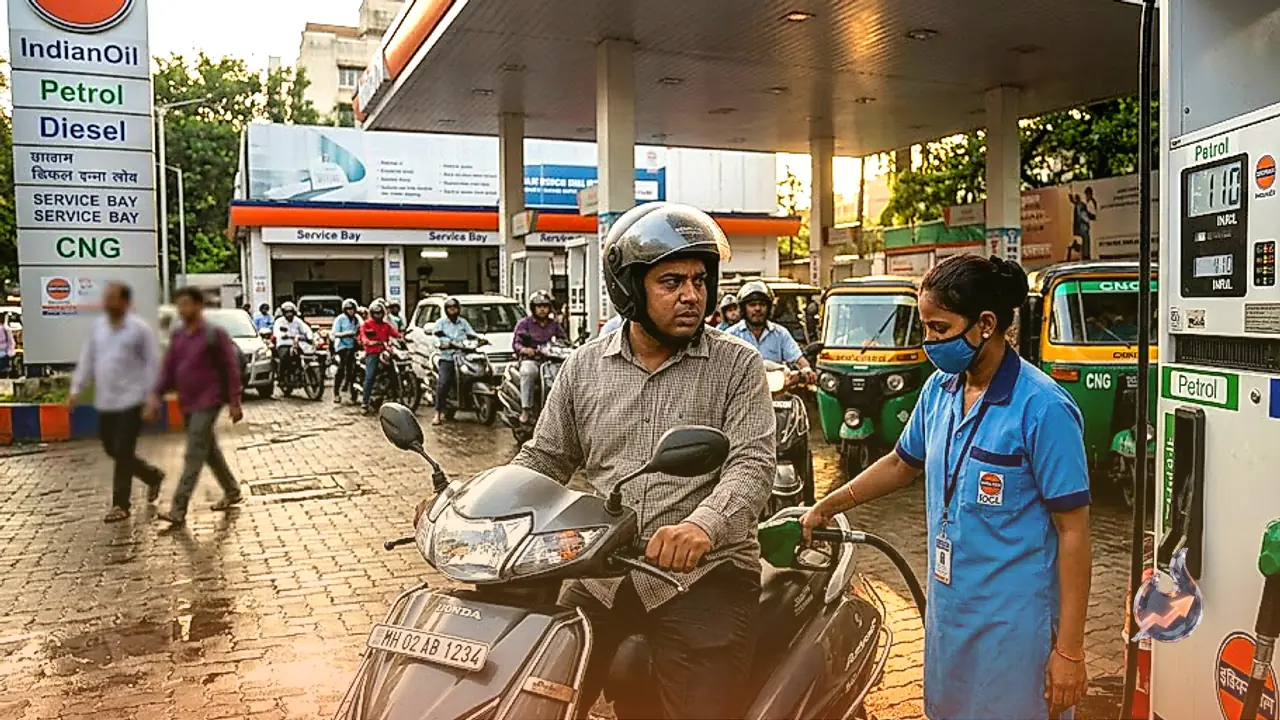
Given that India relies heavily on international crude imports to satisfy its domestic consumption, any upward surge in global oil benchmarks inevitably inflates import costs, compelling domestic oil marketing companies to adjust petroleum product pricing. A comprehensive breakdown of the expected impacts is detailed below
- Petrol: With domestic retail pricing aligned with market mechanisms, oil marketing companies factor in international petroleum valuations and prevailing market conditions, keeping upward pressure active.
- Diesel: Soaring crude quotes directly elevate refinery and input operational expenditures; diesel also plays an indispensable role in heavy freight transport and logistics.
- Domestic LPG: India imports roughly 60% of its total LPG requirements. Domestic LPG is largely insulated from full international price volatility through targeted government subsidies and oil marketing company interventions, though adjustments may experience delays.
- Commercial LPG: Unlike domestic cylinders, commercial LPG pricing is strictly market-linked and promptly mirrors international LPG benchmarks and associated logistical costs.
- CNG: Compressed natural gas pricing is predominantly dictated by the procurement cost and domestic availability of natural gas. While crude trends can indirectly influence competing fuel economics, CNG does not follow a direct crude-to-consumer transmission mechanism.
- PNG: Piped natural gas shares a structural parallel with CNG, where upstream natural gas acquisition expenses carry far greater direct relevance than raw crude movements.
- ATF: Aviation turbine fuel is a direct refined petroleum derivative and remains acutely sensitive to shifts in international crude and refined product quotations.