






















Households and vehicle owners across India woke up to a mixed set of natural gas rates on August 1, 2026, with compressed natural gas (CNG) staying flat in the national capital even as several states pushed pump prices higher. These rates matter far beyond the fuel counter, since a large share of the country's buses, taxis and auto-rickshaws run on CNG, and any change quietly feeds into what people pay to get around. Piped natural gas (PNG), the cooking fuel that reaches kitchens through pipelines, stayed exactly where it was in every city, giving domestic users at least one bill they need not worry about this month.
CNG in Delhi holds firm while other cities pay more
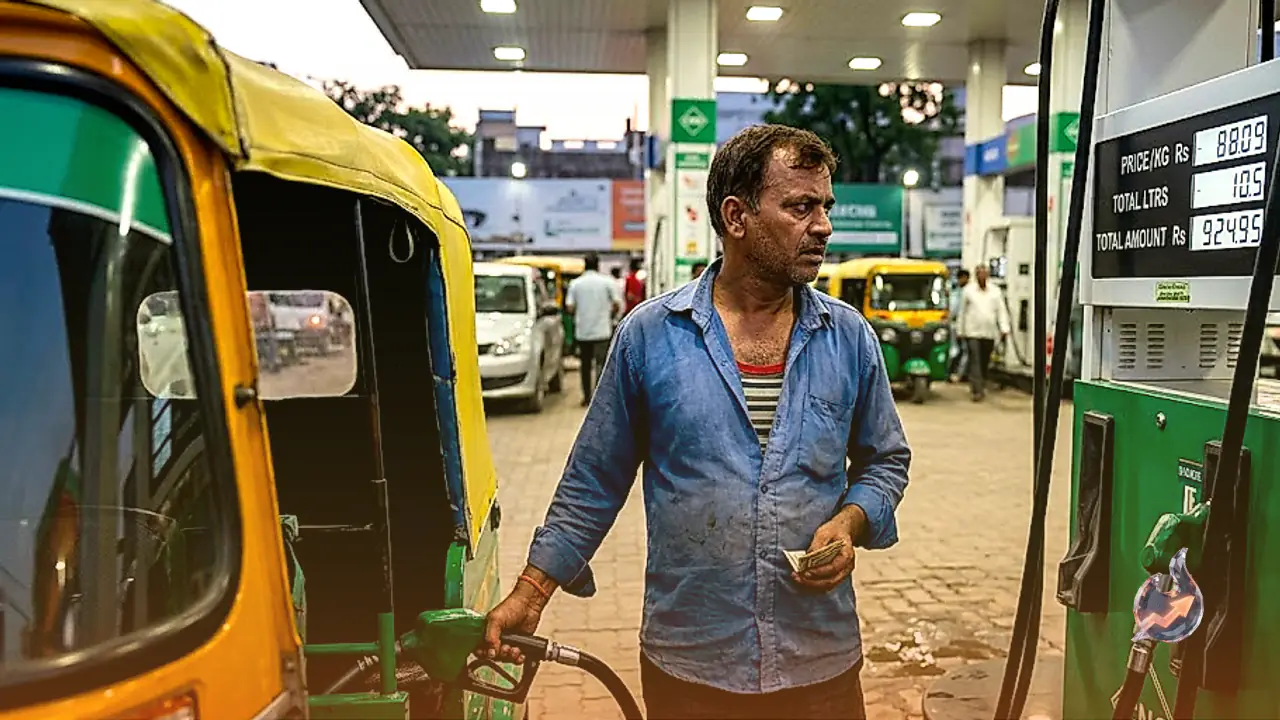
In Delhi, CNG remained unchanged at Rs 83.09 per kg, the same rate drivers were already paying. The picture was pricier elsewhere. Motorists in Kolkata and Chennai continued to pay Rs 97 for every kilogram, while Bengaluru and Bharatpur both stood at Rs 97.50. Mumbai's rate settled at Rs 86 per kg, keeping it among the more affordable metros for CNG buyers.
A handful of smaller cities told a sharper story. In Mathura, a kilogram of CNG now costs Rs 100, crossing the three-figure mark. Dewas and Firozabad both saw an increase of Rs 0.50 to Re 1, taking their rates to Rs 97.50 per kg and Rs 99 per kg respectively.
State-level hikes hit Bihar, Jharkhand, Odisha and Telangana
The steepest pressure came at the state level. CNG turned dearer by Rs 5 per kg each in Bihar, Jharkhand and Odisha, a jump that regular commuters and auto-rickshaw drivers will feel directly. For fleet operators running dozens of vehicles, even a Rs 5 rise multiplies quickly across a single day of driving. Telangana saw the biggest single rise of all, with CNG climbing Rs 12, a change that will ripple through everyday travel budgets in the state.
What CNG actually is
CNG, short for Compressed Natural Gas, works as an alternative to petrol, diesel, gasoline and LPG or propane. It is produced by compressing natural gas, which is largely methane, down to less than 1 per cent of its original volume. It is widely regarded as one of the safest fuels available because it carries no harmful impact on the environment.
PNG stays flat across the board
PNG, the cheapest category of petroleum products in the country, is used in most Indian homes as a substitute for LPG. For August 2026, its rates did not move in any city, a relief for families that rely on piped gas for daily cooking. For a household that cooks two or three meals a day, a stable rate through the month makes budgeting far simpler.
In Delhi, PNG was billed at Rs 49.59, while Kolkata and Chennai each stood at Rs 50. Mumbai's rate was Rs 51.50, and both Hyderabad and Thiruvananthapuram came in at Rs 51. The most economical PNG was found in Bhubaneswar at Rs 45.33, followed by Gurgaon at Rs 48.40 and Noida at Rs 49.45. At the other end, Lucknow was the costliest at Rs 56.50, with Chandigarh at Rs 54.70 and Bengaluru at Rs 53 per SCM.
Why PNG is preferred in kitchens
PNG, or Piped Natural Gas, is drawn from natural gas that is mainly methane and delivered straight to users through pipelines, serving households, industries and commercial spaces alike. Set against LPG, it is less toxic, burns cleaner and sharply cuts the risk of accidents because it is lighter than air and disperses quickly if it leaks.
The one household, one cooking gas rule continues
The requirement to move to PNG wherever the piped infrastructure exists stays in force in August 2026. The government has made it compulsory for a single household to hold only one cooking gas connection, either LPG or PNG, and in areas where PNG is available, families are obliged to switch to it. The intent behind the single-connection rule is to steer homes towards cleaner piped gas wherever the network has reached, and to stop one family from drawing on both systems at once.
Beyond the usual rules for surrendering an LPG connection when you relocate, there is now a firm deadline attached to the switch. Once a household moves fully to PNG, it must close its Indane Gas, HP Gas or Bharat Gas connection within 30 days. There is a cushion for those who move away, though: customers relocating to a non-PNG area can use a transfer voucher to reconnect their LPG cylinder.