






















Precious metals witnessed a notable turnaround on Wednesday, November 11, 2026, as buying interest returned to international commodity exchanges following Tuesday's sharp decline. On India's Multi Commodity Exchange (MCX), gold prices gained roughly 1 percent to trade near Rs 1,41,890 per 10 grams, moving within striking distance of the Rs 1.42 lakh mark. Silver demonstrated an even stronger upward momentum, rallying by 2.70 percent or Rs 4,925 to establish a fresh intraday peak of Rs 1,87,501 per kilogram. However, this recovery in futures contracts stood in stark contrast to the physical retail jewelry market across India, where prices dropped for the second consecutive trading session on the final day of the Diwali festive period.
Domestic Spot Gold Rates Slip Across Caratage Categories
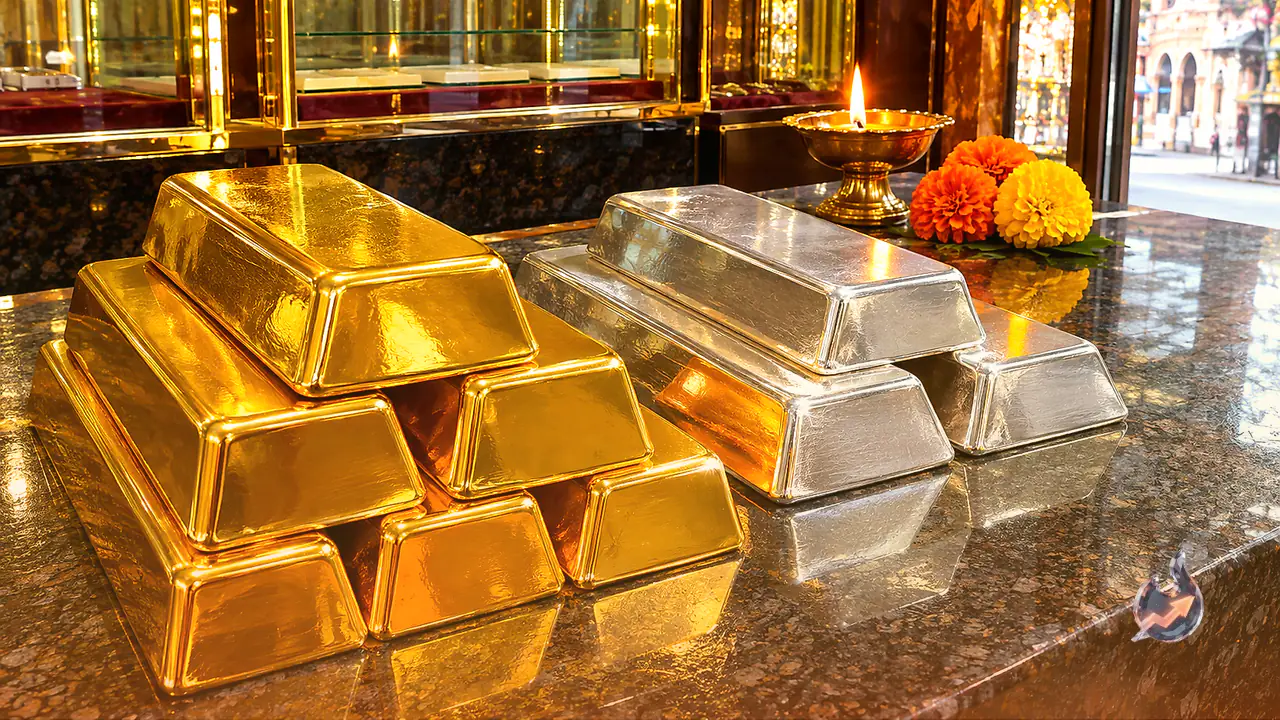
In the physical retail bullion markets, 24-carat fine gold dropped by Rs 710 per 10 grams to settle at Rs 1,41,980. On a 100-gram scale, 24-carat prices declined by Rs 7,100 to touch Rs 14,19,800. The standard 22-carat gold, predominantly used for traditional jewelry manufacturing, registered a decline of Rs 650 per 10 grams to quote at Rs 1,30,150, which translates to a decrease of Rs 6,500 per 100 grams to Rs 13,01,500.
Similarly, 18-carat gold fell by Rs 530 per 10 grams to Rs 1,06,490, while the 100-gram category fell by Rs 5,300 to Rs 10,64,900. Despite this two-day corrective slide in domestic physical prices, bullion in India continues to trade at a substantial premium compared to markets in the Middle East and the West. Countries including Saudi Arabia, the United Arab Emirates, Qatar, Kuwait, Oman, and the United States continue to offer retail 24-carat gold below the threshold of Rs 13,000 per single gram and under Rs 1,30,000 for 10 grams.
City-Wise Breakdown of Retail Gold Prices
Across the majority of major Indian metropolitan consumption centers, retail gold stood uniform at Rs 14,198 per gram for 24-carat purity, Rs 13,015 per gram for 22-carat, and Rs 10,650 per gram for 18-carat. Subtle variations remained visible in select northern and western cities due to local taxation and freight components. Delhi recorded the country's highest physical bullion rates, where 24-carat metal traded at Rs 14,213 per gram, 22-carat at Rs 13,030 per gram, and 18-carat at Rs 10,664 per gram.
In Gujarat, both Ahmedabad and Vadodara saw 24-carat gold priced at Rs 14,203 per gram, 22-carat at Rs 13,020 per gram, and 18-carat at Rs 10,654 per gram. Meanwhile, centers including Mumbai, Kolkata, Bangalore, Hyderabad, Pune, and Kerala quoted 24-carat gold at Rs 14,198 per gram, 22-carat at Rs 13,015 per gram, and 18-carat at Rs 10,649 per gram. Chennai recorded the highest 18-carat rate nationwide at Rs 10,650 per gram.
Global Spot Levels and Energy Benchmarks
On international markets, spot gold advanced by nearly 1 percent toward $4,058 per ounce, recovering from early session levels around $4,049 per ounce. Spot silver showed significantly larger percentage gains, jumping nearly 3 percent to trade above $53 per ounce after earlier clearing $52.4 per ounce.
Energy markets mirrored the modest recovery sentiment, with crude oil benchmarks advancing between 0.5 percent and 1 percent. United States West Texas Intermediate crude futures traded near $86.5 per barrel, while Brent crude held above $982 per barrel. These price movements occurred against a backdrop of shifting macroeconomic expectations driven by the world's largest economy.
Sticky United States Inflation and Federal Reserve Policy Projections
The primary catalyst dictating broader asset price swings was the latest Consumer Price Index (CPI) release from the United States Bureau of Labor Statistics. The Consumer Price Index for All Urban Consumers (CPI-U) climbed 0.4 percent month-over-month on a seasonally adjusted basis in October. While this represented a deceleration from September's 0.6 percent pace, it exceeded the market consensus projection of 0.3 percent. More critically, the core index, which strips out volatile food and energy costs, rose 0.3 percent for the third consecutive month, exceeding expectations of a 0.2 percent print and highlighting entrenched underlying inflationary forces.
Price increases were distributed across multiple expenditure components in October, including recreation, medical care, automotive insurance, household furnishings and operations, and education. The food index rose 0.5 percent, with food at home increasing 0.4 percent and food away from home up 0.5 percent. The energy index moved higher by 0.7 percent during the month following an increase of 5.2 percent in September.
These figures triggered hawkish commentary from central bank officials and reshaped monetary policy expectations for the upcoming Federal Reserve meeting in December 2026. Fed Governor Christopher Waller signaled clear backing for tighter monetary policy, stating he would favor a 50-basis-point interest rate increase should price pressures persist. Dallas Fed President Lorie Logan similarly warned that aggressive monetary tightening could be necessary to steer inflation back to mandate levels. Following these developments, interest rate traders increased the implied probability of a December rate hike to approximately 91 percent, up from 84 percent in the previous session. Because higher yields increase the opportunity cost of holding non-yielding precious metals, gold had plunged nearly 3 percent on Tuesday.
Technical Indicators and Market Analyst Observations
Enrich Money Chief Executive Officer Ponmudi R observed that COMEX Silver futures opened with an upward gap near $51.50 and traded around $52.45, reflecting a 2.4 percent advance that outpaced gold's rebound. The $51.50 to $52.00 corridor has now converted into immediate baseline support, with secondary support established between $48.50 and $49.00. Immediate overhead resistance stands at $54.00 to $54.50, followed by $56.00 to $56.50. The Relative Strength Index (RSI) stood near 41, keeping it below the neutral 50 threshold, though a positive turn in the MACD histogram indicated nascent recovery momentum.
Assessing COMEX Gold futures, Ponmudi R highlighted that the contract opened near $4,045 before advancing 0.65 percent to trade near $4,055 as buyers attempted to stabilize prices after Tuesday's heavy sell-off. The $4,070 to $4,100 band, which served as a support base the prior week, has transformed into overhead resistance, followed by resistance between $4,170 and $4,200. On the downside, support rests between $3,970 and $4,000, with a deeper floor at $3,880 to $3,900. Gold's RSI hovered near 46, and a contracting MACD histogram pointed to an ongoing bounce that still lacks strong conviction. Maintaining levels above $4,100 remains essential for stabilization, whereas a slide below $4,000 exposes the market to a test of $3,900.
Giottus.com Chief Executive Officer Vikram Subburaj noted that silver took the clear lead as Indian futures returned to regular morning trade on November 11. At 9:05 am IST, MCX December gold traded up Rs 755, or 0.54 percent, at Rs 1,41,280 per 10 grams, while MCX silver rose Rs 2,938, or 1.61 percent, to Rs 1,85,514 per kilogram. On COMEX, December gold was quoted at $4,055.40 per troy ounce, higher by $25.20 or 0.63 percent at 8:42 am IST, while December silver added $1.19 or 2.31 percent to reach $52.41 at 8:52 am IST. Subburaj emphasized that silver traded merely 28 cents below its pre-inflation report settlement, whereas gold remained nearly $60 shy of that benchmark, demonstrating that silver recovered the vast majority of Tuesday's drop while gold recouped less than one-third.
Equities Reclaim Multi-Month Peaks
In contrast to the volatility in commodities, Indian benchmark equity indices rallied strongly on November 11, 2026. The Sensex pushed past the 82,500 threshold and the Nifty crossed 25,400, lifting equities to nearly eight-month highs. This performance extended the Sensex's longest winning streak in 26 months and the Nifty's best run in 14 months.
Equity strength was fueled by festive consumer demand, renewed net purchases by Foreign Institutional Investors (FIIs), and resilient corporate earnings reports. Lower crude oil prices and a firming Indian rupee also bolstered domestic investor confidence. Over the first eight trading sessions of November alone, the total market capitalization of companies listed on the BSE expanded by Rs 30,56,512.78 crore.