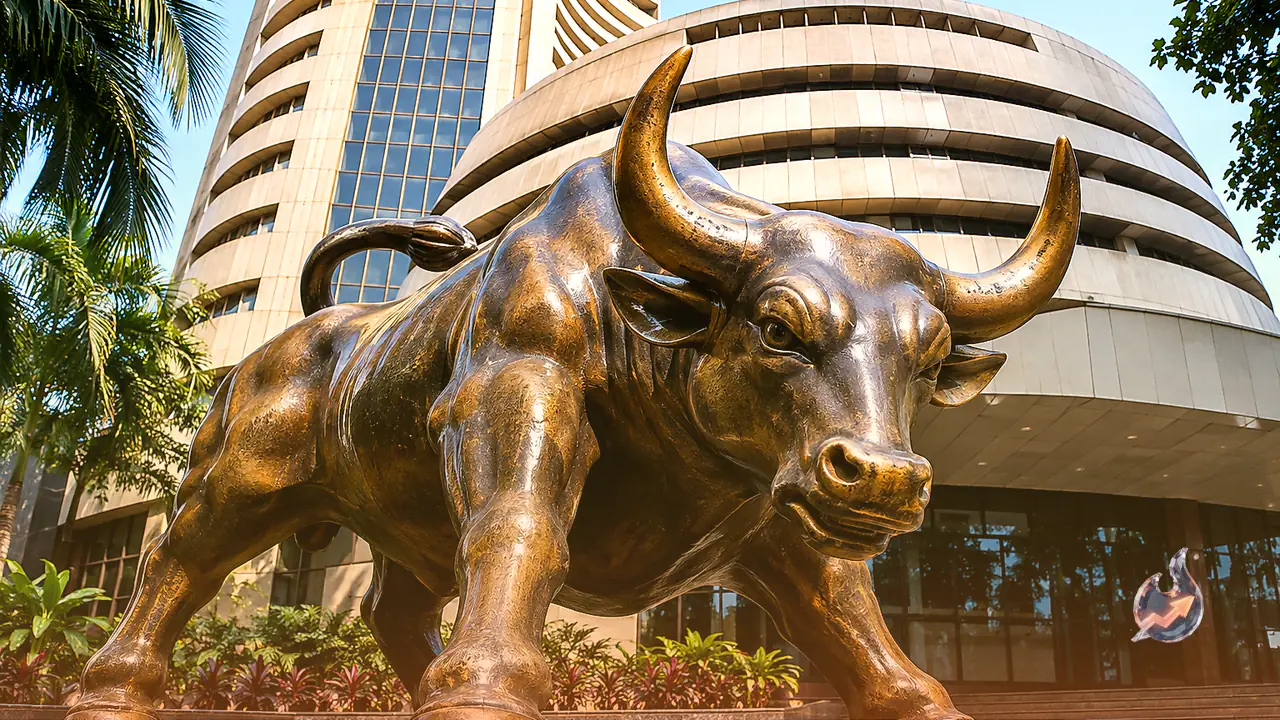





















Indian equity markets experienced an energetic turnaround in November, breaking out of an extended consolidation phase as benchmark indices Sensex and Nifty climbed between 4% and 6% in the run-up to Diwali. This rapid advance propelled the key benchmark to its highest level in nearly eight months, resetting sentiment across Dalal Street. The primary driver behind the renewed risk appetite has been an aggressive comeback by overseas investors, whose sustained buying has reversed months of cautious sentiment. Acknowledging this shifting dynamic, prominent international investment banks including HSBC and Citi have upgraded their outlook on Indian equities, citing structural domestic strengths, improving corporate earnings, and favorable global capital rotations.
Nifty Surpasses Key Milestones to Touch Eight-Month Peak
With domestic markets remaining closed on November 10, 2026, the Nifty 50 stood at 25,044.65 points, marking its strongest closing level in roughly eight months. The index had not traded above the psychologically important 25,000 mark since late February. A powerful short-term burst pushed the index higher by 1,100.30 points, or 4.60%, across just five consecutive trading sessions, significantly improving its short-term and medium-term performance metrics.
Over the span of the trailing month, the 50-stock index has registered an impressive gain of 2,681.30 points, translating to an 11.99% surge. On a six-month horizon, the benchmark has accumulated 1,228.80 points, or a 5.16% return. Despite this remarkable recovery, the year-to-date trajectory for 2026 still sits in negative territory, showing a net decline of 1,101.90 points, or 4.21%. Nevertheless, market observers note that the ferocity of the current upward momentum significantly enhances the likelihood of the Nifty finishing 2026 in positive territory.
Foreign Institutional Investors Mount a Record Comeback
A transformative factor behind the current rally has been the swift return of foreign institutional investors (FIIs) to domestic equities. Beginning October 31, foreign funds transitioned into decisive net buyers, deploying an enormous Rs 53,171.99 crore into Indian shares during the opening trading week of November alone. The buying momentum carried into the subsequent Monday, which recorded fresh net purchases amounting to Rs 7,212.22 crore.
Data compiled by the Stock Edge tracker revealed that overseas investors executed their highest single-day equity acquisitions in years on November 5 and November 6, deploying Rs 14,974.68 crore and Rs 13,749.82 crore, respectively. The heavy influx of institutional capital directly coincided with the onset of the Diwali festival period, delivering critical liquidity to the secondary market and establishing a firm floor beneath key benchmark counters.
Jefferies Identifies Key Beneficiaries of Liquidity Surge
Analyzing this remarkable reversal in overseas fund movements, global brokerage Jefferies noted that persistent selling had finally given way to positive foreign portfolio investor (FPI) flows, recording 8.2 billion dollars in net inflows since the middle of October. Jefferies pointed out that several structural factors could sustain this momentum, including a potential unwinding of crowded global artificial intelligence trades, expectations around equity tax rationalization, robust domestic macroeconomic conditions, reasonable valuations in large-cap equities, and relatively light positioning among institutional managers.
Jefferies highlighted that foreign portfolio investors had been consistent net sellers of Indian equities starting in September 2024, driving cumulative net outflows of 61 billion dollars. Furthermore, the first ten months of calendar year 2026 saw massive capital flight totaling 31 billion dollars. The current trend marks a sharp pivot from that protracted selling cycle, with 8.2 billion dollars in net FPI buying since mid-October, of which 5.8 billion dollars arrived in just six trading sessions in November 2026. Applying three specialized institutional ownership screens, Jefferies flagged several blue-chip names as prime potential beneficiaries of ongoing foreign inflows. The list includes Reliance Industries, HDFC Bank, Axis Bank, Kotak Mahindra Bank, UltraTech Cement, Max Healthcare, Varun Beverages, JSW Energy, DLF, Indian Hotels Company Limited, and Sona BLW.
Citi Sets 28,000 Target for 2027 on Soft Crude and Earnings
Analysts at Citi pointed out that steady corporate earnings, weakening international crude oil prices, and a more measured global pace of corporate artificial intelligence capital expenditures are converging favorably for the Indian economy. As institutional investors diversify out of overconcentrated technology trades, India stands to capture a significant allocation of reallocated global capital. Consequently, Citi raised its Nifty target to 28,000 points by the end of 2027, indicating an upside potential of approximately 12% from previous market close levels.
Citi calculated that every 10 dollar decline in crude oil prices can narrow India's current account deficit by 30 to 40 basis points and temper domestic inflation by roughly 50 basis points. Such macro relief is also estimated to improve Nifty earnings per share by approximately 2%. Furthermore, Citi projected that if active emerging-market fund managers increase their allocation to India by just 100 basis points, the equity market could absorb up to 12 billion dollars in fresh foreign inflows. The raised index target reflects the combined impact of softer energy prices, resilient corporate profitability, and favorable asset allocation shifts.
HSBC Upgrades Indian Equities to Overweight
In parallel, HSBC expressed confidence that India will benefit substantially as global market participants seek diversification away from heavily concentrated AI investments. According to HSBC, the Indian market offers exceptional liquidity depth, an economy oriented around robust domestic consumption, and an exceptionally resilient macroeconomic environment. The brokerage emphasized that steady corporate earnings growth, rapid expansion in commercial bank credit, and targeted administrative policy measures continue to shield the Indian rupee.
These supportive conditions prompted HSBC to officially upgrade Indian equities to an Overweight stance, even though it refrained from specifying an explicit index numeric target. HSBC maintains an optimistic perspective on banking institutions, industrial conglomerates, consumer discretionary companies, real estate developers, and healthcare operators. Additionally, it identified promising structural opportunities in capital goods, cement manufacturers, commercial port operators, and electronics manufacturing services. Within consumer-focused segments, the brokerage expressed an explicit preference for retail operators and automobile manufacturers over traditional fast-moving consumer staples.