





















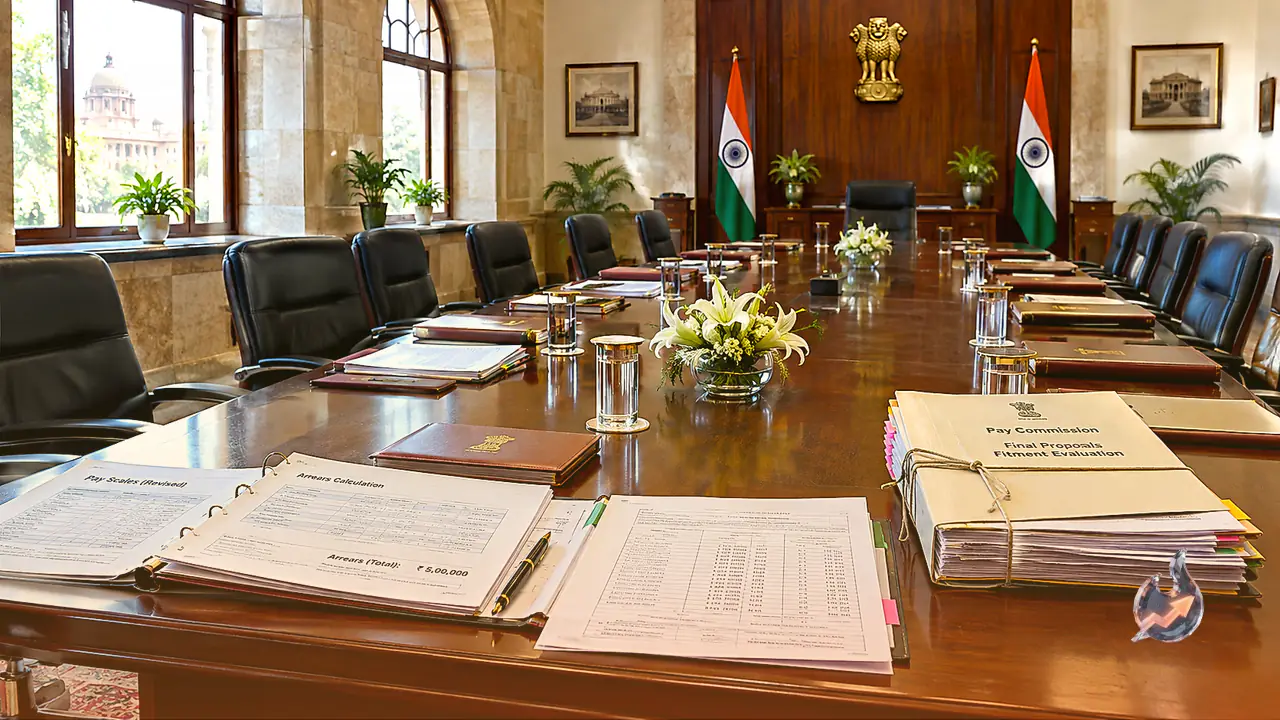

Anticipation is steadily building across government departments as the timeline narrows for the recommendations of the next central pay revision. The 8th Central Pay Commission, chaired by Justice Ranjana Prakash Desai, has completed 12 months of its mandate, leaving six months before the committee is scheduled to submit its final proposals. Operating under an 18-month timeline laid out in its terms of reference, the panel is reviewing the compensation structure that will determine the financial trajectory of roughly 1.17 crore central government employees and pensioners. With the previous 7th Pay Commission cycle concluding at the close of 2025, employees expect an effective rollout starting from January 1, 2026, which would generate substantial lump-sum arrear payments.
The Critical Role of the Fitment Factor
The core determinant of the ultimate salary revision is the fitment factor, a multiplier used to convert existing basic pay and pension figures into the new scale. Deliberations have triggered a broad range of projections from staff associations, financial analysts, and official bodies. While certain conservative voices project modest multipliers close to 1.90, some employee federations have placed much bolder requests on the negotiating table.
The key fitment factor figures under evaluation across various forums include
- 1.92 Fitment Factor: A conservative calculation put forward by fiscal analysts.
- 2.00 to 2.10 Fitment Factor: A cautious baseline projection suggested in expert reviews.
- 2.28 Fitment Factor: A moderate estimate reflecting intermediate salary growth.
- 2.57 Fitment Factor: The multiplier adopted under the 7th Pay Commission, serving as the benchmark standard.
- 2.86 Fitment Factor: An elevated scale proposed in preliminary policy assessments.
- 3.00 to 3.25 Fitment Factor: The baseline demand raised by several staff organisations.
- 3.61 Fitment Factor: A consolidated proposal submitted by representative staff unions.
- 3.833 Fitment Factor: The formal resolution presented by the NC-JCM and associated federations.
- 4.00 Fitment Factor: An upper-boundary formal demand submitted by BPMS.
Examining the Math Behind a 2.57 Multiplier
To evaluate potential earnings, adopting the 7th Pay Commission baseline multiplier of 2.57 provides a clear mathematical illustration. Under this scenario, a Level 7 employee drawing a current basic pay of Rs 44,900 would see their monthly basic salary rise to Rs 1,15,393. The arithmetic difference between the revised basic pay and the existing basic pay sits at Rs 70,493.
Calculating retrospective arrears requires integrating the prevailing dearness allowance (DA) rates across the retroactive period. In this projection, assuming an effective start date of January 1, 2026, the DA rate is factored at 60 percent for the first six months, followed by an increase to 63 percent for the second half of the year from July to December 2026.
Biannual Arrear Distribution for Level 7
For the January to June 2026 period, the existing monthly payout under a 60 percent DA rate equates to Rs 71,840, combining the Rs 44,900 basic salary and Rs 26,940 DA component. Comparing this with the revised basic salary of Rs 1,15,393 results in a monthly difference of Rs 43,553. Aggregating this difference over six months creates an arrear total of Rs 2,61,318 for the first half of the year.
For the July to December 2026 timeframe, with DA escalating to 63 percent, the existing monthly compensation rises to Rs 73,187, comprising the basic pay of Rs 44,900 alongside Rs 28,287 in DA. Measuring this against the revised basic salary of Rs 1,15,393 leaves an adjusted monthly difference of Rs 42,206. Over the second six-month stretch, this amounts to Rs 2,53,236. Combining both periods yields a cumulative 12-month arrear total of Rs 5,14,554 for a Level 7 personnel.
Projected Salary and Arrear Scale Across Pay Levels 1 to 18
Extending this identical calculation model to all grade bands demonstrates the scale of potential lump-sum arrears and base pay revisions under a 2.57 multiplier
- Level 1: Existing basic pay of Rs 18,000 increases to Rs 46,260. First-half arrears stand at Rs 1,04,760, second-half arrears at Rs 1,01,520, reaching a total 12-month arrear figure of Rs 2,06,280.
- Level 2: Basic pay moves from Rs 19,900 to Rs 51,143. Arrears of Rs 1,15,818 and Rs 1,12,236 yield a 12-month total of Rs 2,28,054.
- Level 3: Basic pay increases from Rs 21,700 to Rs 55,769. Arrears over the two halves equal Rs 1,26,294 and Rs 1,22,388, creating a total of Rs 2,48,682.
- Level 4: Basic pay moves from Rs 25,500 to Rs 65,535. The combined 12-month arrear equals Rs 2,92,230, comprising Rs 1,48,410 and Rs 1,43,820.
- Level 5: Monthly basic scales up from Rs 29,200 to Rs 75,044. Arrears reach Rs 1,69,944 for January to June and Rs 1,64,688 for July to December, totalling Rs 3,34,632.
- Level 6: Basic pay rises from Rs 35,400 to Rs 90,978. The full 12-month arrears total Rs 4,05,684, split into Rs 2,06,028 and Rs 1,99,656.
- Level 7: Base salary advances from Rs 44,900 to Rs 1,15,393, delivering a full-year arrear calculation of Rs 5,14,554.
- Level 8: Basic pay moves from Rs 47,600 to Rs 1,22,332, resulting in total arrears of Rs 5,45,496, comprising Rs 2,77,032 and Rs 2,68,464.
- Level 9: Base compensation expands from Rs 53,100 to Rs 1,36,467. Arrear figures of Rs 3,09,042 and Rs 2,99,484 yield an aggregate of Rs 6,08,526.
- Level 10: Base salary shifts from Rs 56,100 to Rs 1,44,177. The 12-month arrears reach Rs 6,42,906, split into Rs 3,26,502 and Rs 3,16,404.
- Level 11: Basic pay rises from Rs 67,700 to Rs 1,73,989, resulting in 12-month arrears of Rs 7,75,842.
- Level 12: Pay scales increase from Rs 78,800 to Rs 2,02,516, generating cumulative arrears of Rs 9,03,048.
- Level 13: Current basic of Rs 1,23,100 elevates to Rs 3,16,367, yielding total arrears of Rs 14,10,726.
- Level 13A: Basic pay scales up from Rs 1,31,100 to Rs 3,36,927, creating total arrears of Rs 15,02,406.
- Level 14: Existing salary of Rs 1,44,200 moves to Rs 3,70,594, resulting in Rs 16,52,532 in full-year arrears.
- Level 15: Base pay rises from Rs 1,82,200 to Rs 4,68,254, producing retrospective arrears of Rs 20,88,012.
- Level 16: Basic pay elevates from Rs 2,05,400 to Rs 5,27,878, bringing 12-month arrears to Rs 23,53,884.
- Level 17: Compensation shifts from Rs 2,25,000 to Rs 5,78,250, resulting in arrears of Rs 25,78,500.
- Level 18: At the highest administrative tier, basic pay moves from Rs 2,50,000 to Rs 6,42,500, yielding cumulative arrears of Rs 28,65,000.
Procedural Milestones and Implementation Schedule
The preparatory framework began with the initial announcement of the 8th Pay Commission in January 2025. Following this, the terms of reference received approval on October 28, 2025, and the commission was formally constituted on November 3, 2025. Under the allocated 18-month duration, the commission is slated to finalize its recommendations around May 3, 2027.
While January 1, 2026, represents the expected effective date following the completion of the 7th Pay Commission cycle, government evaluation will occur once the formal report is submitted. The final financial parameters, including allowances, fitment factor adoption, and payout dates, will ultimately be decided following official review by the central administration.