





















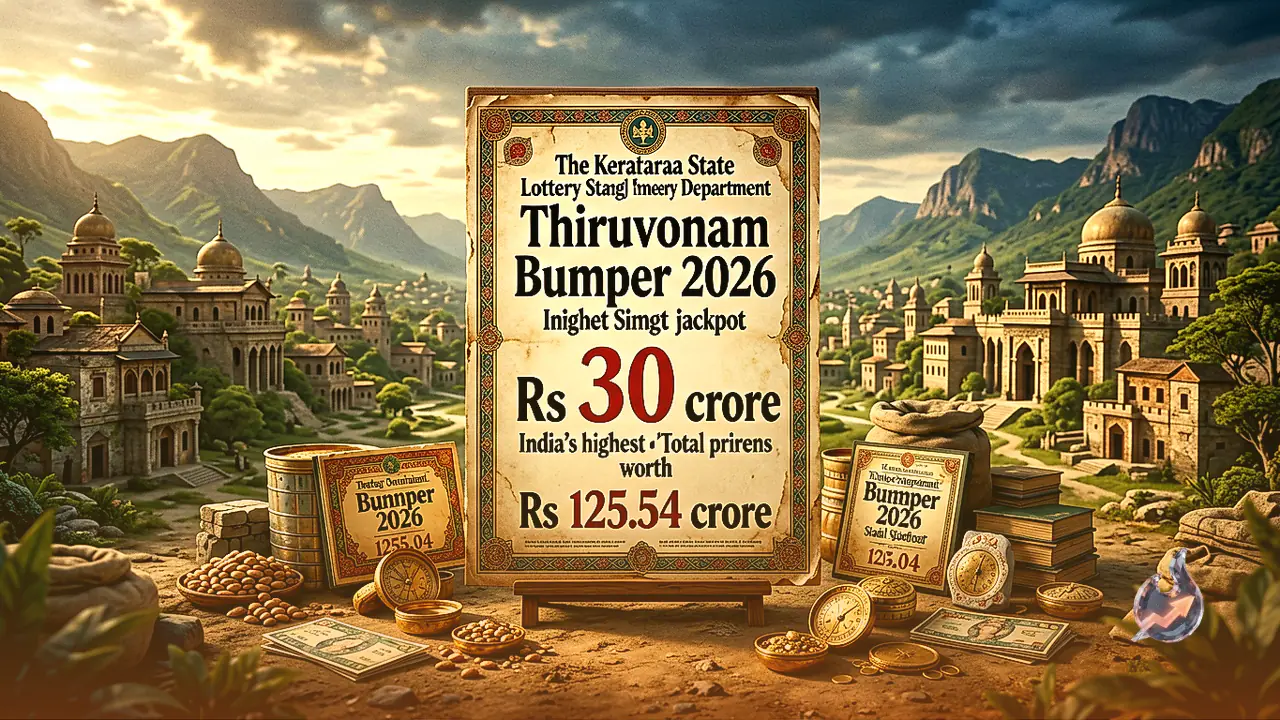

The Kerala State Lottery Department has officially launched its flagship annual lottery event, the Thiruvonam Bumper 2026, setting a historical benchmark with a grand first prize of Rs 30 crore. This payout represents the largest single-ticket jackpot ever presented by any government-run state lottery across India. Updated from the previous year's jackpot of Rs 25 crore, the enhanced jackpot structure reflects growing demand and high ticket turnover during the festive Onam season. For lottery enthusiasts and prospective buyers nationwide, the release of this bumper scheme brings immense excitement, along with important details regarding ticket prices, tier breakdown, taxation rules, and prudential financial management after winning.
Ticket Costs, Print Run, and Venue Details for the Grand Draw
Participation in the Thiruvonam Bumper 2026 requires purchasing a ticket priced at Rs 500. This retail price comprises a base cost of Rs 357.14 combined with a 40% Goods and Services Tax (GST) component. The lottery tickets are made available across ten designated series to facilitate nationwide distribution and streamlined tracking by the state authorities.
To meet expected public demand, the lottery department has allocated an initial batch of approximately 90 lakh tickets for distribution across authorized counters. Authorities have confirmed that additional quantities may be printed if market demand exceeds initial expectations leading up to the draw date. The final grand draw ceremony is scheduled to take place on September 26, 2026, at Gorky Bhavan in Thiruvananthapuram, which serves as the traditional venue for major Kerala state lottery draws.
Complete Breakdown of Prize Tiers and Agent Commissions
Beyond the headline-grabbing top prize, the Thiruvonam Bumper 2026 features a comprehensive multi-tier prize pool designed to reward thousands of ticket holders. The cumulative prize money allocated across all winning categories stands at an impressive Rs 125.54 crore.
The distribution of major prizes across the different tiers is organized as follows
- First Prize: A single winner will claim the jackpot of Rs 30 crore.
- Second Prize: Rs 1 crore each will be awarded to 20 lucky winners across different series.
- Third Prize: Rs 25 lakh each will be disbursed to 20 winners.
- Fourth Prize: Multiple winners will receive Rs 5 lakh each.
- Fifth Prize: Winners will be awarded Rs 2 lakh each.
- Consolation Prize: Tickets matching the first prize number in remaining series will win Rs 5 lakh each.
- Lower Tier Prizes: Sixth prize winners receive Rs 5,000; Seventh prize holders get Rs 2,000; Eighth prize winners claim Rs 1,000; and Ninth prize winners earn Rs 500.
In addition to player payouts, the state lottery framework includes substantial incentives for registered vendors. The lottery agent who sells the winning first-prize ticket will receive a dedicated commission payout of Rs 3 crore, encouraging widespread ticket distribution throughout the state network.
Evaluating the Real Statistical Odds of Winning
While the prospect of winning Rs 30 crore draws millions of buyers, financial analysts and statisticians emphasize understanding the mathematical realities involved. With an initial print of 90 lakh tickets circulating across the market, the probability of holding the single jackpot-winning ticket stands at approximately 1 in 90 lakh. Should the lottery department issue supplemental ticket batches to meet high demand, these odds become even longer.
To put this numerical probability into perspective, statisticians note that 1 in 90 lakh represents a far smaller chance than an individual's lifetime likelihood of being struck by lightning. Buyers are advised to view ticket purchases purely as casual entertainment rather than a viable financial investment or income strategy.
Taxation Regulations Under Section 194B and Net Payout Breakdown
Windfall winnings from lotteries in India are governed by strict taxation statutes under Section 194B of the Income Tax Act. Under these legal provisions, lottery prizes are subject to a flat tax rate of 30%, accompanied by applicable educational and health cesses. Crucially, lottery income does not qualify for any basic exemption limit or standard deduction thresholds, meaning tax applies to the entire prize sum from the very first rupee.
For the Rs 30 crore first prize winner, Tax Deducted at Source (TDS) is automatically withheld by government authorities prior to disbursing the net payout. Consequently, the jackpot winner receives approximately 70% of the gross prize money, net of mandatory tax and cess deductions. Winning participants must account for these immediate deductions when planning their financial affairs.
Essential Financial Advice for Managing a Massive Windfall
Receiving an extraordinary financial windfall often presents sudden psychological and managerial challenges. Wealth advisors strongly counsel jackpot winners to pause before making large purchases or committing to hasty investments. Recommended financial steps include
- Initial Parking Phase: Immediately deposit the net prize payout into a secure bank fixed deposit (FD) or liquid mutual fund for three to six months. This cooling-off window helps avoid emotional decisions driven by sudden wealth.
- Debt Clearance: Pay off existing high-interest personal loans, credit card balances, or mortgages as an immediate high-value priority.
- Conservative Asset Allocation: Distribute capital across low-risk instruments such as government bonds, fixed deposits, equity mutual funds, and long-term retirement accounts like PPF or EPF.
- Real Estate Considerations: Consider prudent investments in residential or commercial property after evaluating long-term maintenance costs and land titles.
- Risk Protection and Estate Planning: Secure comprehensive health and life insurance policies while structuring family trusts or estate plans to protect capital for future generations.