
















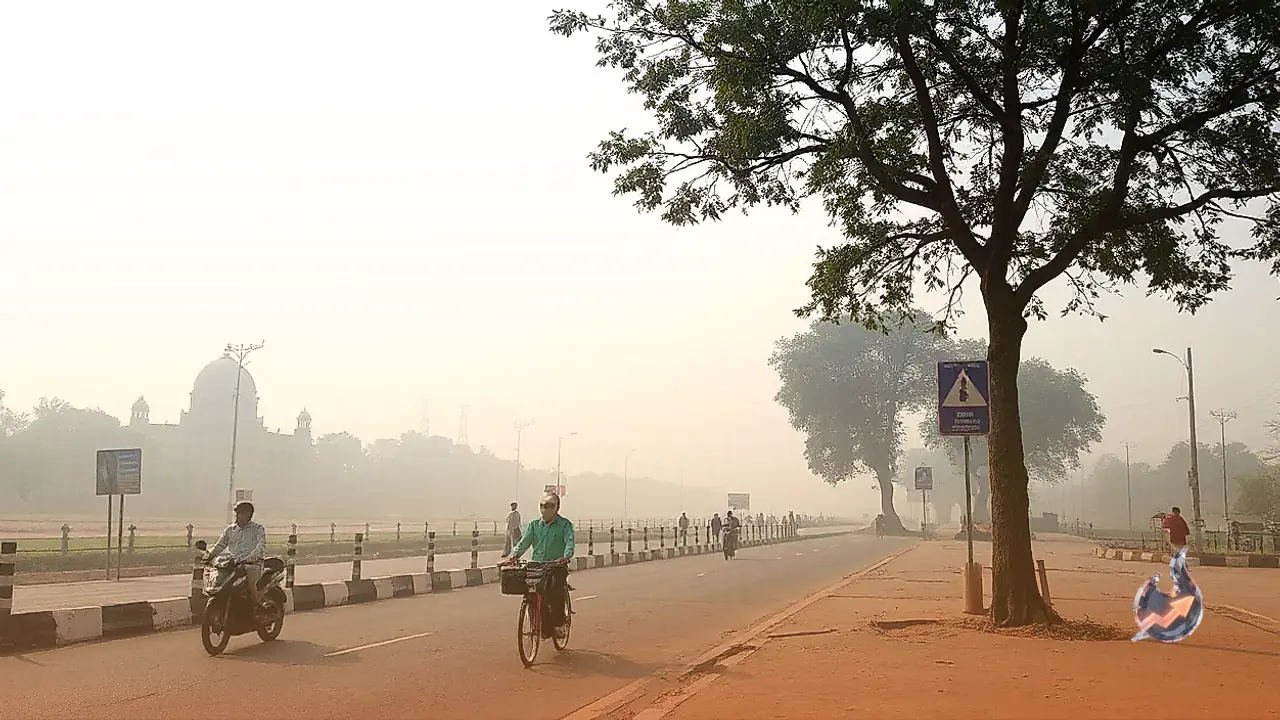

Air quality across the national capital remained in the poor category for the third consecutive day on Saturday, reflecting post-festival pollution spikes and unfavourable weather. Official data recorded an overall Air Quality Index (AQI) of 180 for Delhi. The combination of festive smoke from Dussehra celebrations and calm atmospheric conditions has caused a steady build-up of airborne pollutants across Delhi and the wider National Capital Region. In response to the worsening atmospheric conditions, administrative agencies have intensified field enforcement to check local emissions.
Pollution Readings Spike Across Monitoring Stations
While the overall city index stayed at 180, several monitoring stations reported significantly higher levels of pollutants. In several outer and dense localities, the readings pushed past the 250 threshold into deeper poor territory. According to the monitoring data, Jahangirpuri logged an AQI of 270, closely followed by Mundka at 264. Vivek Vihar recorded an index of 261, while the station at Alipur stood at 254.
Elevated levels were also detected across residential and institutional hubs across the capital. Punjabi Bagh logged an AQI of 247, RK Puram touched 240, IIT Delhi recorded 221, and Burari Crossing reached 217. In central and southern locations, Chandni Chowk stood at 211, Pusa and Siri Fort each recorded 209, and Dwarka Sector-8 posted an index of 206. This followed an even sharper deterioration on Friday, when three stations breached the very poor mark. On Friday, Punjabi Bagh recorded an AQI of 302, Pusa touched 319, and RK Puram hit 307. Out of the 56 operational monitoring stations reporting data on Friday, 36 recorded air in the poor category, while the rest remained in the moderate band.
Targeted Action Plans Ordered for Identified Hotspots
Reviewing the situation, Delhi Environment Minister Manjinder Singh Sirsa directed officials to isolate the city's worst pollution hotspots and draft targeted action plans for each of them. During a review meeting, the minister instructed departments to conduct a deep analysis of station-wise AQI data to determine the primary local causes behind elevated readings in specific neighbourhoods. Agencies will be assigned explicit accountability, along with binding timelines to implement corrective measures.
The review pinpointed key localized drivers behind the pollution spikes, including unpaved road dust, traffic bottlenecks, construction and demolition work, unauthorized street parking, and open trash burning. Administrative departments are now tasked with formulating area-specific field measures addressing these precise triggers to prevent localised accumulation of particulate matter.
GRAP Stage 1 Enforcement and Emission Sources
Earlier in the week, as pollution metrics worsened, the Commission for Air Quality Management implemented Stage 1 of the Graded Response Action Plan (GRAP) across Delhi and NCR. Under this framework, authorities are focusing on mechanized road sweeping, water sprinkling, strict adherence to construction and demolition guidelines, improved municipal waste collection, and intensified curbs on vehicular emissions.
Official records on Delhi's emission profile indicate that vehicular traffic forms the largest single contributor among listed sources, making up 20.3 percent of total emissions. Residential activities account for 5.2 percent, industrial manufacturing contributes 4.2 percent, and construction sites generate 2.6 percent. Meanwhile, the power and energy sector is responsible for 2 percent, refuse burning makes up 1.8 percent, unpaved road dust accounts for 1.4 percent, and miscellaneous sources make up the remaining 1.3 percent. With winter setting in, administrative efforts remain tightly focused on the rigorous ground enforcement of GRAP measures to prevent further air degradation.