


















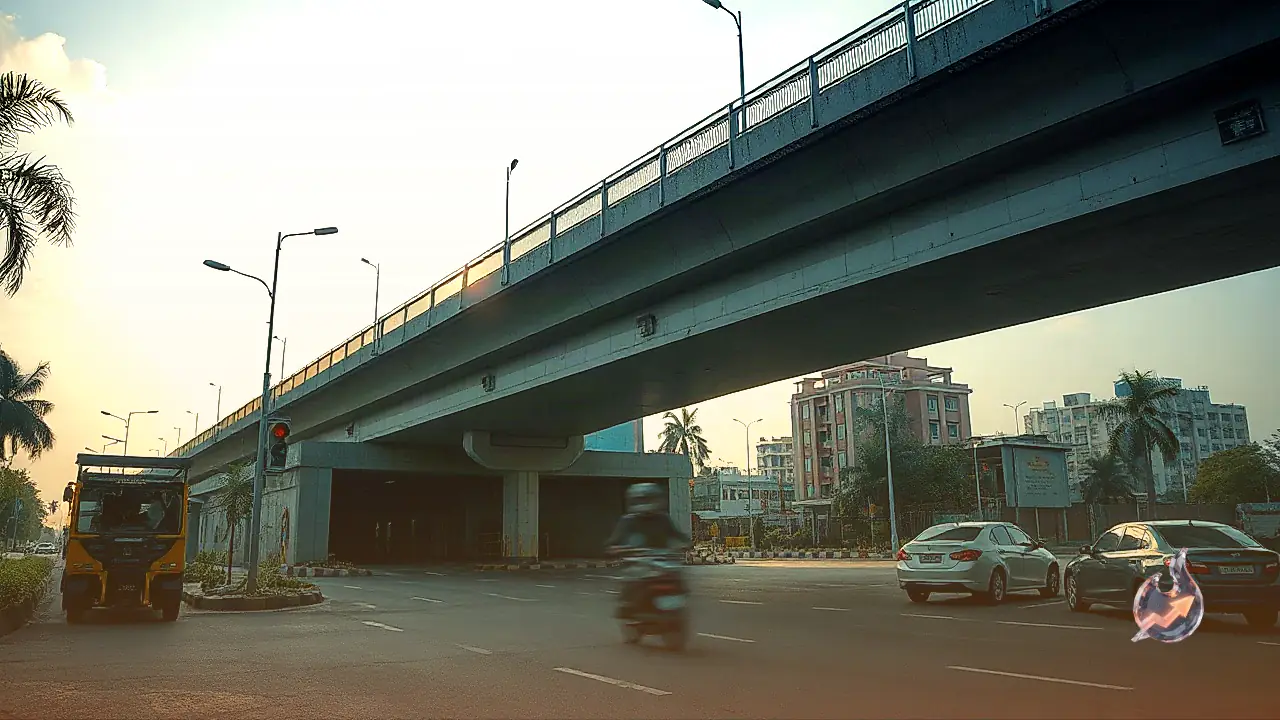

Commuters navigating the busy transit corridor between Delhi and Noida may soon experience significant relief from endless traffic delays. The Delhi government is actively assessing a proposal to construct a 500-meter underpass at the Crown Plaza traffic signal near Mayur Vihar Phase-1. If approved and implemented, this major infrastructure project aims to resolve one of the most frustrating bottlenecks on the Delhi-Uttar Pradesh border, benefiting hundreds of thousands of daily drivers who currently face severe congestion during peak morning and evening hours.
Chronic Congestion at Crown Plaza Signal Demands Infrastructure Solution
The Crown Plaza intersection in Mayur Vihar Phase-1 has long been identified as a critical traffic choke point along the Delhi-Uttar Pradesh border road. During peak commuting hours, thousands of vehicles become trapped in creeping queues at the signalized junction. The traffic crisis worsens considerably during the monsoon season, when rainwater accumulation and reduced speeds transform the daily commute into a grueling ordeal. The main cause of this continuous gridlock is the simultaneous convergence of several heavy vehicular streams. Traffic coming off the Delhi Noida Direct (DND) Flyway meets vehicles moving toward Chilla and Trilokpuri, alongside substantial internal movement from Mayur Vihar residential neighborhoods. This heavy concentration makes it extremely difficult for pedestrians to cross safely, while creating long vehicular tailbacks that spill over onto connecting arterial roads.
Design Blueprint: Grade-Separated Underpass and Surface Rotary
The proposed design focuses on separating long-distance transit traffic from local neighborhood vehicular movements. Under the plan being evaluated, a 500-meter grade-separated underpass will allow vehicles traveling from the DND Flyway toward Chilla and Trilokpuri to bypass the Crown Plaza signal completely. Long-distance commuters who merely need to cross the intersection without turning can travel directly through the subterranean channel, eliminating signal delays entirely. Meanwhile, the surface-level road will remain dedicated to local motorists and vehicles making turning movements into nearby residential and commercial pockets. To further streamline surface vehicular movement, authorities are considering constructing a circular traffic rotary on the surface road to ensure smooth, continuous traffic management without signal interruptions.
Feasibility Studies and Underground Infrastructure Mapping
Although the project holds strong potential for congestion relief, official approvals remain contingent on detailed technical evaluations. A government official clarified that while the project is under serious consideration, a final construction directive has not yet been issued. The Public Works Department (PWD) is currently leading a comprehensive feasibility assessment to determine the alignment of the 500-meter underpass, design entry and exit points, and plan how surface traffic will be re-routed during and after construction. A key phase of this feasibility exercise involves mapping underground public utilities. Engineering teams must conduct detailed surveys to identify water pipelines, high-voltage electrical cables, gas pipelines, and underground telecommunication networks passing through the intersection. Any conflicting utility lines will need to be carefully shifted or protected prior to excavation. Additionally, environmental surveys will map trees in the project area, with engineers tasked with designing entry ramps to preserve as much greenery as possible.
Combined Impact with Barapullah Phase-3 Corridor Expansion
The proposed underpass is part of a broader infrastructure transformation underway in the Mayur Vihar zone. Regional connectivity is set to receive a major boost with the upcoming launch of the Barapullah Phase-3 elevated corridor. Spanning 3.5 kilometers, this elevated signal-free highway will directly link Mayur Vihar Phase-1 with Sarai Kale Khan and the All India Institute of Medical Sciences (AIIMS) in South Delhi. Expected to open for traffic next month, the Barapullah Phase-3 corridor will absorb a substantial volume of inter-city traffic moving toward South and Central Delhi. Civil engineers anticipate that once both the Barapullah Phase-3 corridor and the proposed Crown Plaza underpass become fully operational, the cumulative effect will permanently eliminate chronic border delays, establishing a smooth vehicular flow across East Delhi and Noida.