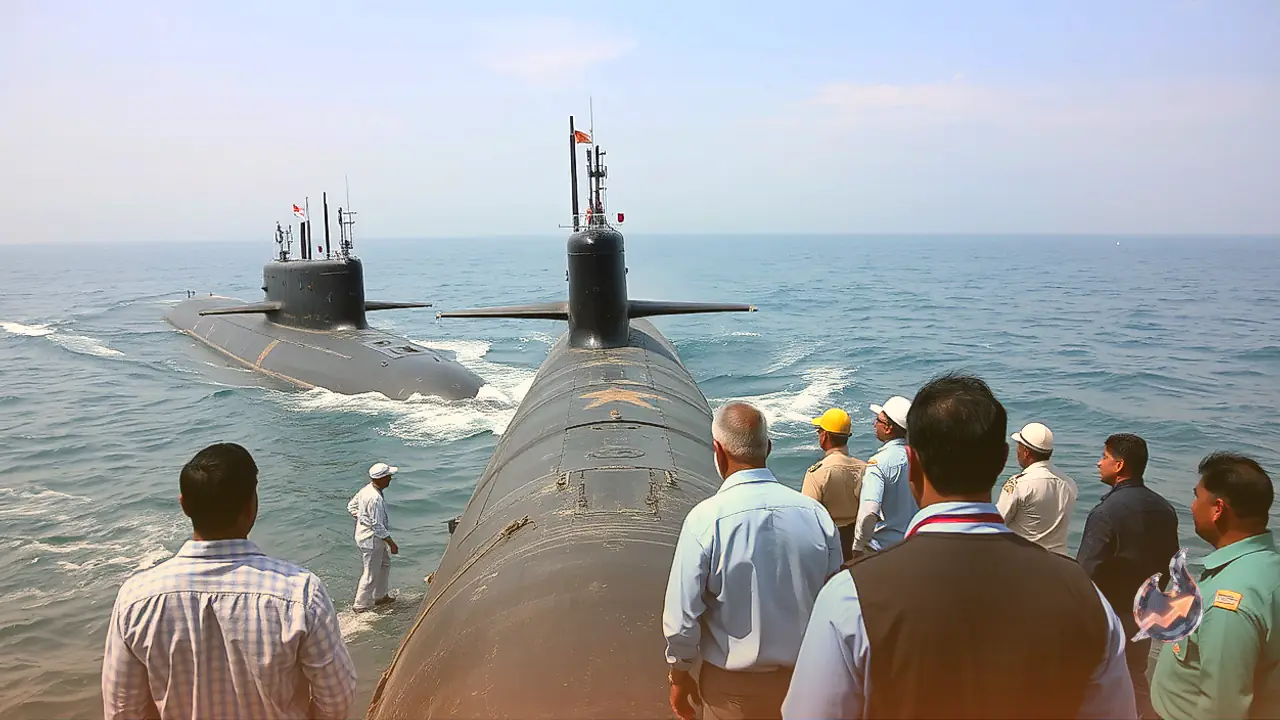

A critical operational dilemma is quietly unfolding beneath the surface of the Indian Ocean as the Indian Navy grapples with an aging submarine fleet against rapidly expanding maritime responsibilities. While regional waters demand heightened subsurface patrol cycles and continuous deterrent deployments, the force levels of operational vessels have steadily eroded. Long-term vessel construction and expansion initiatives have slipped significantly past their original timelines. Under an ambitious 30-year construction roadmap formulated back in 1998, the service was envisioned to operate a core strength of 24 modern conventional submarines by the year 2030, a benchmark that now appears increasingly out of reach. With four Sindhughosh class boats already decommissioned and only six Kalvari class units inducted in their place, prolonged delays in prospective deliveries risk creating an alarming void in subsurface warfare readiness.
Subsurface dominance remains the cornerstone of modern sea control and sea denial strategies. History and contemporary naval operations consistently show that silent, submerged vessels possess asymmetric lethal potential capable of nullifying vast surface battle groups. When legacy vessels retire faster than replacement platforms can be built and commissioned, the resulting operational gap cannot be closed overnight through emergency acquisitions. If contractual timelines for next-generation platforms continue to witness friction, this capability shortfall will directly challenge naval operational postures in critical maritime choke points.
Decommissioning Pressures and the Stalled 2030 Goal
At present, the Indian Navy deploys a force of 16 conventional diesel-electric submarines spread across three distinct design lines: the Scorpene-based Kalvari class, the Russian-built Sindhughosh class, and the German-origin Shishumar class. Supplementing these conventional assets are three strategic nuclear ballistic missile submarines. The institutional framework guiding force modernization stems from 1998, when Vice Admiral AK Chatterjee formulated a comprehensive 30-year indigenous and collaborative submarine acquisition plan. The objective was to cultivate robust domestic manufacturing competencies alongside targeted foreign technology transfers to guarantee an inventory of 24 modern conventional hulls by 2030.
Execution across subsequent decades has unfortunately deviated far from that projection. The Sindhughosh class has already seen four of its boats phased out of active operational duty, including the lead vessel of the class, INS Sindhughosh. Conversely, the newer induction pipeline has managed to deliver only six Kalvari class Scorpene submarines into service so far. While the Shishumar class vessels have undergone structured mid-life upgrades to prolong their operational life and modernize onboard combat systems, their average hull age has now crossed roughly 35 years. Multiple aging platforms are scheduled for mandatory phase-out over the coming years, creating an urgent operational requirement to induct fresh hulls before existing squadron numbers decline further.
Strategic Nuclear Platforms Bolster Undersea Deterrence
Amid setbacks and pacing challenges within the conventional diesel-electric inventory, the national strategic nuclear submarine program has progressed at a considerably steadier tempo. The induction of INS Aridhaman, the third nuclear-powered ballistic missile submarine within the Arihant class, has substantially reinforced the sea leg of the national strategic nuclear triad. This robust second-strike survivability works in tandem with land-based ballistic launchers and air force strike platforms to present a complete, round-the-clock deterrent posture.
INS Aridhaman is equipped to carry eight K-4 nuclear-capable ballistic missiles, with each missile possessing an operational strike range of approximately 3500 kilometers. Adding to this undersea deterrent pipeline, the fourth ballistic missile submarine of the class has already been launched at the shipbuilding center in Visakhapatnam, while advanced conceptual design and engineering are underway for a substantially larger successor platform designated as the S-5 class. Within any strategic triad, nuclear-propelled submarines represent the most elusive element because they can remain submerged at extreme depths for months at a time without breaking surface. Even if terrestrial command nodes or air bases were to suffer preemptive strikes, submerged ballistic missile submarines guarantee uninhibited retaliatory capability.
The Critical Role of Air Independent Propulsion
The operational value of underwater warfare extends far beyond nuclear deterrence into the realm of tactical conventional operations. The recent destruction of the Iranian warship IRIS Dena, which was tracked and sunk near the coast of Sri Lanka by an American submarine, illustrated how vulnerable high-profile surface combatants remain against an unseen underwater stalker. The surface vessel had no prior tactical awareness of the subsurface threat stalking its path, confirming once again that acoustic stealth underwater surpasses sheer surface presence.
For modern diesel-electric boats, Air Independent Propulsion, commonly known as AIP, serves as the defining survival and combat technology. An operational AIP plug allows a conventional boat to remain continuously submerged for two to three weeks without having to breach the waterline. By contrast, conventional boats lacking AIP must routinely operate near the surface in a snorkeling profile to run diesel generators and recharge their storage battery banks. Snorkeling severely degrades a vessel's tactical stealth, exposing mast signatures and acoustic noise to enemy maritime patrol aircraft, radar networks, and surface task forces. Currently, the Indian Navy is working on an integration schedule to retrofit an indigenous AIP system developed by DRDO onto its six Kalvari class hulls.
Project 75I Valuation and Extended Delivery Schedules
The largest pending capital acquisition aimed at rebuilding force levels is Project 75I, an expansive defense tender valued at approximately 70000 crore rupees. This mega-program seeks to procure between six and nine advanced conventional submarines configured with proven AIP solutions. Crucially, the collaborative bid pairing Indian defense shipyard Mazagon Dock Shipbuilders with German manufacturer TKMS has crossed the rigorous technical evaluation benchmark set by naval authorities.
Commercial and technical negotiators are now advancing toward finalizing financial parameters for the acquisition of Type-214 submarines equipped with fuel-cell AIP systems. However, industrial execution cycles mean that actual inductees will not arrive immediately following price discovery. Standard shipbuilding lead times dictate that the first submarine will be delivered roughly seven years after final contract execution. Concurrently, efforts to expand domestic production of associated submarine ordnance are advancing, highlighted by Hyderabad-based firm VEM Technologies entering an industrial partnership with TKMS to manufacture heavy torpedoes within India.
Project 76 and Project 77 Lay the Foundation for Future Autonomy
Looking further into future operational horizons, the Navy has outlined the conceptual foundation for Project 76. This initiative will serve as a fully indigenous conventional submarine design incorporating a modified, next-generation AIP system developed by DRDO. Operating alongside this conventional path, the Navy is pursuing nuclear attack capabilities through Project 77, focused on building domestic nuclear-powered attack submarines, often categorized as SSNs.
The Cabinet Committee on Security has already accorded formal clearance for the construction of two such nuclear attack submarines under a capital allocation of 35000 crore rupees. Lead vessel completion under this program is currently projected around 2036-37. To preserve operational institutional competencies and maintain subsurface patrol coverage during the intervening construction decade, the Navy is also actively exploring the lease of a nuclear attack submarine from Russia. Through this comprehensive mix of indigenous design pipelines and targeted transitional arrangements, the Navy ultimately aims to induct at least 22 Made in India submarines to secure enduring maritime superiority.