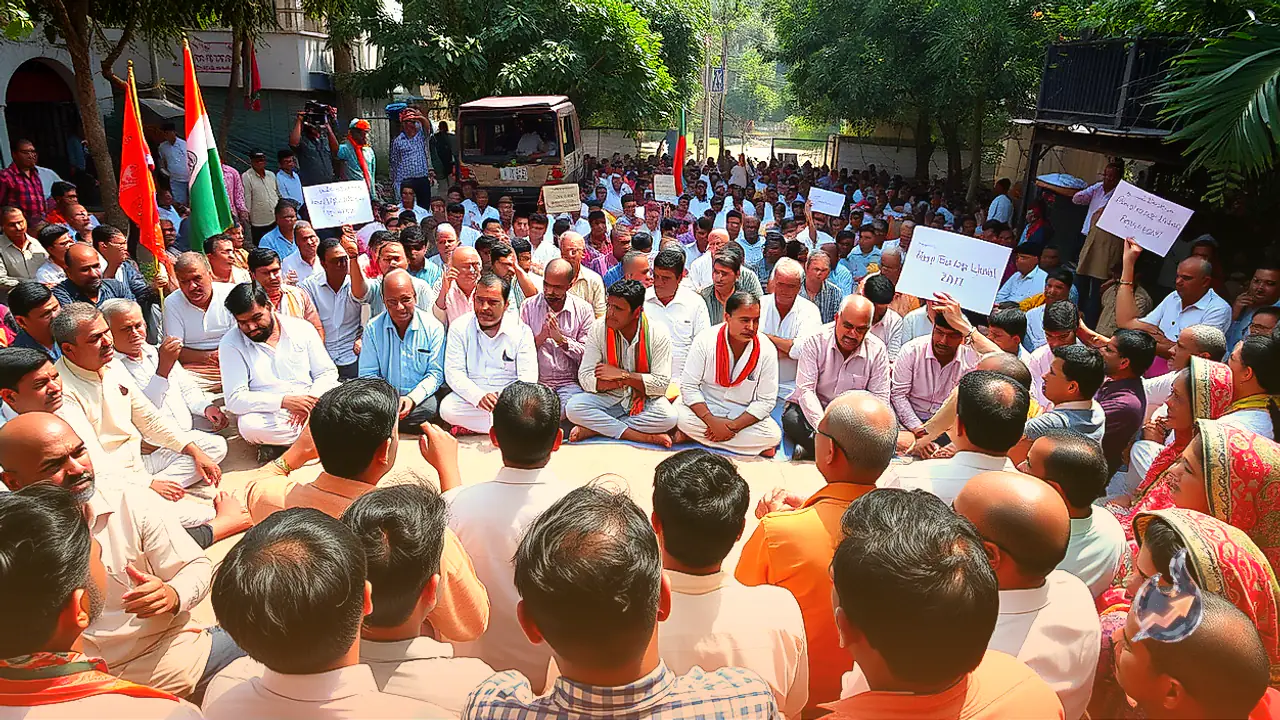


















A critical gathering of the opposition INDIA bloc in the national capital saw prominent leaders deliberate on future political actions, though key regional allies chose to attend remotely. Former Maharashtra Chief Minister Uddhav Thackeray and former Uttar Pradesh Chief Minister Akhilesh Yadav did not mark their physical presence at the venue, choosing instead to log in virtually. In contrast, former West Bengal Chief Minister Mamata Banerjee arrived in Delhi well on time, accompanied by her nephew and Member of Parliament Abhishek Banerjee. The primary agenda on the table was formulating a coordinated resistance against the Election Commission of India over its Special Voter Revision (SIR) initiative and challenging the Chief Election Commissioner. The parties finalized dates and plans for a series of protest rallies slated for October and November. Alongside the official agenda, discussions quietly moved toward building an unhesitating consensus around Rahul Gandhi as the alliance's prime ministerial candidate.
While several partner parties have rarely opposed Rahul Gandhi taking center stage, Trinamool Congress supremo Mamata Banerjee had consistently expressed reservations about this proposition in the past. Her relationship with both Rahul Gandhi and the Congress party has historically remained strained. However, the latest meeting marked a dramatic departure from her earlier stance. Mamata Banerjee emerged as the most vocal supporter of Rahul Gandhi stepping into the leadership role. During the proceedings, she openly acknowledged her political vulnerabilities, urging fellow opposition constituents to rally together in support of her party. Her willingness to back Rahul Gandhi without conditions reflects the severe constraints she now faces rather than a simple ideological embrace.
Mounting Pressure In West Bengal Following Electoral Loss
The political ground beneath Mamata Banerjee has shifted drastically following the installation of the first-ever Bharatiya Janata Party government in West Bengal. The regional administration has placed severe pressure on her remaining cadre, leaving her and her surviving circle in conditions akin to virtual house arrest. It was against this backdrop of institutional and local pressure that she readily agreed to keep Rahul Gandhi at the helm of the national coalition. Observers view this rapid realignment not as a spontaneous surge of camaraderie, but as a survival tactic driven by mounting difficulties at home.
Historically, Mamata Banerjee has maintained a deeply adversarial posture toward the Congress party, despite having launched her own political career within its ranks decades ago. Severe fallouts with central leadership eventually led her to break away and form the Trinamool Congress. From her perspective, the Congress was treated with the same political distance and hostility as the Left Front. Following her exit from the Congress fold, she spent a period aligned with the BJP-led National Democratic Alliance (NDA). Although she subsequently forged a brief seat-sharing arrangement with the Congress for a state assembly election, the alliance quickly collapsed ahead of the next electoral contest. Her longstanding rivalry with the Left parties, whom she eventually ousted from power, remained equally uncompromising.
The Systematic Weakening Of The Bengal Congress Unit
The 2021 West Bengal assembly election underscored Mamata Banerjee's refusal to accommodate the Congress. Despite nationwide rhetoric regarding a consolidated anti-BJP front, Trinamool Congress flatly turned down an alliance in the state. The electoral result was devastating for the Congress, reducing its legislative footprint in the state assembly to zero. While the party later secured a solitary seat in a subsequent assembly by-election with the backing of Left parties, Mamata Banerjee soon engineered that lawmaker's defection into her own party. Because the lone legislator represented the entirety of the party's strength, anti-defection provisions presented no technical barrier. A similar dynamic unfolded during the 2024 Lok Sabha elections; even as negotiations progressed under the INDIA bloc umbrella, she allocated no parliamentary seats to the Congress in West Bengal, leaving its state leadership entirely sidelined.
Failed Ambitions Of Leading A Non-Congress National Front
After clinching a third consecutive term in the 2021 assembly contest despite an intense campaign by the BJP, Mamata Banerjee grew confident that a similar strategy could dislodge the ruling party at the Centre. Many regional heavyweights began viewing her as a formidable counterweight to the national ruling party. Encouraged by this perception, she championed the concept of an alternative opposition alliance that would exclude the Congress entirely. She embarked on interstate political outreach, traveling to Maharashtra to consult with senior leaders such as Uddhav Thackeray and Sharad Pawar. She also maintained close communication with Samajwadi Party leader Akhilesh Yadav, who met with her repeatedly during visits to Bengal.
These maneuvers briefly fueled her ambitions to position herself as a premier contender for the prime ministership on the national stage. That plan hit an insurmountable roadblock when Sharad Pawar publicly asserted that any credible opposition unity without the Congress was entirely unfeasible.
Shifting Fortunes And The Realities Of Power Transition
Following the defeat of the opposition in the 2024 Lok Sabha elections, Mamata Banerjee directly challenged Rahul Gandhi's leadership capability and offered to lead the INDIA bloc herself. At that stage, her ambition received notable backing from Samajwadi Party chief Akhilesh Yadav, Rashtriya Janata Dal national president Lalu Prasad Yadav, and several other coalition participants. While this response bolstered her standing, the Congress central leadership deliberately remained quiet, allowing evolving ground realities to play out.
Subsequent electoral victories for the Congress in Karnataka, Himachal Pradesh, and Telangana signaled a revival of the grand old party's organizational strength. Nationally, the extensive outreach marches led by Rahul Gandhi began to show tangible dividends. The impact became evident in the 2024 parliamentary results, where the BJP was brought down from its previous tally of 303 seats to 240 seats.
Since losing the state government, Mamata Banerjee's political influence and bargaining leverage have eroded considerably. Roughly 60 of her 80 MLAs and 20 of her 29 MPs have abandoned her ranks. Across West Bengal, she faces growing local discontent, encountering active protests wherever she travels. While she contends that these demonstrations are orchestrated by the ruling BJP administration, observers note that state transitions in Bengal have historically unleashed intense political retribution against outgoing regimes. When Mamata Banerjee previously unseated the Left Front, its cadres faced comparable disruptions, leaving resentments that linger to this day. Those enduring grievances continue to make local Left leaders wary of broader national compacts with former adversaries. Now confined by a dwindling legislative base, Mamata Banerjee appears to have accepted Rahul Gandhi's authority as an unavoidable necessity.