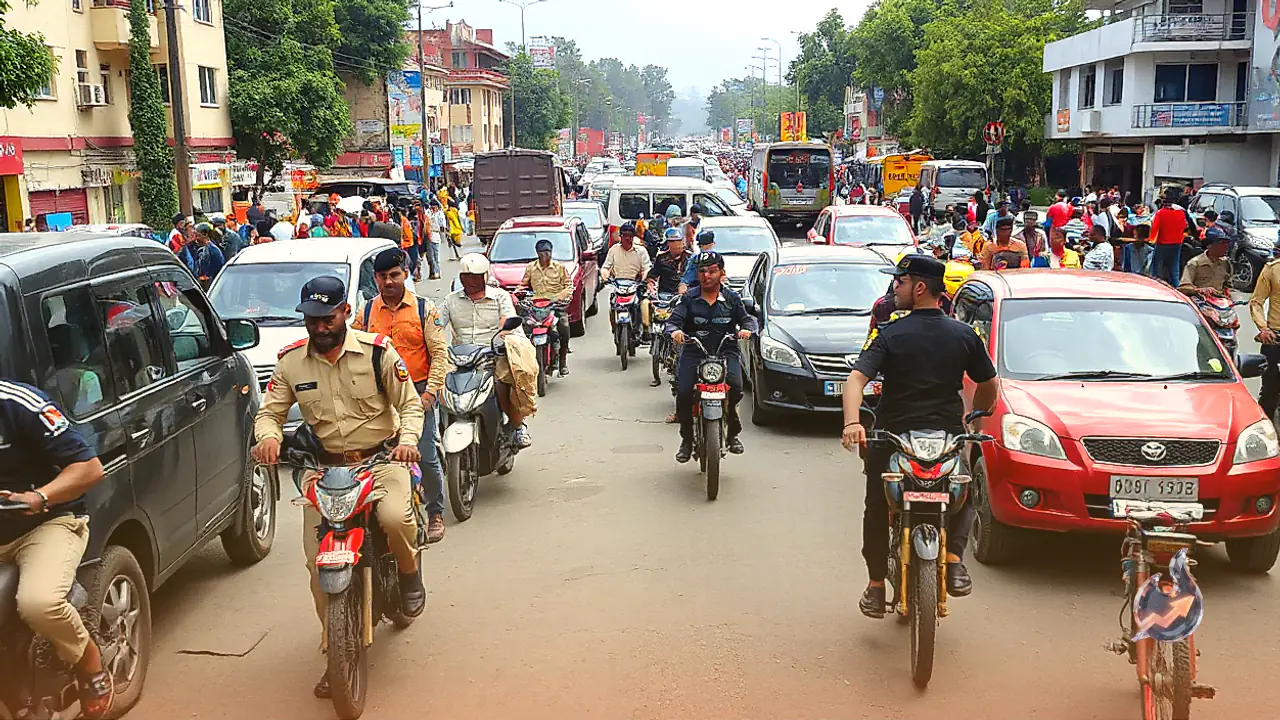



















Air quality across the National Capital Region has deteriorated to alarming levels as seasonal weather patterns set in, prompting authorities to bring specialized emergency measures into play. On Saturday, air monitors in Noida registered an overall index mark of 303, falling squarely into the very poor bracket. Microscopic particle concentrations climbed significantly during this period, with PM 2.5 measured at 222 micrograms per cubic metre and PM 10 reaching 269 micrograms per cubic metre. Faced with deteriorating conditions, administrative agencies have urged citizens to curb vehicular emissions and cooperate with state measures while early mitigation rules remain active.
The Emergency Blueprint for Regional Air Quality
Originally notified in 2017 by the Ministry of Environment, Forest and Climate Change, the Graded Response Action Plan serves as a structured protocol to counter severe atmospheric pollution across Delhi and surrounding districts. The framework operates on an escalation model where anti-pollution measures intensify in direct proportion to the worsening air quality numbers. Instead of uniform seasonal bans, it applies calibrated restrictions designed to suppress emission sources before airborne pollutants trap the region in persistent haze.
Enforcement responsibilities currently rest with the Commission for Air Quality Management. The commission tracks atmospheric shifts and pollution statistics by relying on predictive modelling and observational records provided by the India Meteorological Department alongside the Indian Institute of Tropical Meteorology. Whenever index benchmarks cross specific thresholds or scientific agencies project an impending spike in toxicity over consecutive days, the commission orders the immediate invocation of the corresponding stage.
Initial Restrictions Under the First Tier
The anti-pollution operational system is arranged into four sequential stages matching pollutant concentrations. The opening tier takes effect as soon as the index hovers between 201 and 300, a span defined as poor air quality. Work sites handling excavation, demolition, and building activity are placed under rigorous dust-suppression mandates. Open burning of domestic refuse and leaves is strictly outlawed, while transport of uncovered loose building material faces stiff checks.
Municipal crews step up mechanical sweeping and deployment of water tankers along high-traffic corridors to keep road dust settled. Enforcement squads tighten inspections against end-of-life motor vehicles, specifically diesel cars older than 10 years and petrol units past 15 years of age. Commuters are actively encouraged to step away from private car usage in favor of mass transit options. Emphasizing public responsibility, Delhi Environment Minister Manjinder Singh Sirsa appealed to drivers on Friday to keep polluting vehicles off the road while the first stage remains in place.
Escalating Curbs Under the Second Tier
When the pollution index climbs into the 301 to 400 zone, classified as very poor, the second stage is activated with harsher industrial and urban rules. A primary mandate at this level is the shutdown of diesel generator sets across residential and commercial establishments, preserving exemptions only for healthcare units and critical public utilities. Commercial eateries, roadside dhabas, and hotels are prohibited from firing up open coal or wood tandoors, choking off localized sources of black smoke.
To discourage personal driving, civic parking authorities hike vehicle parking rates across urban lots. Concurrently, regional authorities ramp up service frequencies across the Delhi Metro and operational fleets of electric and compressed natural gas buses. This schedule expansion aims to absorb extra passenger volumes and persuade office-goers to leave their four-wheelers parked at home.
Third Tier Crackdown on Vehicles and Construction
A transition into the 401 to 450 range brings the severe classification and triggers the third stage of emergency intervention. At this point, normal construction and demolition work is halted across the board. The ban spares only non-polluting activities tied directly to healthcare infrastructure, strategic projects, and national security installations, leaving ordinary private and commercial building projects frozen.
Stringent transport barriers are simultaneously erected on the roads of Delhi and neighboring districts. Passenger vehicles running on older emission standards, specifically BS-III petrol and BS-IV diesel four-wheelers, are barred from operating. Furthermore, educational authorities intervene to protect younger age groups by ordering the physical closure of primary schools, shielding small children from heavy particulate intake.
The Emergency Protocol of the Final Tier
Readings breaching the 450 threshold usher in the fourth and most drastic stage, known as the severe-plus or emergency classification. During this phase, regional borders are closed to heavy commercial transport entering the capital, allowing passage solely to trucks hauling essential provisions or running on clean energy alternatives.
Educational shutdowns broaden to encompass older school grades and university colleges, requiring institutions to shift completely to remote digital instruction. Administrative directives may mandate that government offices and private corporate facilities send at least 50 percent of their workforce home under remote working setups. If meteorological factors prevent dispersal of the atmospheric blanket, governments hold the authority to enforce odd-even vehicular rationing to slash road traffic in half.
Health Hazards Posed by Particulate Matter
Crossing the 201 index line marks an immediate public health hazard, creating respiratory irritation for healthy individuals and causing acute distress for people battling pulmonary and cardiovascular illnesses. As the metric rises beyond 301, the region shifts into a state of public health crisis. The primary danger stems from PM 2.5 particles, which measure under 2.5 micrometres in diameter. These tiny particulates bypass the body's natural respiratory defenses, settling deep inside lung tissue and crossing directly into the bloodstream. Evaluating the current atmospheric deterioration, Delhi minister Sirsa remarked, "The situation is not good."