



















Massive infrastructure initiatives are transforming connectivity across the country, with bridges, flyovers, and elevated corridors being constructed in urban and suburban pockets. Engineering is meant to deliver speed, safety, and everyday convenience to commuters. When execution falters or planning prioritizes compromises over safety standards, critical public works turn into textbooks of faulty design. Issues ranging from sudden lane drops and acute turning angles to aviation clearance violations have drawn sharp public scrutiny. Alongside recurring concerns over bridge collapses in Bihar, several major urban structures illustrate the costly consequences of flawed structural planning.
Barapullah Phase 3 in Delhi: Six Lanes funneled abruptly into Three
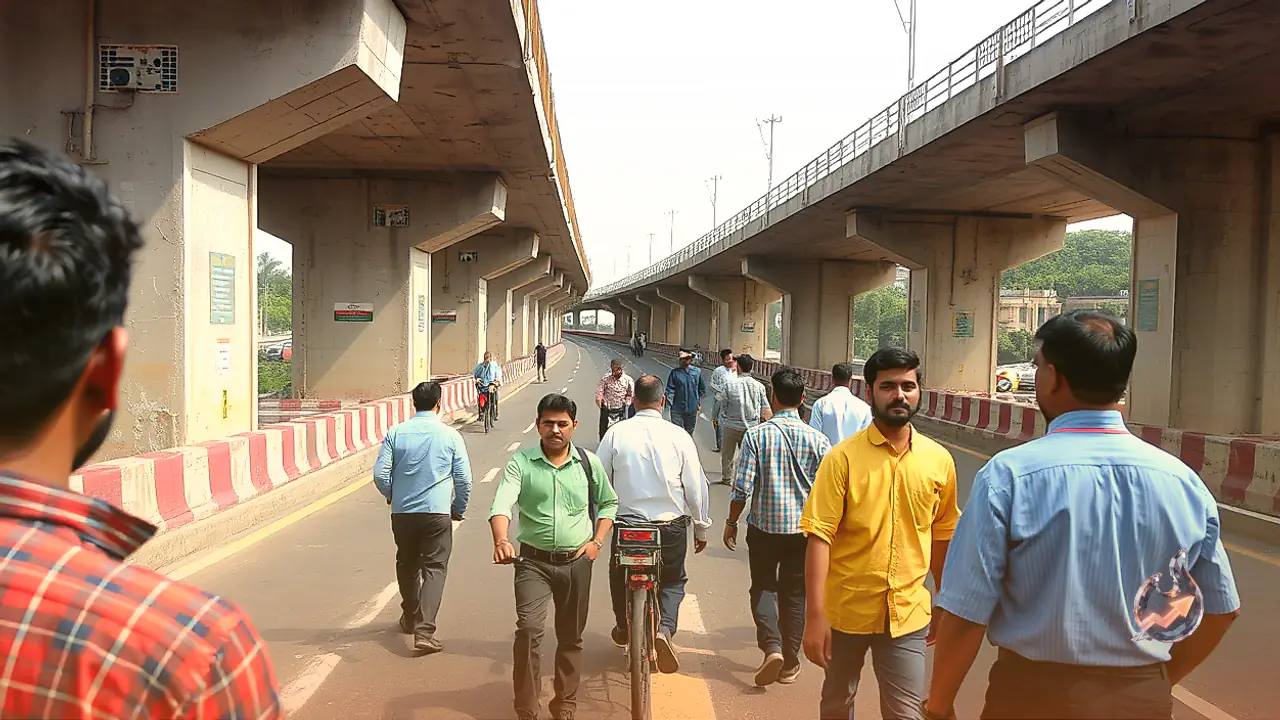
Designed to alleviate chronic traffic bottlenecks across the capital, Phase 3 of Delhi's Barapullah elevated corridor carried high expectations for motorists. Once operational phases advanced, a glaring geometric bottleneck came to light. Two separate three-lane carriageways merge directly into a single three-lane road. This means that a six-lane volume of moving vehicles is forced abruptly into a space meant for half that capacity.
The merge point near Sun Dial Park converges at an approximate 90-degree angle. A drone survey conducted by the traffic police flagged this layout as a major engineering defect. Forcing high-speed traffic through a sudden perpendicular merge reduces vehicle clearance, creates chronic tailbacks, and substantially elevates collision risks during peak hours.
Bhopal's Aishbagh Rail Overbridge: An 18-Crore Rupee Spend with an Acute Right Angle
In the capital city of Madhya Pradesh, an 18-crore rupee railway overbridge was built near the Aishbagh area to bridge urban transit divides. The project quickly became notorious for its extreme 90-degree turn situated midway through the structure. Authorities initially approved the unusual alignment citing severe space limitations and land constraints at the site.
As visuals of the bridge circulated widely, the peculiar design faced intense public criticism, prompting the state administration to suspend eight engineers tied to the project. Navigating this perpendicular corner requires drivers to decelerate drastically. Any misjudgment or standard cruising speed at such a sharp turn poses a significant threat of vehicles skidding or crashing into barriers.
Indore's Z-Shaped Bridge: Navigating Consecutive Perpendicular Turns
Madhya Pradesh hosts yet another controversial bridge layout, located in the commercial hub of Indore. Engineered in a distinctive Z-shape, this bridge departs entirely from typical straight or gently curved roadway designs. The structure incorporates two consecutive sharp 90-degree bends along its span. Much like the structure in Bhopal, spatial limitations around the corridor were cited as the primary driver behind this unconventional geometry.
Placing two back-to-back right-angle corners on an elevated bridge presents serious operational challenges for drivers. Under heavy traffic conditions or during night commutes, navigating rapid successive sharp bends heightens the probability of accidents, undermining the fundamental purpose of rapid grade-separated transit.
Mira Bhayander Flyover: A Dangerous Halving of Lane Width
Near Mumbai, a newly opened flyover in the Mira Bhayander locality has generated controversy over its abrupt lane reduction. The bridge carries four full lanes of traffic before suddenly shrinking down to two lanes. The Mumbai Metropolitan Region Development Authority, known as MMRDA, defended the layout by describing it as part of a phased future transit plan.
Critics point out that slashing roadway width by half midway along a high-speed flyover creates severe conflict zones for motorists. As vehicles across four lanes compete to merge into just two lanes, drivers are forced to cut across traffic. This abrupt bottleneck not only chokes transit flow and triggers congestion but also spikes the likelihood of sideswipe collisions.
Mumbai Airport Metro Viaduct: Structural Clearance exceeds Aviation Norms
A fifth prominent instance of questionable planning concerns a metro rail viaduct built near Mumbai Airport. Any elevated structure erected within airport funnel and approach zones must adhere strictly to established civil aviation safety thresholds. Structural evaluations revealed that the elevation of a metro viaduct segment near Mumbai Airport surpassed mandatory aviation safety limits.
This development immediately triggered questions regarding the rigor of pre-construction surveys and clearance checks within regulated airport boundaries. If the concerned aviation authorities refuse to grant height exemptions, officials may be forced to dismantle and rebuild a section stretching approximately one kilometer. Such remedial demolition would cause substantial project delays and impose a heavy financial burden on the public exchequer.