


















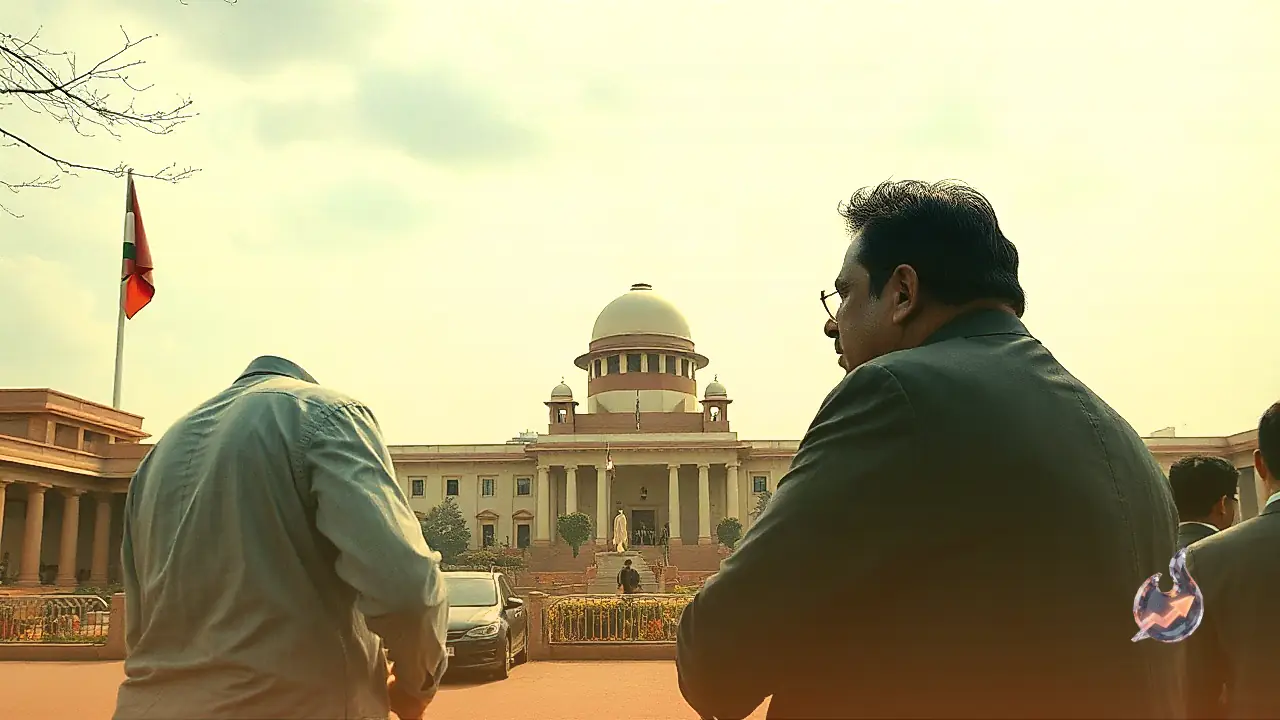

A high-voltage exchange unfolded inside the Supreme Court on Tuesday, 22 September 2026, during the hearing of a petition concerning the national song Vande Mataram. The courtroom witnessed sharp arguments between the central government's senior law officer and counsel representing the petitioner before a three-judge bench headed by Chief Justice of India Justice Surya Kant. Solicitor General Tushar Mehta appeared for the Union government, while Senior Advocate Dr S Muralidhar, former Chief Justice of the Orissa High Court, represented petitioner TM Krishna. The confrontation escalated rapidly when Mehta invoked the term Naxalite while addressing the legislative process, triggering vehement objections from Muralidhar and prompting judicial intervention.
Challenge to the Prevention of Insults to National Honour Amendment
The litigation centers on the constitutional validity of the 2026 amendment introduced to the Prevention of Insults to National Honour Act. Carnatic vocalist TM Krishna filed the petition questioning the statutory changes before the top court. The three-judge bench hearing the matter comprised CJI Surya Kant, Justice Joymalya Bagchi, and Justice V Mohana. Leading the arguments for Krishna, Dr S Muralidhar submitted that the 2026 amendment penalised the act of preventing or disrupting the singing of the national song, yet failed to establish a clear statutory definition of what constitutes the national song itself.
Muralidhar argued before the judges that the executive cannot introduce substantive additions or punitive meanings into an enactment through administrative tools such as an office memorandum. He stressed that when statutory provisions carry serious penal consequences, including imprisonment, the underlying terms must be explicitly defined by the legislature itself rather than left to bureaucratic circulars or executive interpretations.
Dispute Over Court Notice and Legislative Authority
As arguments progressed, Solicitor General Tushar Mehta strongly urged the bench to refrain from issuing a formal notice on the petition. Mehta submitted that issuing an official judicial notice would generate unnecessary sensationalism around the sensitive subject. Responding to this contention, Muralidhar maintained that history does not bind constitutional adjudication, noting that legal frameworks and public opinions continually evolve over time. He emphasised that his query went to the fundamental core of the legislative and lawmaking process.
Mehta took strong exception to this position, countering that those who harboured objections had already voiced them inside Parliament, and were now seeking to litigate the settled matter before the judiciary. The Solicitor General remarked that the formulation of laws cannot be dictated according to the perspectives of Naxals, an assertion that immediately drew sharp resistance from the opposing counsel.
Objection to Terminology and Refusal to Apologise
Dr S Muralidhar registered a strong protest against the phrasing chosen by the government counsel. He asserted that he did not want such an expression, used by the Solicitor General of India, to find a place on the open court's official record. Muralidhar remarked that such terminology was unbefitting of a law officer of the state, adding that he had never heard a government counsel deploy such language during judicial proceedings. He subsequently called upon Mehta to issue an apology for using the term.
Mehta refused to tender any apology, stating firmly that he would not say sorry. As the confrontation intensified between the two senior legal figures, Justice Joymalya Bagchi had to step in to defuse the courtroom tension. Explaining his stance, Mehta clarified that he used the formulation because Muralidhar appeared to be questioning the institutional process of legislative decision-making established under the Constitution. Mehta reiterated that the authority to enact statutes lies strictly with Parliament.
Judicial Moderation and Ideological Context
Seeking to restore order in the courtroom, the bench led by CJI Surya Kant intervened and stated that the term Naxalite would not be taken on the court record. The Chief Justice clarified that the bench would strictly confine the scope of the hearing to legal and constitutional interpretation rather than peripheral controversies.
Even so, Mehta reaffirmed that the primary authority to make decisions rests with Parliament and asserted that his observations were focused purely on constitutional mechanics, reiterating his refusal to apologize. When Muralidhar pointed out that the Solicitor General was repeating the contested term, Mehta responded that he was not labeling any individual as a Naxal, but was speaking strictly in the context of an ideology and perspective regarding state institutions.