























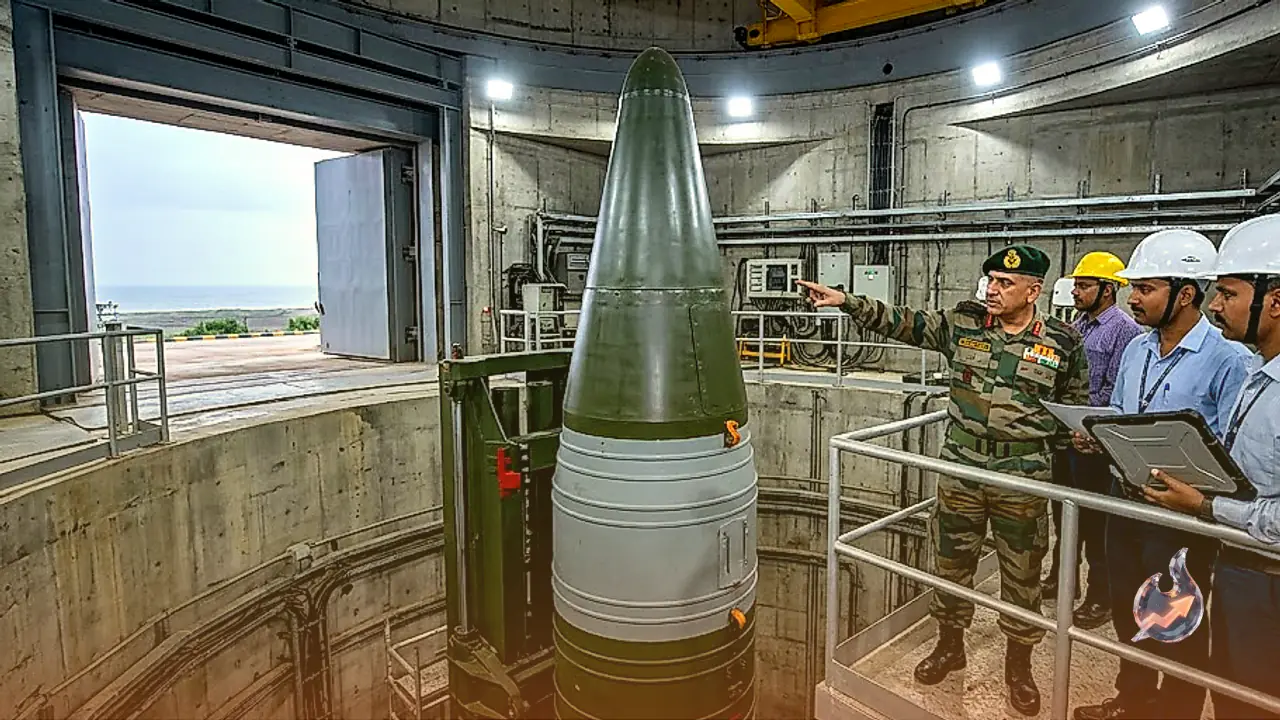

The narrative of India's defense research begins in 1983 when the nation's leadership entrusted the missile program to the renowned scientist Dr. A.P.J. Abdul Kalam under the Integrated Guided Missile Development Program. During that era, the unwritten global rule dictated that military might equaled political dominance. Advanced aerospace and missile technologies were neither sold for money nor shared out of diplomatic goodwill. To curb India's ambitions, the United States and Western nations enforced stringent controls through the Missile Technology Control Regime, with the explicit goal of preventing the country from developing long-range missile capabilities.
The Genesis of Agni-TD
Dr. Kalam and his dedicated team of scientists treated these restrictions as a monumental challenge. When the first Agni test was conducted in 1989, it was not a fully combat-ready weapon but a technology demonstrator designated as Agni-TD. Its primary objective was to verify whether India could engineer a rocket capable of surviving re-entry into Earth's atmosphere from space without burning up. This two-stage rocket utilized a solid fuel motor from the SLV-3 space launcher in its first stage and a liquid engine from the Prithvi missile in the second stage. When the missile successfully traveled one thousand kilometers to hit its target with precision, the global defense community took immediate notice.
Overcoming Sanctions Through Self-Reliance
Following the 1989 test, virtually all international doors were closed to India as embargoes choked the supply of hundreds of critical components, including computer chips, special maraging steel, ring laser gyroscopes, and carbon composites. However, scientists at the Defence Research and Development Organisation viewed these bans as an invitation to innovate. DRDO collaborated extensively with premier national universities, IITs, and private industrial firms. Maraging steel that was denied through imports was forged directly in domestic laboratories, while specialized carbon fibers were successfully manufactured locally after foreign suppliers refused export.
The Strategic Impact of Agni-1
During the 1999 Kargil conflict, the Indian military recognized an urgent operational requirement for a rapid-response missile capable of deterring regional adversaries. Within a remarkably short span of three years, Agni-1 was developed to fulfill this exact need, undergoing its maiden test on January 25, 2002. Standing approximately fifteen meters tall and weighing twelve tons, this single-stage solid-fueled missile was designed to strike targets between seven hundred and nine hundred kilometers away, with upgraded variants extending the range to twelve hundred kilometers. Capable of carrying a one-ton nuclear warhead, it was inducted into the Strategic Forces Command in 2007.
Expanding Reach with Agni-2
To address complex strategic challenges posed by multiple regional neighbors, India required a longer-range delivery system, prompting DRDO to initiate the Agni-2 project, which was successfully tested on April 11, 1999. Measuring twenty-one meters in length and weighing sixteen tons with a two-stage solid propellant configuration, this missile can transport a one-ton payload up to twenty-five hundred kilometers. Equipped with a specialized carbon-carbon composite heat shield capable of enduring temperatures exceeding three thousand degrees Celsius during atmospheric re-entry, it entered military service in 2004 to cover critical military installations across neighboring territories.
Agni-3 and Penetration Aids
To project heavy nuclear payloads deep into strategic continental zones, India developed Agni-3, completing its comprehensive test on July 9, 2006. This two-stage solid-fueled missile stands seventeen meters tall, measures approximately two meters in diameter, and weighs roughly fifty tons. It can deliver a warhead weighing between two thousand and twenty-five hundred kilograms over a distance of thirty-five hundred to five thousand kilometers with pinpoint accuracy. The missile incorporates advanced ring laser gyroscope navigation alongside penetration aids and dummy decoys designed to confuse enemy defense systems.
Advanced Capabilities of Agni-4 and Agni-5
Agni-4 marked a major technological milestone by shifting from heavy metallic structures to lightweight composite materials. Tested on November 15, 2011, the twenty-meter missile weighed only seventeen tons and could deliver a one-ton payload across four thousand kilometers, securing formal military induction in 2015. Subsequently, the three-stage solid-fueled Agni-5 was successfully tested on April 19, 2012, boasting a range exceeding five thousand kilometers while carrying a 1.5-ton nuclear warhead. Its defining feature is the canister launch system, allowing road-mobile deployment and rapid retaliatory strikes across vast geographic spans.
The Next-Generation Agni-Prime
On June 28, 2021, India flight-tested Agni-Prime, a modern, next-generation system intended to replace older variants like Agni-1 and Agni-2. Featuring an operational range between one thousand and two thousand kilometers, a composite airframe, and cannisterized launch architecture, this system is fifty percent lighter than its predecessors, significantly boosting the nation's readiness against potential security threats.