






















Inside Shatrujeet Brigade Airborne Drills: How Mi-17 Helicopters Drop Troops Behind Enemy LinesIndia
25 Aug 2026, 6:09 pm (1 hour ago)· 2

Inside Shatrujeet Brigade Airborne Drills: How Mi-17 Helicopters Drop Troops Behind Enemy Lines

The Indian Army's Shatrujeet Brigade demonstrated advanced heliborne assault capabilities and aerial vehicle transport during a major military exercise.

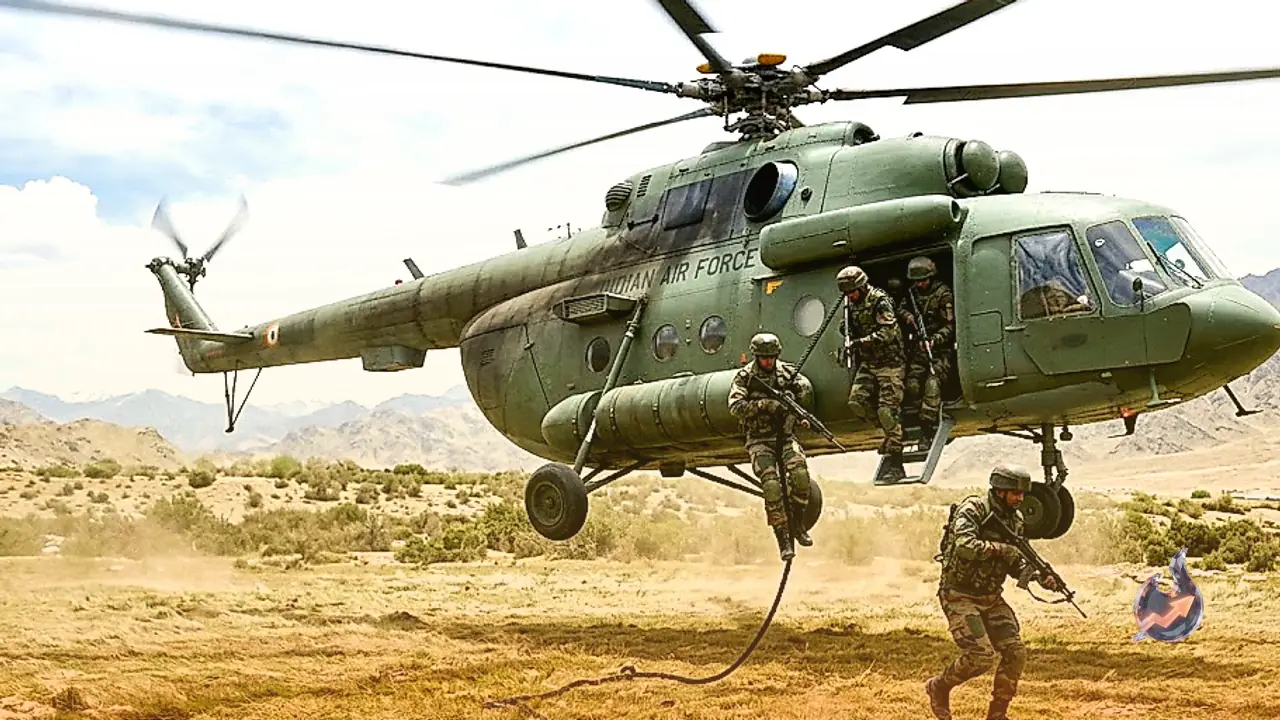
Preparing for the demands of modern warfare, the Indian Army recently showcased its formidable heliborne capabilities through a specialized military exercise. During these drills, the elite Shatrujeet Brigade demonstrated high-precision aerial insertion tactics designed to strike enemy territory swiftly and decisively. The primary objective of the exercise was to deploy combat troops and heavy equipment directly into target zones without a moment's delay, catching adversaries off guard.

Participating commandos executed highly demanding techniques such as STIE and slithering during the operations. Utilizing these specialized methods, soldiers rappelled down from hovering helicopters to the ground within seconds. Upon landing, the troops immediately established defensive perimeters and simulated aggressive encirclement maneuvers. This high-intensity operation highlights the readiness of Indian soldiers to penetrate hostile territory during emergencies and neutralize threats instantly.

Also read

The drills also rigorously tested the force's ability to mount immediate responses tailored to evolving tactical scenarios. A standout achievement of the exercise was the seamless coordination between the Shatrujeet Brigade and the assets of the Indian Air Force. This synergy underscored the military's capacity for rapid and accurate combat deployment through aerial corridors, an integration considered vital for navigating fast-paced future battlefields.

A major highlight of the entire demonstration involved the innovative use of Mi-17 V5 helicopters to airlift Light Strike Vehicles and Rapid Tactical Transport Systems by suspending them beneath the aircraft. This novel capability enables the rapid transport of essential mobility assets and heavy gear directly to frontline areas within minimal timeframes.

Such tactical transport capabilities prove invaluable in scenarios demanding immediate troop deployment accompanied by instant vehicular mobility and logistical support. These advancements significantly enhance the reaction speed and operational momentum of military units in the field. The successful execution by the Shatrujeet Brigade reinforces the Indian Army's ongoing commitment to building agile, integrated, and responsive combat capabilities tailored for the future of warfare.


Questions & Answers

What was the main objective of the Shatrujeet Brigade's exercise?
The primary objective was to deploy combat troops and heavy equipment directly into target zones without delay to counter adversaries swiftly.
Which special techniques were demonstrated during the drills?
Soldiers demonstrated highly demanding techniques such as STIE and slithering to descend from helicopters directly into target areas.
Which helicopter featured prominently as a major attraction?
The Mi-17 V5 helicopter served as a major attraction by demonstrating the ability to airlift Light Strike Vehicles and Rapid Tactical Transport Systems.
Which force collaborated closely in this operation?
The operation featured seamless coordination between the Shatrujeet Brigade and the assets of the Indian Air Force.

Comments 2

Karan Malhotra@karan-malhotra·48m ago

This airborne drill by the Shatrujeet Brigade goes beyond a routine military display, serving as a robust strategic deterrence for future conflicts. The successful sling-load transport of tactical vehicles by Mi-17 helicopters and the execution of high-risk insertion techniques demonstrate that our forces are fully equipped to secure swift and decisive advantages in hostile terrain.

Ravikash Gupta@ravikash·47m ago

This military drill is not merely a tactical demonstration, but a significant economic signal for future defense budgets, domestic manufacturing, and defense industrial corridors. When the military executes rapid transport of advanced technology and heavy equipment via platforms like the Mi-17, it strongly accelerates the demand for indigenous manufacturing and Light Strike Vehicles built under domestic initiatives. Moving forward, such modern combat readiness will unlock new avenues for heavy investment and corporate growth within the defense and aerospace sectors.

Citizen journalism

Become a TrendKia journalist

Voice of the people

Share news, photos and videos from your area with TrendKia and let your voice reach the nation. Every citizen a journalist.

Join now
CH 01 LIVE
TrendKia TV ON AIR