


















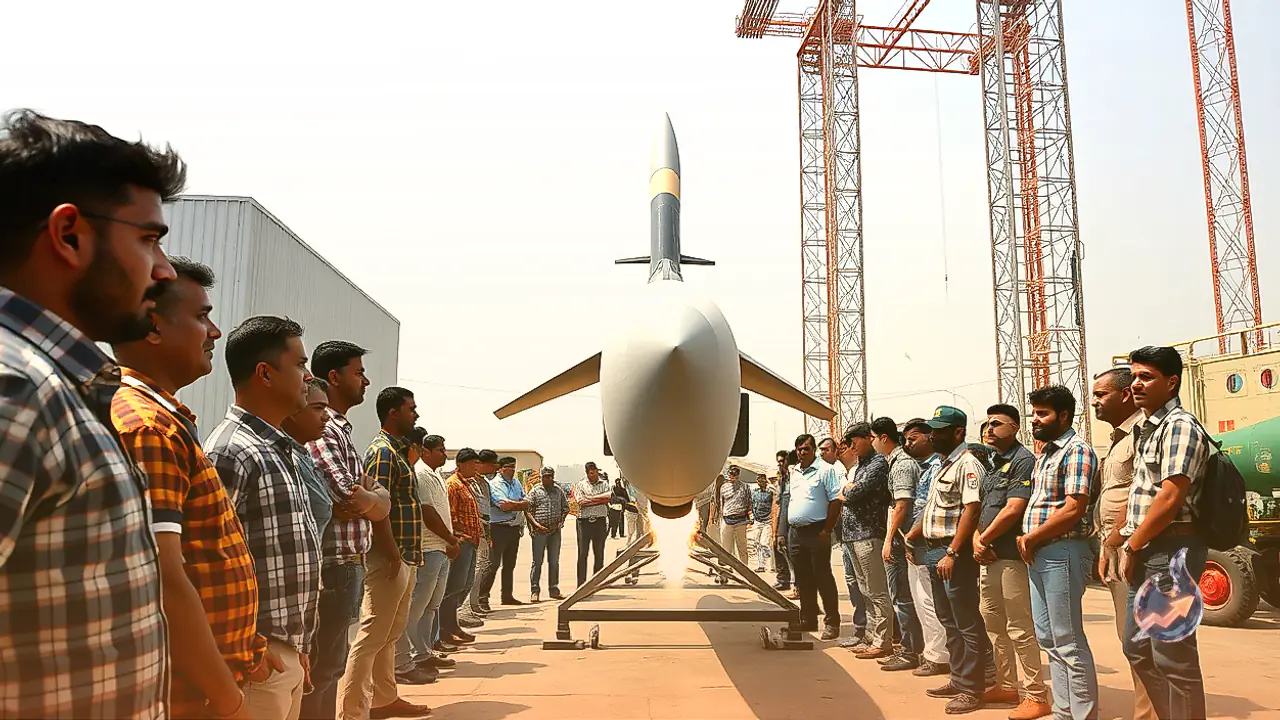

India is preparing to significantly reshape its aerial strike doctrine by engineering a more compact and agile iteration of its signature supersonic cruise missile. Jointly developed under the BrahMos Aerospace banner, the next-generation BrahMos NG system is being tailored to address physical constraints that historically prevented lightweight multi-role combat aircraft from fielding heavy supersonic ordnance. During Operation Sindoor, the operational deployment of the original BrahMos demonstrated unprecedented precision against adversary installations, overwhelming regional radar networks and air defense perimeters. However, maximizing that same strategic capability across a broader range of frontline aviation assets required a complete reassessment of the weapon's dimensions and mass.
Evolutionary Need and Historical Program Roots
The institutional foundation of this weapon architecture dates back to 1998, when a bilateral agreement between India's Defence Research and Development Organisation and the Russian defense entity NPO Mashinostroyeniya formally created BrahMos Aerospace. The joint venture embarked on designing a versatile cruise missile platform capable of striking ground and maritime targets with pinpoint accuracy. The program marked its initial operational milestone with a maiden test flight conducted in 2001, paving the way for the eventual induction of customized variants into the Indian Army, Navy, and Air Force.
In its baseline operational configuration, the standard BrahMos flies at an approximate velocity of Mach 2.8, delivering devastating kinetic and explosive impact on land and sea objectives. Nonetheless, its hefty bulk and heavy launch weight restricted its carriage primarily to heavy aircraft. Lightweight supersonic fighters simply could not carry such a substantial payload without compromising their structural limits and flight characteristics. The BrahMos NG initiative directly resolves this dilemma through a redesigned airframe, advanced propulsion systems, electronic hardening, and an increased share of indigenous subcomponents. Looking ahead, the manufacturing entity envisions adapting this streamlined missile across strike aircraft, surface combatants, submarines, and mobile land launchers.
Structural Miniaturization and Weight Reduction
The defining technological breakthrough of the BrahMos NG lies in its substantial weight reduction. The existing air-launched variant of the BrahMos tips the scales at roughly 2.9 to 3 tonnes, a parameter that places intense structural demands on the host jet and severely caps internal payload limits. Conversely, technical disclosures highlighted by the Russian news agency TASS in September 2025 indicated that designers intend to cap the NG variant at approximately 1.29 tonnes.
This figure reflects an ongoing refinement process, considering that prior projections had estimated an overall mass of 1.6 tonnes with an airframe length of around 6 meters. Such statistical shifts point to iterative design enhancements during the engineering cycle, although formal validation of the final production baseline is still pending. Trimming the system down to 1.29 tonnes fundamentally alters the logistics of airborne integration. Lighter multi-role jets gain the capability to transport the missile, while heavy long-range interceptors can potentially mount multiple rounds per sortie following technical airframe modifications.
Propulsion Architecture and Mach 3.5 Velocity
Flight velocity and kinetic energy remain central to the platform's ability to defeat sophisticated anti-missile umbrellas. Projected performance figures suggest that the BrahMos NG could achieve top terminal velocities of up to Mach 3.5, which translates to an operational speed of approximately 4300 kilometers per hour. At such speeds, interceptor networks like THAAD or Iron Dome face severe reaction-time deficits.
The underlying propulsion logic builds on the proven two-stage design of the original system. In the current weapon, a solid-propellant booster motor ignites at launch to accelerate the missile to supersonic velocity before burning out and separating. Following stage separation, an air-breathing liquid-fuel ramjet takes over to sustain supersonic cruising speeds through the remaining flight path. For the NG iteration, engineers are incorporating refined thermal and aerodynamic solutions to uphold even higher cruise velocities. Regarding reach, preliminary engineering models had placed the effective operational range at roughly 290 kilometers, whereas September 2025 TASS reports pointed to an expanded envelope exceeding 300 kilometers.
Expanding Aircraft Integration Beyond the Su-30MKI
A primary catalyst behind the entire NG development roadmap is broad aeronautical compatibility. At present, the air-launched BrahMos is integrated strictly on the Sukhoi Su-30MKI heavy fighter. In December 2021, the Ministry of Defence announced the successful demonstration of the air-launched missile launched from a Su-30MKI platform off the coast of Odisha, validating the technical feasibility of the missile-aircraft pairing.
Even so, the sheer bulk of the existing missile limits the number of units that can be carried on a single sortie. Developing the BrahMos NG opens the path to equipping India's indigenous Light Combat Aircraft, the Tejas, with long-range precision supersonic strike capability. Marrying the agility of the Tejas with a Mach 3.5 cruise missile promises to significantly upgrade tactical options and expand deep-strike deterrence along operational sectors.