























Just ahead of India's Independence Day celebrations on August 15, security forces have neutralized a major cross-border conspiracy backed by Pakistan's intelligence agency, the ISI. Over the past week, synchronized crackdowns across four cities in three states resulted in the arrest of 12 individuals linked to terror modules. Operations were executed across Amritsar and Tarn Taran in Punjab, Bardhaman in West Bengal, and the national capital, Delhi. Investigation details indicate that Pakistan-based handlers assigned specific operational tasks to different modules. The intent extended beyond creating public panic, explicitly aiming to target police infrastructure, security installations, and high-profile political leadership to induce widespread instability.
Amritsar Operations: Railway Surveillance and Delhi Footprints
Punjab Police dismantled two distinct terror modules operating in the Amritsar region, apprehending nine individuals, including four minors. Search operations led to the recovery of three illegal pistols, nine live cartridges, four petrol bombs, and a stolen motorcycle. According to Punjab DGP Gaurav Yadav and Amritsar Police Commissioner Gurpreet Singh Bhullar, interrogation revealed that the suspects maintained direct contact with handlers operating from abroad while conducting reconnaissance of high-priority security locations.
Investigators uncovered that the module had mounted surveillance cameras near strategic railway tracks, streaming live footage directly to their overseas handlers. Police Commissioner Gurpreet Singh Bhullar stated that preliminary probes also showed the suspects had previously travelled to Delhi's Jantar Mantar. While in the capital, they received local logistical support and materials intended for an attack. However, tight security prevented them from executing the plan, forcing them to return to Punjab. Law enforcement agencies are actively mapping the financial pipeline and identifying remaining local accomplices.
Tarn Taran Arms Seizure and the 'Chacha-Rehman' Leads
In a parallel operation in Tarn Taran district, a joint team of Punjab Police and the Border Security Force (BSF) arrested a key suspect named Manjit Singh. A thorough search of his residence yielded a major cache of military-grade weaponry, including seven foreign-made pistols, one MP-9 gun, extensive ammunition, and multiple mobile phones. During questioning, the suspect confessed that the arms consignment had been dropped across the border from Pakistan using drones.
Police officials confirmed that these weapons were intended for target killings and high-profile violent strikes across the region. Forensic examination of the suspect's mobile phones revealed several Pakistani contacts, notably two numbers saved under the aliases 'Chacha' and 'Rehman'. Investigative agencies are presently working to establish whether these entries represent real identities or tactical codenames used by senior handlers.
West Bengal Links: Political VIP Targets and Honey Trap Probe
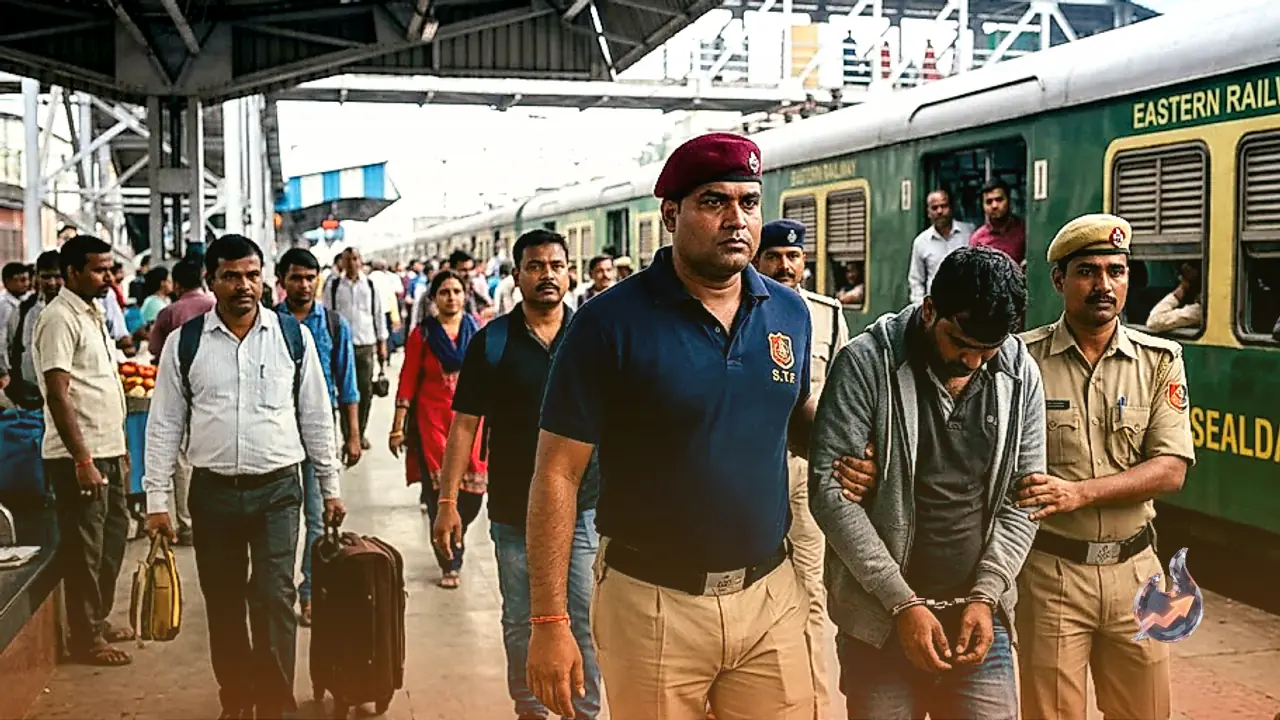
The investigation expanded significantly following arrests in Bardhaman, West Bengal, where suspect Mohammad Hamim Mandal, alias Hamim Fuego, was taken into custody. Intelligence inputs suggest that this specific module was plotting attacks against top political figures, including the Chief Minister of West Bengal. The suspect was reportedly in constant communication with Pakistan-managed social media handles and multiple international WhatsApp accounts.
According to the filed FIR, digital evidence extracted from the suspect's devices confirmed active chats with Pakistani handlers, foreign contact records, and coordinated online activities. The network functioned to recruit local youths, secure arms, gather intelligence on sensitive installations, and track VIP movements. Furthermore, investigators are probing a potential honey trap dimension, wherein a female operative was allegedly assigned to infiltrate political and VIP circles. This aspect remains under active investigation pending formal independent confirmation.
Disguised Attack Scheme at Delhi's Jantar Mantar
Among the uncovered plots, inputs regarding Delhi have been classified as extremely critical. Interrogations revealed a scheme to launch a major strike at Delhi's Jantar Mantar by infiltrating the area dressed in official police uniforms. The perpetrators intended to leverage police attire to bypass security cordons and cause maximum casualties in a crowded zone.
Jantar Mantar is a highly sensitive location in the capital, characterized by frequent political demonstrations and large public gatherings. The revelation of a planned uniform-disguised attack prompted immediate escalation of security protocols across Delhi, with police forces putting strategic locations under heightened surveillance.
Multi-Agency Coordination, Financial Scrutiny, and August 15 Security
With 12 suspects in custody across three states, joint investigative teams are focusing on whether these modules operated independently or under a single unified Pakistan-based command structure. Central questions center on tracing funding sources, identifying key recruiters, mapping drone delivery routes, and determining whether a coordinated strike was scheduled prior to August 15.
Given the elevated threat perception surrounding Independence Day, security protocols nationwide have been placed on high alert. Punjab Police, West Bengal STF, Delhi Police, and central intelligence agencies are conducting a coordinated investigation. Digital forensics teams are analyzing mobile logs, banking records, social media trails, and international communication channels to completely dismantle the underlying network.