





















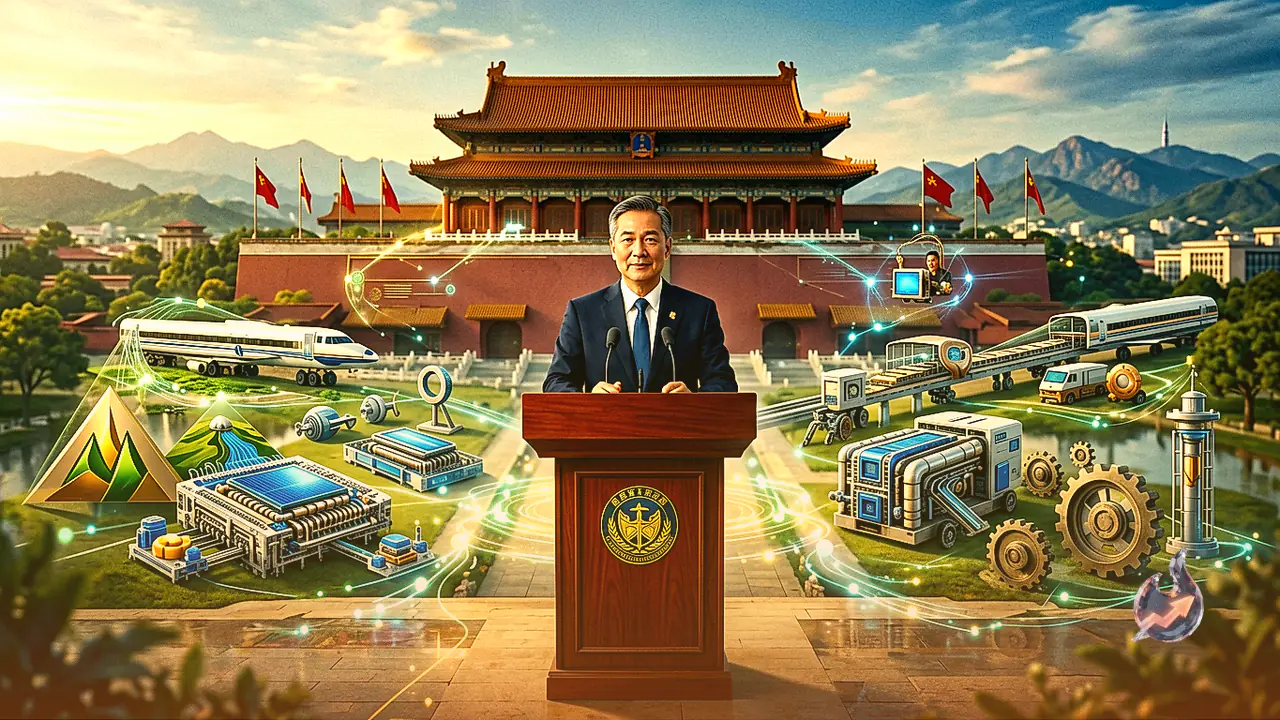

Addressing the nation from the ramparts of the Red Fort on Independence Day, Prime Minister Narendra Modi presented a comprehensive blueprint for India's future development trajectory. Moving beyond a mere accounting of past achievements, the address clearly delineated a strategic vision aimed at transforming India into a fully developed nation by 2047. Central to this vision is achieving complete self-reliance in energy, which the Prime Minister identified as the foundational pillar for sustained economic expansion. To power the nation's accelerating growth, the government is executing a multi-pronged strategy encompassing deep-sea hydrocarbon exploration, nuclear power expansion, domestic semiconductor fabrication, and clean energy transition.
₹85,000 Crore Allocated for Ocean Exploration to Reduce Crude Oil Imports
To reduce India's long-standing reliance on imported crude oil and natural gas, Prime Minister Modi announced a major initiative in energy security. The central government has allocated ₹85,000 crore for an intensive deep-sea energy exploration mission named 'Samudra Manthan'. Addressing past regulatory bottlenecks, the Prime Minister highlighted that previously nearly 99 percent of India's offshore maritime boundary was designated as a 'no-go area', severely hindering exploratory activities. Under the updated policy framework, these zones have been opened up as 'go-ahead areas', empowering energy exploration companies to search for untapped oil and gas reserves beneath the ocean floor and bolster national energy sovereignty.
Targeting 100 GW of Nuclear Power Capacity by 2047
With the exponential growth of artificial intelligence, massive data centers, semiconductor foundries, and modern industrial hubs, electricity demand across India is projected to rise sharply. Recognizing that renewable sources alone cannot fulfill base-load power requirements, Prime Minister Modi announced a national target of achieving 100 GW of nuclear power capacity by 2047. This expansion in atomic energy aims to provide uninterrupted, clean power to fuel high-tech industries. The initiative forms part of a diversified energy matrix combining solar capacity, nuclear generation, and offshore oil and gas production.
Expanding Semiconductor Plants and Securing Critical Minerals
Positioning India as a key player in the global technology supply chain remains a top national priority. The Prime Minister announced that between 5 and 7 new semiconductor manufacturing plants will be established across the country within the next 7 to 8 years. Emphasizing that advanced electronics and chip manufacturing depend heavily on critical minerals, the government is securing international partnerships and creating dedicated critical mineral corridors. These measures are designed to insulate domestic industries from global supply chain disruptions and reduce import dependence on critical raw materials.
Solar Capacity Reaches 160 GW as PM Surya Ghar Crosses 50 Lakh Homes
The acceleration of clean energy infrastructure continues to play a central role in substituting fossil fuel consumption. India's installed solar energy capacity has surged from approximately 2 GW prior to 2014 to 160 GW today. Highlighting the rapid adoption of residential solar installations, the Prime Minister noted that the PM Surya Ghar Muft Bijli Yojana has surpassed 50 lakh participating households. Beyond eliminating electricity bills for families, thousands of homeowners are generating financial earnings by supplying surplus solar power back to the national grid.
Historic Milestone in Railway Electrification and Infrastructure Pace
Illustrating the accelerated pace of infrastructure delivery over the past decade, Prime Minister Modi cited the transformation of the national railway network. Railway electrification in India originally commenced in 1925, yet only 30 percent of the network was electrified over the subsequent 90 years. In stark contrast, the past decade witnessed the completion of 100 percent electrification across the entire rail network. Alongside complete railway electrification, rapid expansion of urban metro systems and modernization of public transport networks are laying the structural groundwork for Viksit Bharat 2047.
The Saptadhara Vision, AI Skill Training, and Strategic Reforms
The Prime Minister outlined the 'Saptadhara' (seven pillars of power) framework to guide economic and strategic policies over the next 5 to 7 years. Key priorities include establishing end-to-end manufacturing value chains from design to final assembly, ensuring Indian products compete globally on quality and cost. Highlighting the youth as both the drivers and primary beneficiaries of development, the roadmap emphasizes AI skill training, startup innovation funding, and expanded technical education. The address also incorporated defense self-reliance, curbing Naxalism, executing structural socio-economic reforms, and launching a drug-free India campaign as integral components of the national strategic agenda.