




















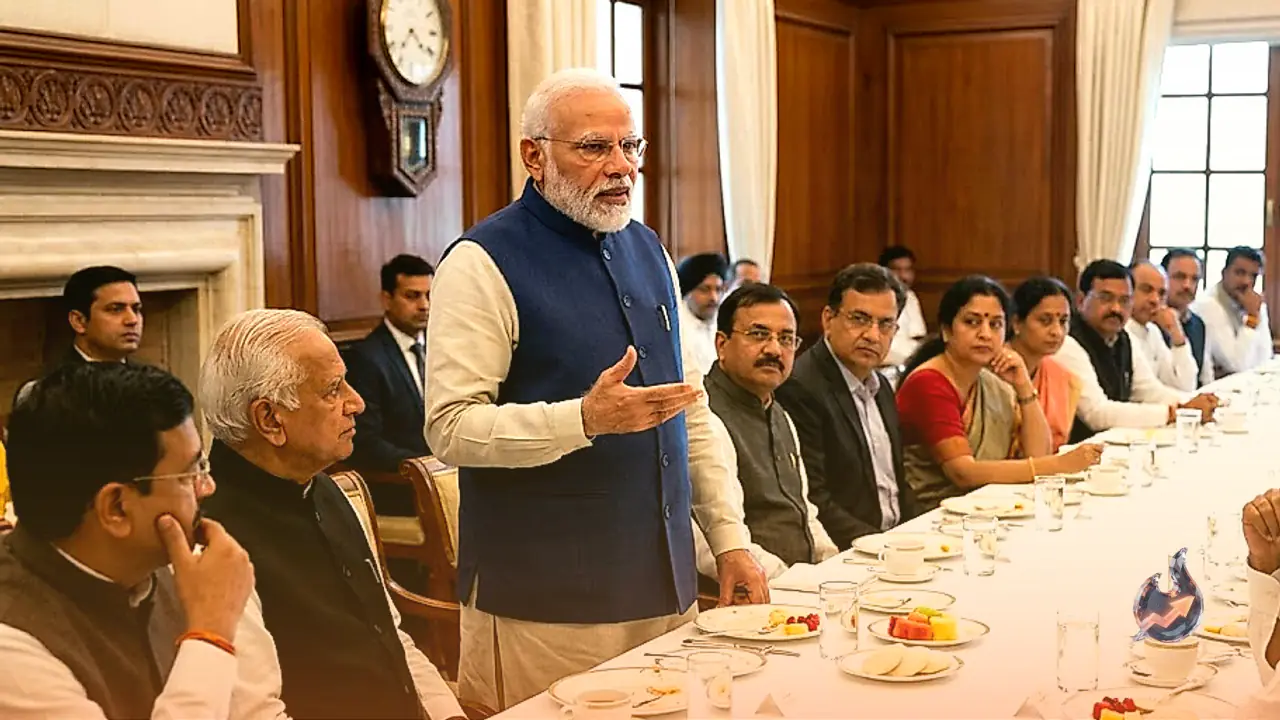

Wednesday morning witnessed an insightful political interaction in the national capital as Prime Minister Narendra Modi hosted 37 members of parliament from the ruling National Democratic Alliance (NDA) over breakfast at his official residence. The meeting diverged significantly from routine political assemblies, characterized instead by an informal, family-like atmosphere wherein the Prime Minister shared personal reflections accumulated over decades of public service and administrative governance. Beyond legislative agenda items, the core objective of the session was to impart practical wisdom regarding public ethics, parliamentary discipline, and the delicate nature of voter trust.
Vigilance in Public Life and Safeguard of Official Credentials
During the detailed conversation, Prime Minister Narendra Modi issued a firm word of caution regarding the potential pitfalls that accompany public office. He emphasized that establishing credibility and goodwill in politics requires years of dedicated effort, yet a single moment of oversight or moral compromise can erase that hard-earned trust instantly. Representatives were explicitly advised to refrain from accepting inappropriate hospitality or engaging with dubious individuals whose intentions might jeopardize their integrity. In public life, numerous interest groups attempt to approach elected officials, making it imperative that every action is taken with utmost care and transparency.
Furthermore, the Prime Minister highlighted the crucial need to safeguard official credentials, specifically letterheads and signatures. He instructed MPs to ensure that their official letter pads and sign-offs never fall into unauthorized or improper hands. Misuse of an elected representative's official documentation can lead to severe political embarrassment and legal entanglements. Prime Minister Modi reinforced the principle that absolute vigilance and moral clarity remain the strongest safeguards for anyone serving in public life.
Sustained Public Outreach and Constructive Engagement with Opposition
Shifting focus to constituency duties, Prime Minister Narendra Modi reminded the lawmakers that an MP's responsibility extends far beyond attending parliamentary sessions. He stressed that interacting with constituents must not be treated as a periodic exercise restricted to election campaigns. Lawmakers must maintain an unceasing dialogue with the public, visiting their constituencies regularly to understand local grievances firsthand. Staying accessible to ordinary citizens builds long-term faith in democratic governance.
Addressing interpersonal dynamics with political opponents, the Prime Minister advocated for restraint and diplomatic dialogue. He suggested that when opposition leaders present flawed, misleading, or provocative arguments, lawmakers should avoid entering into aggressive public clashes. Instead, the preferred strategy should be to reason patiently and present counterarguments grounded in facts and logic. Prioritizing the politics of winning hearts and minds over confrontation, he noted, creates a more constructive political environment.
Listening to Youth Aspirations and Addressing Root Causes
Recognizing India's demographic advantages, Prime Minister Narendra Modi urged the MPs to establish direct channels of communication with the younger generation. He observed that modern youth are highly articulate, energetic, and eager to voice their perspectives and challenges openly. Representatives must listen to young citizens with patience and an open mind rather than dismissing their concerns.
The Prime Minister explained that sustainable solutions to socio-economic problems can only be formulated when leaders grasp the underlying root causes. By engaging regularly with young voters in their respective regions, parliamentarians can channel youth energy into nation-building efforts and ensure that policy interventions accurately address ground realities.
Parliamentary Attendance and Cross-Party Learning
On parliamentary operations, Prime Minister Narendra Modi insisted on strict attendance and meaningful participation in House proceedings. He encouraged MPs to spend maximum time inside the parliament chamber during sessions, observing debates and absorbing the nuances of legislative crafting. Making optimal use of one's parliamentary tenure is essential for personal growth as a legislator and for serving the nation effectively.
In addition, he urged lawmakers to cultivate a mindset of continuous learning that transcends party lines. Knowledge and constructive insights can be gained not only from senior party colleagues but also from experienced leaders belonging to opposition ranks. Working collaboratively and learning from diverse parliamentary voices enhances the overall quality of governance.
Personal Discipline, Time Management, and Health Maintenance
Alongside political guidance, Prime Minister Narendra Modi spoke candidly about personal discipline, time management, and health preservation amidst demanding work schedules. Sharing details of his daily routine, he described how practicing yoga and maintaining physical fitness provide the physical stamina and mental clarity necessary to navigate complex administrative duties. He encouraged the lawmakers to prioritize their health, noting that physical well-being is vital for sustained public dedication.
This breakfast interaction forms part of an ongoing series of small-group meetings that Prime Minister Narendra Modi regularly conducts with parliamentarians during active legislative sessions. The group present on Wednesday comprised first-time elected BJP MPs as well as representatives who joined the party from other political backgrounds. BJP President Nitin Nabin was also present during the session, which provided lawmakers with practical guidance for their tenure.