




















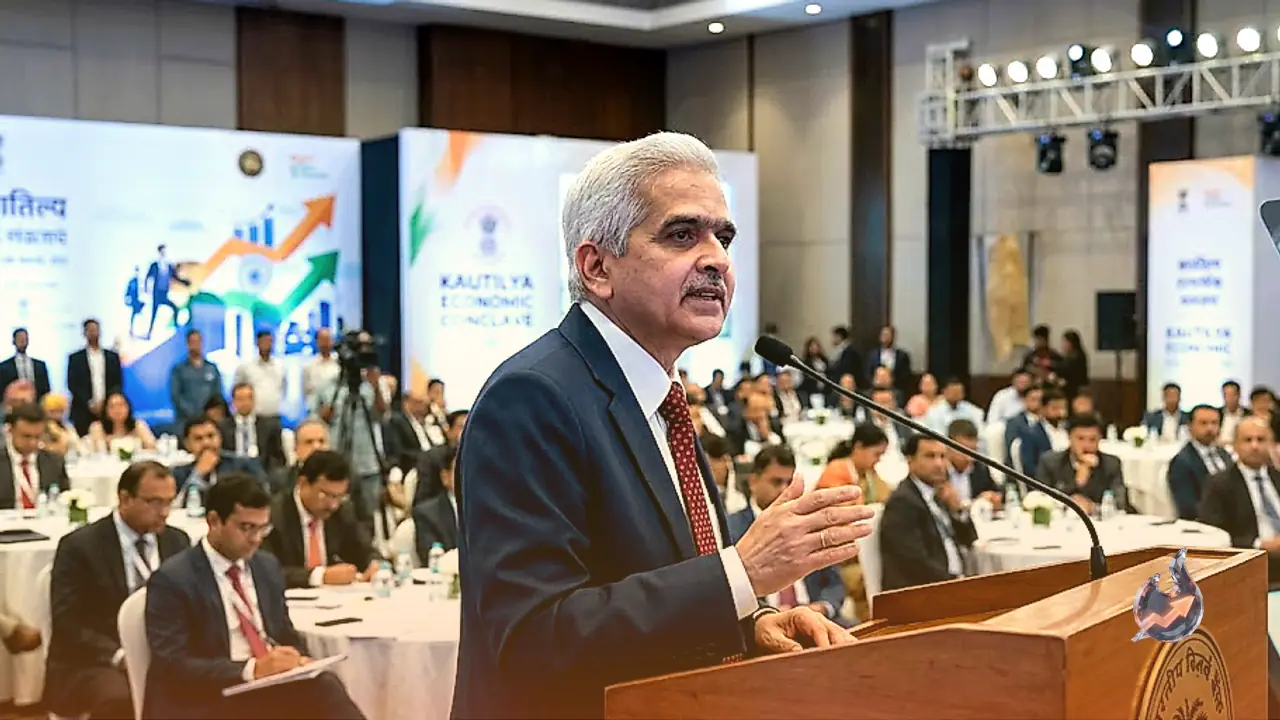

India's sustained economic resilience amidst global financial turbulence is the direct outcome of a series of deliberate, mutually reinforcing policy measures rather than a stroke of good fortune. Addressing the Kautilya Economic Conclave, Shaktikanta Das, former Governor of the Reserve Bank of India and Principal Secretary-2 to the Prime Minister, asserted that the nation's economic momentum has brought it within striking distance of an eight percent growth trajectory. He emphasized that sweeping measures across taxation, inflation management, banking cleanup, and budgetary prudence have constructed durable safeguards capable of absorbing external macroeconomic shocks.
Real GDP Trajectory Nears Eight Percent Benchmark
Reviewing the economic indicators, Shaktikanta Das highlighted that taking the continuous stretch from the July-September period of fiscal year 2025-26 through the April-June period of fiscal year 2026-27 yields an actual real GDP growth rate slightly above eight percent. He observed that this achievement directly confirms his previous assessment shared with the Financial Times, London, wherein he had noted that India was closing in on an eight percent expansion mark. Backing this trend, the economy recorded an expansion of 7.8 percent during the June quarter, significantly outpacing earlier forecasts. Das attributed this consistent momentum primarily to vibrant domestic consumer demand and an increasingly supportive investment landscape across sectors.
Decade of Strategic Measures Builds Economic Resilience
Detailing the structural transformation of the past ten years, Shaktikanta Das noted that policy actions were never intended as isolated interventions. Instead, they were designed as structural shock absorbers that allow the economy to withstand headwinds and stage rapid recoveries. Among the decisive initiatives, he pointed to the nationwide rollout of the Goods and Services Tax (GST), the formalization of flexible inflation targeting frameworks, meticulous fiscal management, the rapid proliferation of digital payment networks, and comprehensive balance-sheet cleanups across the commercial banking system.
Prudent External Management And Trade Diversification
The former central bank governor stressed that vigilant stewardship of the domestic financial system and external balances has emerged as a cornerstone of national stability. India has broadened its export profile across diverse international markets while pursuing targeted free trade agreements. Simultaneously, robust inward remittances from the overseas diaspora and sustained surpluses in services trade continue to reinforce the external account. This careful calibration has effectively shielded domestic industries and financial institutions from volatile international currency movements and global credit cycles.
Harnessing The AI Shift And Long-Term Green Investments
Looking ahead, Shaktikanta Das observed that India must capitalize on the artificial intelligence revolution to preserve high economic velocity. The national AI roadmap rests on two complementary foundations, led by domestic development of foundational AI models, massive investments in high-performance computing facilities, indigenous semiconductor manufacturing, and an innovation-driven research ecosystem. Meanwhile, the next phase of capital expansion will demand patient long-term finance, requiring deeper corporate bond markets, enhanced participation from insurance and pension funds, and modernized municipal financing mechanisms. These capital flows must align with sustainability priorities, including the National Green Hydrogen Mission, electric mobility networks, renewable energy grids, sustainable farming practices, and circular economy initiatives, all driving the nation toward its goal of becoming a developed economy by the year 2047.