





















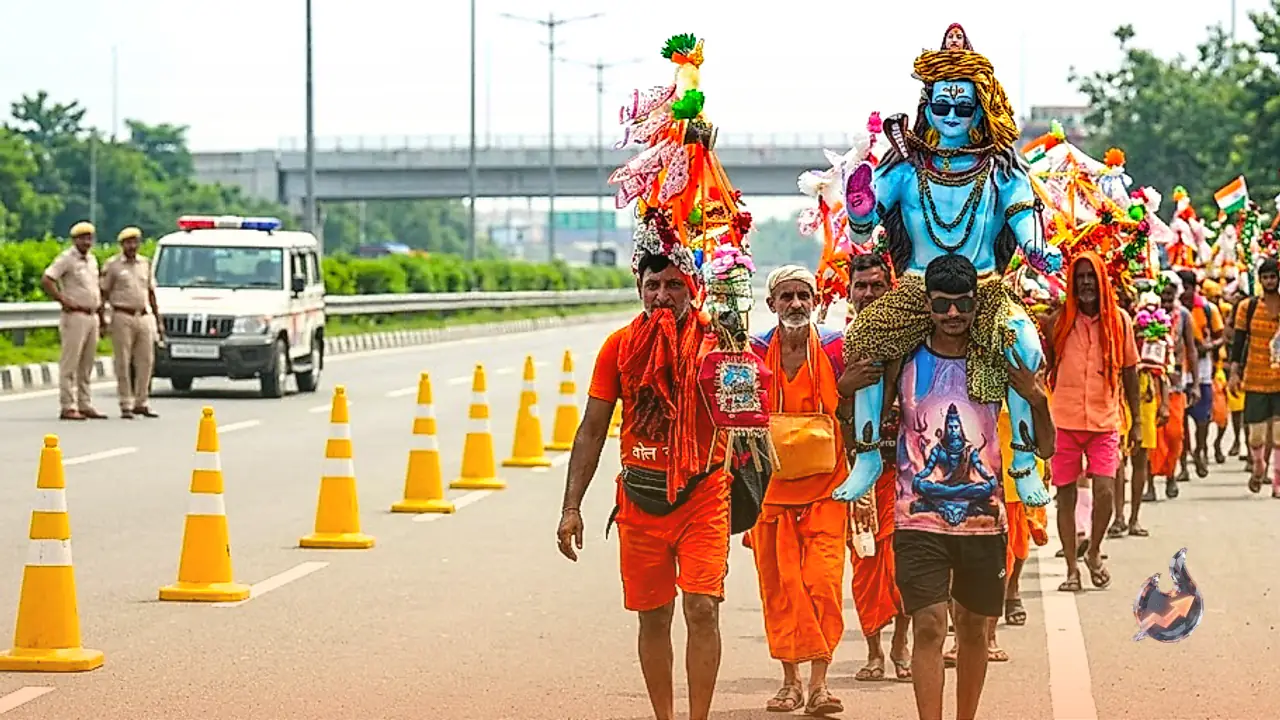

The annual Kanwar Yatra has officially commenced with the onset of the holy Sawan month, prompting administrative authorities to enforce extensive traffic management and security frameworks across major transit corridors. Running from July 30 to August 12, the 14-day pilgrimage witnesses thousands of devotees carrying sacred water from Haridwar to their native towns. To prevent traffic bottlenecks and ensure the safety of pedestrians walking along high-speed roads, authorities have instituted phased vehicular bans, route diversions, and round-the-clock surveillance spanning highways connecting Delhi, Ghaziabad, Meerut, Muzaffarnagar, Roorkee, and Haridwar.
Phased Vehicle Bans and Restrictions Across Main Routes
To streamline the movement of pilgrims, traffic restrictions are being introduced in structured phases. Beginning at 8:00 AM on July 30, heavy commercial transport vehicles, including trucks, trailers, cantors, and tractor-trolleys, have been completely barred from entering designated Kanwar routes leading from the Delhi-Ghaziabad border toward Haridwar. The second phase of enforcement begins on August 5, after which light passenger vehicles such as cars, private buses, and auto-rickshaws will also face entry bans on primary pilgrimage roads.
Three Key Closed Corridors and Designated Alternate Routes
Traffic authorities have identified three vital road stretches along the Delhi-Ghaziabad border that are fully restricted for regular vehicular movement. These include the 37-kilometer Pipeline Road extending up to Loni, the 39-kilometer segment from Kadrabad on the Ghaziabad-Meerut border to Seemapuri on the Delhi border, and the 50-kilometer stretch of the Delhi-Meerut Expressway (DME).
The Uttar Pradesh portion of the Delhi-Meerut Expressway has been reserved exclusively for Kanwar pilgrims. Heavy vehicles were prohibited on this expressway starting July 30, while light vehicles will be permitted to ply until August 7. From August 7 to August 12, the expressway section will be entirely shut for all general vehicular traffic. To accommodate commuters traveling toward Haridwar, Moradabad, Amroha, and Lucknow, traffic is being diverted to alternative arterial roads, including NH-9, the Eastern Peripheral Expressway, the Ganga Expressway, and the Delhi-Dehradun Expressway.
Authorities clarified that the Delhi-Dehradun Expressway will remain fully open for high-speed motorized transport, including heavy and light commercial vehicles. However, walking on foot or carrying Kanwar along this expressway is strictly prohibited. While this provides a reliable bypass for commuters traveling toward Uttarakhand, motorists should still anticipate elevated traffic density and localized slowdowns near connecting points.
Police Deployment and Multi-Layered High-Tech Surveillance
The 126-kilometer pilgrimage route stretching from Ghaziabad to Haridwar has been systematically mapped into 157 beats and 502 permanent duty posts. More than 3,500 police personnel have been deployed to oversee crowd management, law enforcement, and traffic redirection. Mobilized security assets include 100 Police Response Vehicles (PRVs) and 16 Quick Response Teams (QRTs) conducting continuous patrols along the route.
To maintain operational control, authorities have erected 8 watchtowers and operationalized 10 control rooms, with the centralized command hub stationed at Meerut Crossing. Continuous aerial and ground monitoring is being conducted using tethered drones and hundreds of high-definition CCTV cameras linked directly to the main control room, enabling real-time traffic adjustments based on crowd density.
Pilgrim Rest Camps and Emergency Support Infrastructure
Comprehensive arrangements have been made to cater to the lodging and health needs of walking pilgrims. Over 300 Kanwar pilgrim camps have been established within Ghaziabad district limits alone, with more than double that number operational along the remaining stretch up to Haridwar. These shelters offer resting facilities, meals, and basic healthcare services.
An extensive fleet of emergency vehicles has been positioned along the pilgrimage route to handle accidents and vehicle breakdowns promptly. Infrastructure on standby includes 65 ambulances, 12 fire tenders, 41 mobile cranes, 79 hydraulic cranes, and 9 recovery vehicles operational 24/7 to clear blockages and ensure swift medical response.
NH-34 Restrictions and Travel Guidelines for Commuters
The Delhi-Haridwar National Highway (NH-34), which connects Delhi, Ghaziabad, Meerut, Muzaffarnagar, and Roorkee before reaching Haridwar, will see a total ban on heavy commercial vehicles from August 4 to August 12. Significant portions of NH-34 will be dedicated solely to foot pilgrims during this period. Emergency service vehicles, including police cars, ambulances, and disaster management units, will remain exempt from these restrictions.
Traffic officials strongly advise commuters to avoid designated Kanwar routes wherever possible until August 12. Travelers are urged to plan journeys with additional buffer time, strictly follow directions issued by traffic personnel, and monitor official real-time traffic advisories, as diversion protocols may be updated dynamically based on crowd movement.


