






















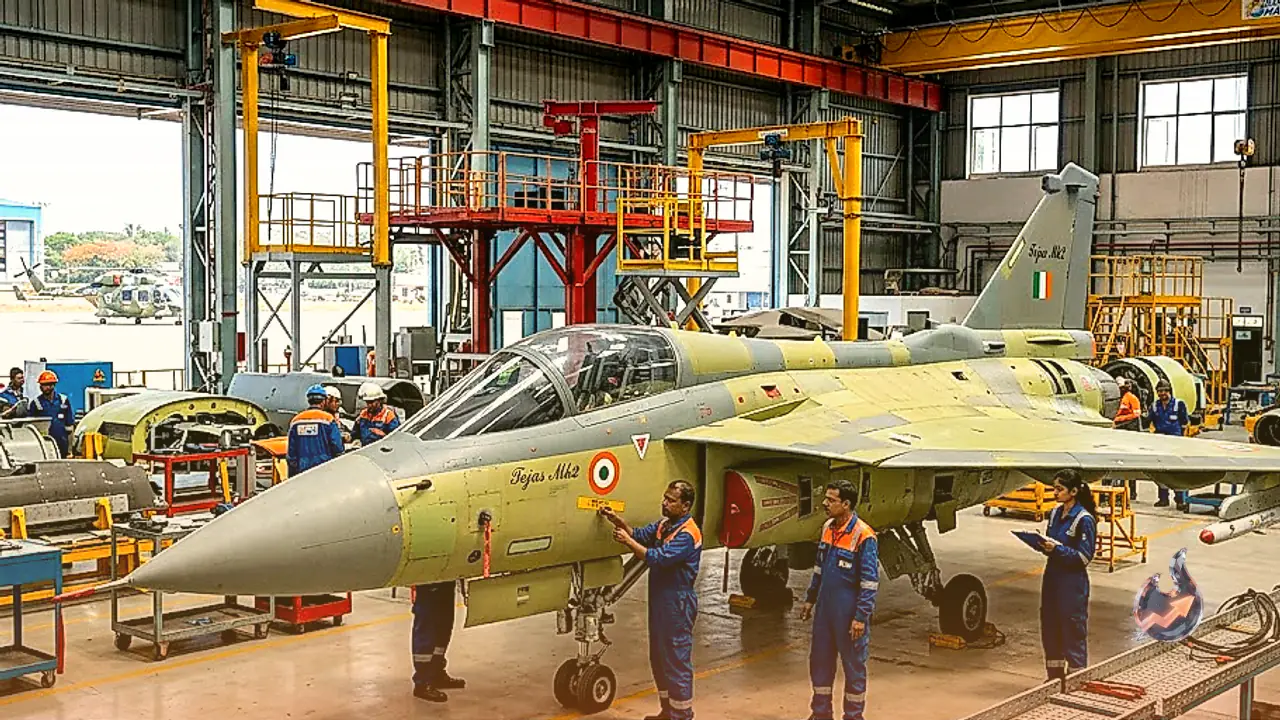

India's indigenous military aviation roadmap has achieved a crucial milestone with the successful structural assembly of the first airframe prototype for the Tejas Mk2 combat aircraft. Developed as an advanced 4.5-generation medium-weight fighter, the aircraft has now transitioned from individual component manufacturing and digital design into comprehensive airframe integration and trial preparation. In modern aerospace engineering, completing the structural airframe marks the moment a clean-sheet design physically materialises into a unified platform ready for internal systems fitment.
Hindustan Aeronautics Limited (HAL) achieved this build milestone by joining the forward, centre, and aft fuselage sections into a single, cohesive airframe. Significantly, HAL pushed ahead with building this prototype on its own initiative, maintaining progress despite the absence of a finalised commercial contract. With the structural backbone now physically established, engineers are shifting focus toward equipping the platform with operational subsystems.
Ground Runs Slated for March 2027 Ahead of Debut Flight
According to Ravi Kumar, Chairman and Managing Director of HAL, the aerospace manufacturer is working toward conducting the first official ground run of the Tejas Mk2 prototype by March 2027. Ground runs represent a pivotal phase in any flight-test campaign, during which the aircraft remains anchored or taxis on the tarmac while technicians evaluate the integrity of its structural joints, engine throttling, internal avionics, flight-control surfaces, and auxiliary power units. Only after all safety and technical parameters meet rigorous certification benchmarks will clearance be granted for flight operations.
Following successful ground evaluations, the aircraft is scheduled to undertake its maiden flight between mid and late 2027. This inaugural test flight will signify a major technological leap for domestic aeronautics, demonstrating the operational validity of a homegrown medium-weight platform featuring a close-coupled canard-delta wing layout.
Four Prototypes Planned, Weapon Testing Slated for 2030
To execute the extensive validation campaign required before mass manufacturing, HAL has formulated a plan to construct a fleet of four developmental prototypes. The initial two aircraft will be assigned primarily to exploring aerodynamic parameters, validating flight safety margins, and confirming smooth communication across onboard avionics and control systems.
The third and fourth prototypes will be dedicated almost exclusively to weapons testing and combat subsystem evaluations. Live ordnance trials are anticipated to commence around 2030, putting the fighter through realistic weapon separation, tracking, and targeting exercises. If the evaluation timeline progresses without major disruptions, the Tejas Mk2 platform is projected to secure full production clearance by 2031, opening the door for active squadron deliveries.
Powered by GE F414 Engines with 80 Percent Transfer of Technology
The Tejas Mk2 will be propelled by the American-built GE Aerospace F414-INS6 afterburning turbofan engine. This powerplant offers substantially higher thrust compared to the GE F404 engine currently installed on the Tejas Mk1 and Mk1A variants. The Aeronautical Development Agency (ADA) has already acquired an initial batch of F414 engines to support the construction and early flight runs of the prototype fleet.
To guarantee an uninterrupted engine supply for long-term fleet requirements, HAL and GE Aerospace have been engaged in discussions regarding joint engine production directly within India. HAL's CMD noted that core technical issues have been ironed out, with the proposed framework incorporating approximately 80 percent technology transfer. HAL is presently awaiting the final commercial proposal from GE Aerospace, after which negotiations over pricing, manufacturing schedules, and operational deliverables will move forward. Domestic manufacturing of the F414 is expected to stabilise the propulsion supply chain and reduce foreign dependencies.
4.5-Generation Architecture, Mach 1.8 Speed, and Canard Design
Positioned in the same broad operational category as frontline 4.5-generation jets like the Rafale, the Tejas Mk2 incorporates considerable structural enhancements over the smaller Mk1A. It boasts an extended fuselage, close-coupled canards paired with a delta-wing geometry, and redesigned, larger air intakes to feed the powerful powerplant. The F414 turbofan will generate roughly 98 kilonewtons of thrust, pushing the aircraft to a maximum operational speed of approximately Mach 1.8.
The fighter is engineered to operate at a service ceiling of around 50,000 feet. Situational awareness will be anchored by the domestically developed Uttam Active Electronically Scanned Array (AESA) radar, integrated alongside a cutting-edge electronic warfare suite designed to counter multi-spectrum threats in dense combat environments.
Expanded 6.5-Tonne Payload to Replace Legacy Squadrons
A central design priority for the Tejas Mk2 is an expanded strike capacity. The aircraft will be capable of hauling up to 6.5 tonnes of weapons, external fuel stores, and tactical mission payloads across 13 external hardpoints. In contrast, the baseline Tejas Mk1 features 8 hardpoints. This increased carrying capacity allows the platform to shoulder an assortment of beyond-visual-range missiles, precision-guided ground attack munitions, and auxiliary drop tanks simultaneously.
Once serial production begins, the Tejas Mk2 is slated to play a defining role in revitalising the Indian Air Force's fighter inventory. Over time, it is intended to replace phasing-out legacy fleets, specifically taking over roles long held by Jaguar, Mirage-2000, and MiG-29 combat aircraft.
Curated Defence Spending and Growing Export Potential
India currently commits thousands of crores of rupees every year to procure foreign defence equipment. Mastering local production of medium-weight fighter platforms directly shields the exchequer from massive foreign exchange outflows. Furthermore, building sovereign manufacturing capacity positions the country as an emerging exporter in global markets. International buyers are already queuing up to procure systems like the BrahMos cruise missile, and establishing a successful, mass-produced indigenous fighter jet could transform domestic aerospace into a major driver of foreign revenue generation.