























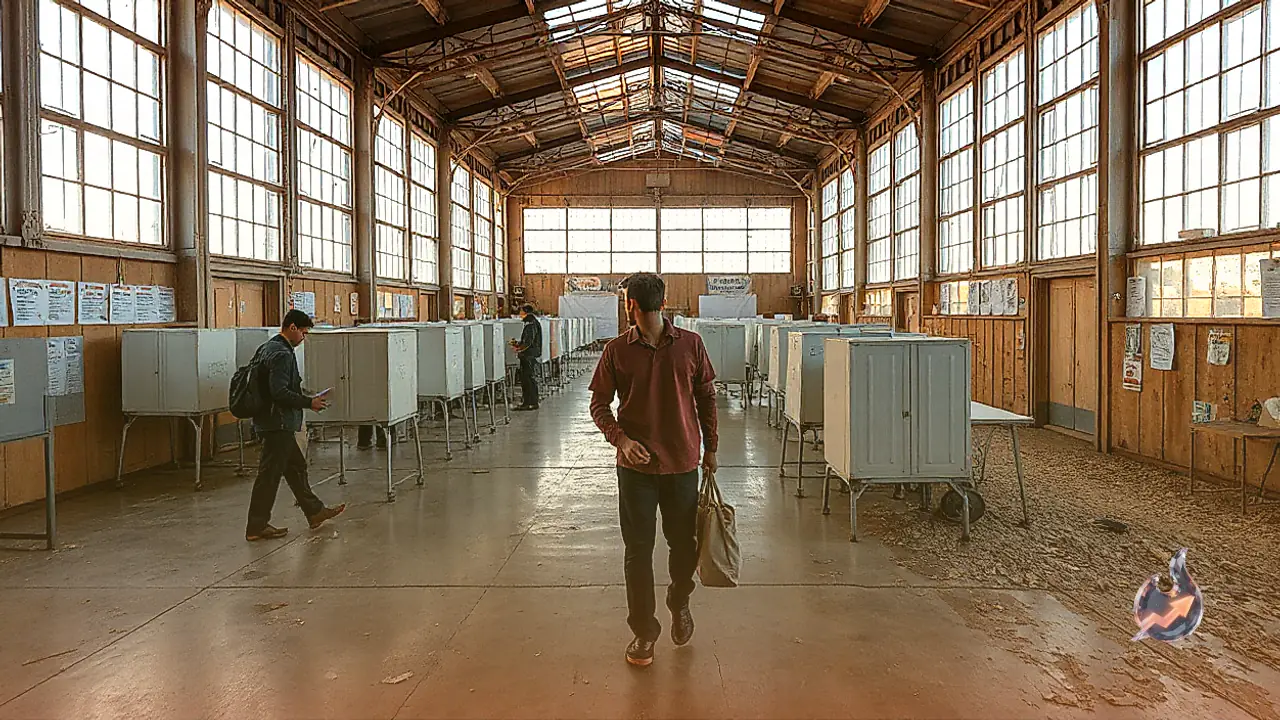

Across the globe, the United States is recognized as a dominant force in digital innovation and computer technology, yet its electoral machinery continues to rest firmly upon traditional paper sheets. While countries like India have transitioned entirely to standalone electronic voting machines, American voters cast their ballots by filling out physical forms with a pen. With the conclusion of the 2026 midterm elections, where the incumbent Republican administration and President Donald Trump faced significant defeats against a resurgent Democratic party, attention has once again turned to the unique mechanics of the American voting booth and why the nation relies on paper rather than touchscreen voting consoles.
The Two-Year Midterm Cycle and Congressional Balance
In the American political calendar, presidential terms are set at four years. Exactly halfway through that tenure, at the two-year mark, midterm elections are conducted. Citizens do not cast ballots for the presidency during these contests, as the chief executive remains in office for the full four-year stretch. Instead, the balance of power within the United States Congress is decided.
Every single seat in the House of Representatives, totaling 435 voting districts, comes up for election because members of the lower chamber serve terms of only 2 years. In contrast, members of the Senate hold six-year terms. Rather than renewing the entire Senate at once, the chamber functions on a staggered cycle where approximately one-third of the membership, roughly 33 to 35 seats, is contested every 2 years. Concurrently, around 36 states hold gubernatorial races to choose state governors alongside thousands of municipal and county posts.
Political observers view midterms as a referendum on the incumbent president's opening 2 years of governance. When a ruling party loses its legislative majority, passing flagship policies, enacting statutory reforms, or confirming high-level administrative appointments becomes profoundly difficult for the White House.
Decentralized Election Infrastructure and Tabulation
Unlike electoral frameworks managed by a single central commission, the United States operates a decentralized voting apparatus. Administration rests entirely in the hands of counties, municipalities, and townships. Across more than 10,000 separate local voting jurisdictions, municipal clerks and county boards execute polling and vote tabulation through autonomous regional teams.
When a voter receives a paper ballot, they record their preferences by filling in circular or rectangular marks next to candidate names using a black or blue pen. The filled sheet is subsequently fed into a digital optical scanner. This scanning unit interprets the darkened areas, tabulates the choices, and logs the vote onto secure, localized storage drives. In densely populated urban counting facilities, high-throughput digital scanning machines process thousands of paper sheets every hour. Conversely, in certain remote or sparsely populated rural districts, election workers continue to perform hand tallies.
Ballots are collected through several distinct channels, each requiring specific verification protocols
- In-person Election Day votes: Ballots submitted directly at physical voting precincts on the primary polling date are the first to be scanned and tabulated once polls close.
- Early in-person voting: Sheets completed by citizens who visited authorized early voting centers prior to the main voting date are processed alongside precinct returns.
- Mail-in and absentee ballots: Envelopes delivered through the postal system undergo rigorous signature verification and residency validation before they can be removed and scanned.
- Provisional ballots: Whenever a voter's eligibility cannot be instantly verified at the poll, they receive a provisional sheet that is counted only after administrative checks confirm their status.
Air-Gapped Machines and Physical Security
To eliminate the risk of remote intrusion, vote tabulating scanners are completely air-gapped, meaning they are never connected to the internet or wide-area local networks. Machines are protected with tamper-evident physical seals that are logged before and after operating hours. In addition, designated observers from both the Democratic and Republican parties remain inside the counting rooms throughout the tabulation window, maintaining full visual transparency over every step.
The original paper documents are preserved in locked, climate-controlled storage vaults. Retaining the physical paper allows election officials to carry out manual hand recounts or forensic evaluations whenever a race is narrowly decided or challenged in court.
Certification and the Path to Final Results
Following the conclusion of voting, precinct judges and municipal clerks review returns to ensure that the volume of collected ballots strictly reconciles with voter sign-in registers. Once local precincts conclude canvassing, the final totals are transferred to the Secretary of State or a designated state canvassing board for formal certification. Because each state follows its own statutory schedule, official certification can take anywhere from a few days to several weeks.
At present, approximately 98% of all voters in the United States cast their ballots using physical paper or systems that produce a human-verifiable paper record.
Why American Elections Avoid Standalone EVMs
Cybersecurity specialists and election administrators consistently warn that purely electronic voting terminals reliant on complex operating systems can theoretically be manipulated through altered software or hardware tampering. In stark contrast, physical ink on a sheet of paper cannot be modified or erased by an invisible software virus or distant cyberattack. A physical mark represents a permanent record that cannot be hacked over a network.
This physical foundation provides an incontrovertible audit trail. If questions of legitimacy arise, human workers can physically examine the ballots without relying on digital logic. Across most US states, statutory rules mandate post-election risk-limiting audits, where a random sample of paper ballots is hand-tallied to verify that the automated optical scanners calculated the margins with 100% precision.
Several defining milestones have cemented this reliance on physical paper
- The 2000 Bush v. Gore legal battle: Tabulation disputes involving Florida's mechanical punch-card ballots demonstrated the severe risks of ambiguous voting materials, triggering an immediate push for unambiguous physical records.
- The 2016 foreign interference claims: Allegations of external cyber attempts directed against digital election infrastructure prompted a national movement to decommission paperless electronic machines. Federal grants subsequently enabled states to transition toward paper-backed optical scan systems.
- Midweek working schedules: American federal elections take place on a regular Tuesday without a statutory national holiday. Because millions of working citizens cannot travel to polling stations during work hours, they rely on mail-in ballots weeks in advance, a process that requires paper forms.
- Municipal budgetary realities: With no central electoral body absorbing costs, purchasing entirely new digital voting consoles and upgrading their proprietary software every couple of years poses an unsustainable burden on county budgets. Paper ballots and rugged optical scanners represent a more durable, fiscally sound investment.
Ultimately, the American electoral system operates on a hybrid architecture, combining the tangible security of physical paper with the rapid tabulation capabilities of modern optical scanning.