























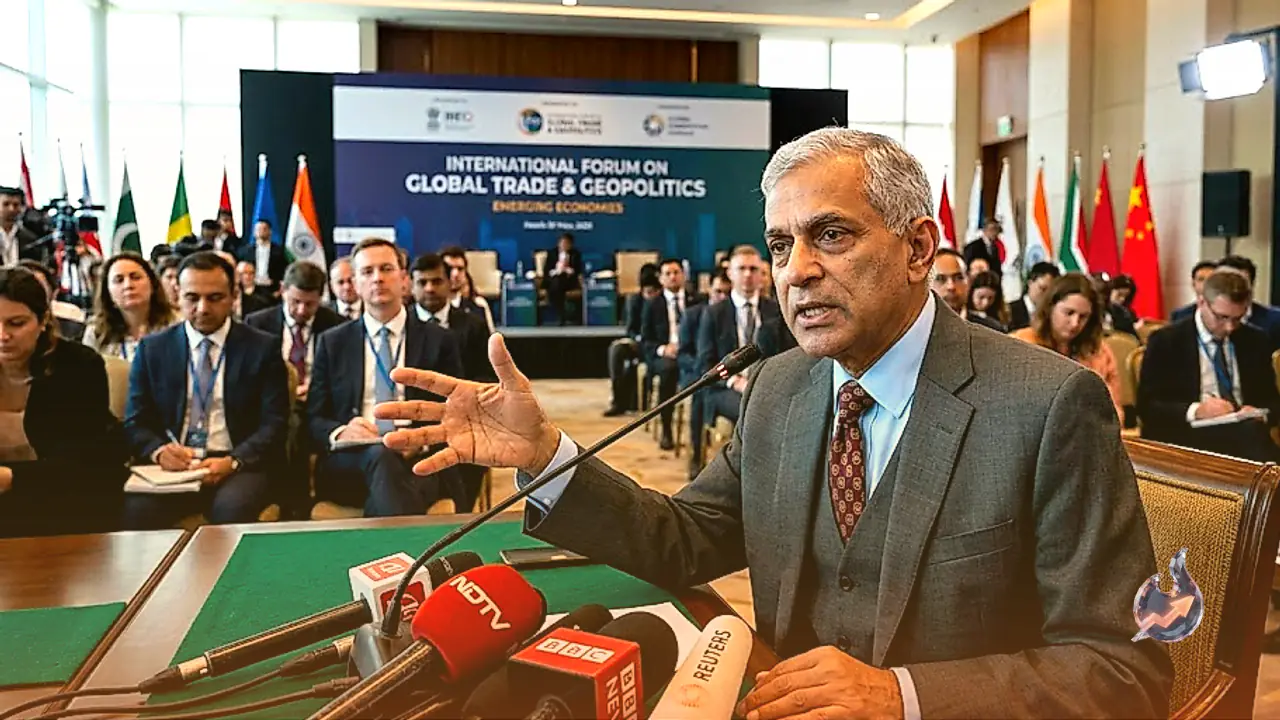

The recent issuance of the New Delhi Declaration at the BRICS summit has triggered intense discussions across the global political landscape. However, renowned international affairs expert Dr. Brahma Chellaney has pointed out a stark contradiction between the group's official statements and the actual behavior of its most powerful member. While the BRICS platform is actively used to lecture the world on the negative impacts of Western economic sanctions, Chellaney argues that China is quietly playing a highly disruptive game behind the scenes. In an effort to derail India's aspirations of becoming a major global manufacturing hub, Beijing has systematically disrupted the supply chains of critical minerals and advanced industrial machinery. According to Chellaney, those within BRICS who criticize unilateral decisions by the United States must also confront the coercive practices of China, which routinely betrays its own partners despite projecting a facade of unity on paper.
The Gap Between Words and Deeds in BRICS
The New Delhi Declaration explicitly states that the member nations strongly condemn unilateral economic sanctions that violate international law. This statement was clearly aimed at the financial penalties and trade restrictions frequently imposed by Western countries, particularly the United States. However, the reality within the bloc presents a massive contradiction. China, one of the founding and most influential members of BRICS, is actively using its dominant market position and supply-chain hegemony to squeeze other member nations. Dr. Chellaney has labeled this behavior as the ultimate double standard, pointing out that the very country co-signing declarations against economic coercion is its chief practitioner within the group.
This contradiction threatens to undermine the credibility of the entire BRICS bloc on the global stage. When a coalition positions itself as a champion of the Global South and an alternative to Western-led financial systems, its internal cohesion must reflect those values. By allowing its largest economic engine, China, to weaponize supply chains against a fellow founder like India, the bloc risks being viewed as a vehicle for Beijing's unilateral ambitions rather than a cooperative alliance. Chellaney points out that this structural hypocrisy makes the group's grand declarations ring hollow to international observers.
China's Strategy of Economic Coercion
According to Dr. Chellaney's analysis, while China officially opposes Western sanctions, it routinely employs illegal economic pressure tactics to achieve its geopolitical objectives. Beijing has developed a persistent habit of abruptly restricting the export of rare earth elements, critical minerals, manufacturing equipment, and vital industrial components. By imposing sudden bans or introducing highly restrictive bureaucratic hurdles, China exerts unilateral economic pressure that disrupts open trade and destabilizes global supply networks. This weaponization of industrial supply chains contradicts the core principles of fair and open global commerce that BRICS claims to champion.
Targeting India's Global Manufacturing Ambitions
Over the past few months, Beijing has specifically targeted India by deploying a mix of formal regulations and informal administrative barriers. China has blocked the transfer of critical manufacturing equipment, essential raw materials, and technical expertise destined for Indian industries. This targeted blockade directly hurts Indian businesses that rely heavily on Chinese machinery, tooling, and industrial inputs. The ultimate objective behind Beijing's strategy is to prevent India from emerging as a viable alternative manufacturing hub in the global market, thereby preserving China's near-monopoly over global production.
The implications for India's economic growth are substantial. As India seeks to capitalize on the global 'China plus one' strategy, where multinational corporations look to diversify their manufacturing bases away from China, access to high-quality industrial machinery and critical minerals is paramount. By choking the flow of these essential inputs, Beijing attempts to keep Indian factories reliant on finished Chinese goods rather than developing their own indigenous production capabilities. This tactical bottlenecking demonstrates that China views India's industrial rise not as a mutually beneficial development within the Global South, but as a direct threat to its own economic supremacy.
Paper Unity and Real-World Friction
The high-minded lectures in the BRICS declaration regarding protectionism and Western sanctions stand in sharp contrast to the ground reality of intra-bloc relations. Within the group, China continues to implement non-tariff barriers and market-access restrictions against its own partners, such as India. Dr. Chellaney’s assessment highlights that the projected solidarity of BRICS is largely confined to official paper documents. In the real world, Beijing remains fully committed to asserting its economic dominance, even if it means sabotaging the economic growth of its fellow BRICS members.


