

















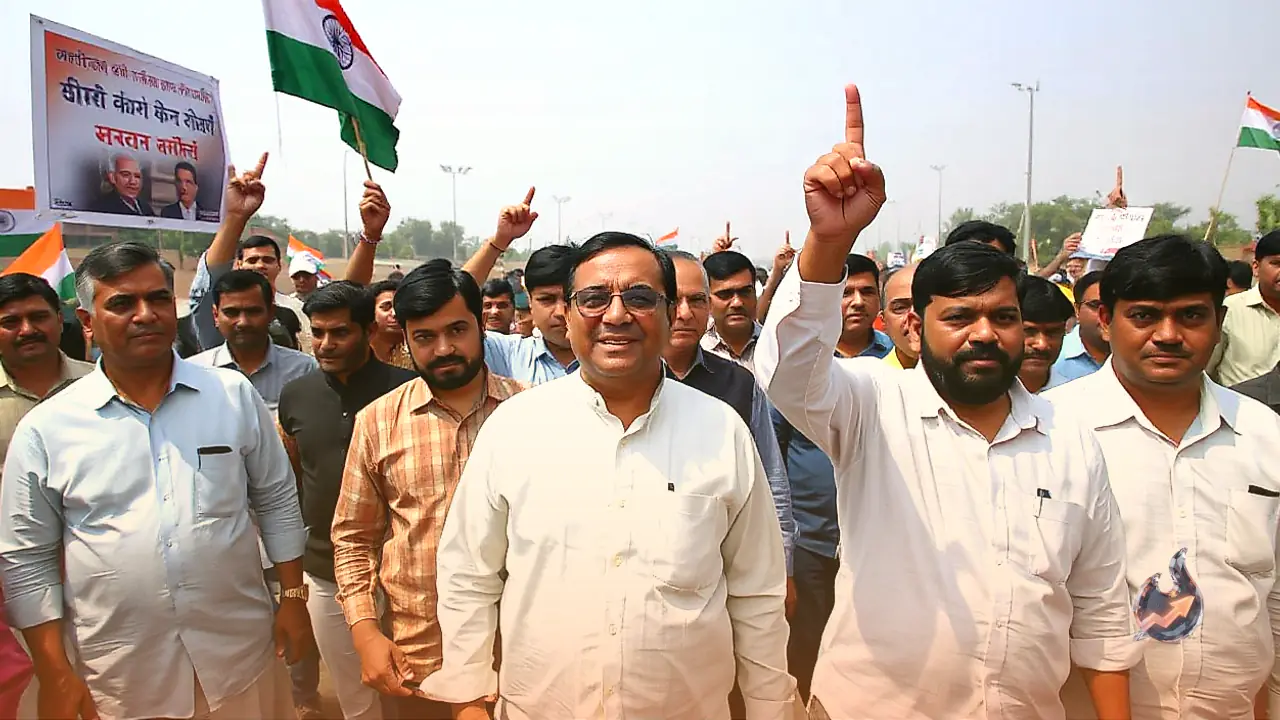

The Congress party has made it clear that its ongoing agitation will persist until Chief Election Commissioner Gyanesh Kumar is removed from office and India's electoral machinery is thoroughly reformed to ensure complete transparency. Addressing journalists, Congress General Secretary K. C. Venugopal asserted that the party's relentless protests across various states and districts will only halt once the election system becomes impartial and fair, though activities may pause temporarily during Diwali.
Massive Rallies and Direct Political Fight
Highlighting the scale of opposition, Venugopal described the mega rally organized by the party in New Delhi on November 1 as one of the largest demonstrations in the country. He emphasized that the political battle being waged by the party is directly against Prime Minister Narendra Modi and Union Home Minister Amit Shah. The leadership maintained that this struggle cannot be abandoned halfway and will continue until the country's voting processes are rendered entirely flawless and just.
Voter Deletion and Welfare Schemes
Raising serious concerns over electoral integrity, the party alleged that large-scale deletion of names from voter rolls is systematically depriving impoverished citizens of not just their fundamental right to franchise, but also vital benefits from various government welfare schemes. Venugopal claimed that these welfare benefits are being rapidly and rigidly linked with voter ID cards, compounding the crisis for vulnerable populations over the exclusion errors.
Ground-Level Strategy with Vote Rakshaks
To combat these discrepancies on the ground, Congress is launching a comprehensive nationwide campaign titled 'Vote Bachao, Desh Bachao' at the panchayat level over the next month and a half. Under this massive grassroots initiative, the party will deploy a dedicated 'Vote Rakshak' at every single polling booth across the nation. Their core responsibility will involve scrutinizing voter lists, identifying individuals whose names have been unjustifiably dropped, and physically visiting their homes to assist them in getting their names re-enrolled.
Parliamentary Strategy and Floor Coordination
At the organizational level, various state and district units of Congress are actively rolling out local programs, alongside concrete plans to orchestrate joint opposition actions with other political parties. Venugopal affirmed that the upcoming session of Parliament will witness aggressive protests on this matter, with the united opposition cornering the ruling administration on recent controversies and pressing public concerns. Recalling the previous parliamentary session, the party noted that sustained opposition protests effectively prevented Amit Shah from entering the House for nearly two weeks.
Addressing administrative affairs in Kerala, Venugopal defended the state government's governance, stating that an efficient administration is in place to address all raised grievances. He remarked that minor administrative lapses and stray incidents are natural, but appropriate action will be taken wherever warranted. Regarding allegations linking Kerala Excise Minister M. Laju to liquor bar owners, he defended the administration's handling of the matter, noting that public representatives naturally interact with various constituents in their areas. He questioned why former Excise Commissioner S. Sambasiva Rao raised corruption allegations only after leaving office, while affirming that the government has nonetheless agreed to investigate the complaints and take necessary action.