





















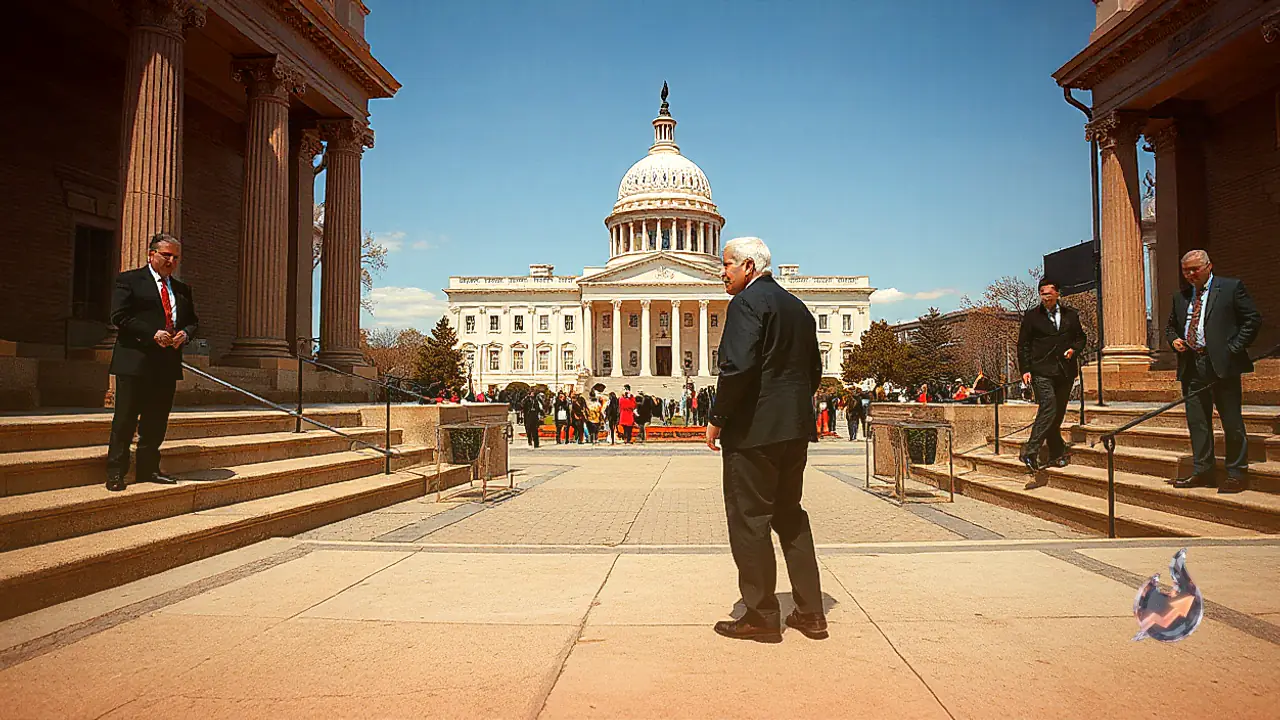

House Speaker Mike Johnson is set to step down from the Republican Party leadership hierarchy in the wake of substantial losses in the midterm elections. Johnson will decline to pursue backing to serve as the House minority leader when the incoming Congress convenes. Two individuals knowledgeable about the arrangement detailed the development on Wednesday while speaking under conditions of anonymity. The departure immediately triggers an open contest among lawmakers aiming to capture the primary leadership assignments within the House Republican conference.
Continuing as a District Representative From Louisiana
Despite walking away from the party leadership bench, Johnson intends to maintain his seat in the House as a standard lawmaker representing Louisiana. He recently secured re-election across his Shreveport-area congressional district, locking in his eighth term in office. His step back coincided directly with Democrats securing enough seats to capture the House majority. The resulting change in numerical balance left House Republicans in position to organize an internal transition and elect a fresh floor leader suited for minority status.
Steve Scalise and Jim Jordan Positioned for Leadership Battle
House Republicans will formally convene in Washington next week to choose their next chief official. The resulting contest is widely anticipated to pit two long-standing intraparty contenders against one another. Representatives Steve Scalise of Louisiana and Jim Jordan of Ohio previously pursued the top post during prior leadership vacuums. The decisive Democratic midterm victory has now intensified the internal competition across the different factions inside the House GOP.
Hakeem Jeffries Slated for Speaker as Democrats Take Control
The transition of power will formally transfer the speaker's gavel across the aisle to the Democratic caucus as the upcoming legislative session opens. House Democrats are actively preparing to put forward New York Representative Hakeem Jeffries, their current party floor leader, for the speakership. Under the constitutional order of succession, the speaker holds the second spot behind the presidency. The formal House vote to decide the speaker of the House is set to take place on Jan 3, 2027.
The Tumultuous Path to the Gavel in 2023
Johnson initially secured the speakership in 2023 following the dramatic removal of Kevin McCarthy of California from the post. That ouster stood out as an unprecedented internal coup within the chamber's institutional memory. Prior to that shakeup, Johnson operated as a junior member of the leadership tier. His rapid ascent emerged only after party members repeatedly failed to unite behind any single immediate successor following McCarthy's fall from power.
Trump Ties and the Post-2020 Election Strategy
Leading up to the Jan 6, 2021 assault on the US Capitol, Johnson played an active role in building legal and political support for Donald Trump's false claims regarding widespread election fraud. Those challenges focused on the outcome of the 2020 presidential race, which Trump lost to Democrat Joe Biden. Once elevated to the speaker's office, Johnson deepened his political connection to Trump, openly detailing a cadence of near-daily calls and policy consultations with the president.
Unrealized Predictions of Defying Historic Midterm Trends
Throughout the campaign cycle, Johnson insisted that Republicans were positioned to overturn standard historical patterns during the midterms. Voters in midterm cycles traditionally penalize the political party that occupies the presidency. However, Johnson's forecast failed to materialize on ballot night. Instead, Republicans incurred significant seat losses, surrendering the majority to the Democratic Party. The outcome dismantled Johnson's political leverage and eliminated any clear path toward retaining his position at the head of the conference.
Tight Margins and Fractured Blocs
Johnson's tenure in the speaker's chair was defined by microscopic operating margins, procedural standoffs, and recurrent internal rebellion. While peers and analysts frequently characterized him as an accidental speaker who took office by default, Johnson nevertheless constructed an enduring alliance with Trump. He guided the party conference across one of the thinnest legislative majorities documented in the modern era, culminating in a tenure marked by both a rapid ascent and a swift departure.
His withdrawal is poised to reignite entrenched conflicts between establishment conservative figures and far-right factions. Scalise, serving as the majority leader, has cultivated alliances among mainstream conservative lawmakers, including members with close links to the business community and energy producers. Jordan, a former collegiate wrestler who directed the House Judiciary Committee, maintains dedicated backing among hard-right and anti-establishment lawmakers.
Both Scalise and Jordan sought the speaker's gavel in 2023 after McCarthy was pushed out of power, but neither candidate secured the necessary majority as member ballots remained deadlocked. That paralysis eventually positioned Johnson as the consensus alternative. With the next Congress approaching in January and the elevation of Hakeem Jeffries slated for Jan 3, 2027, Republicans now face another high-stakes leadership vote in Washington to navigate their transition into the House minority.