

















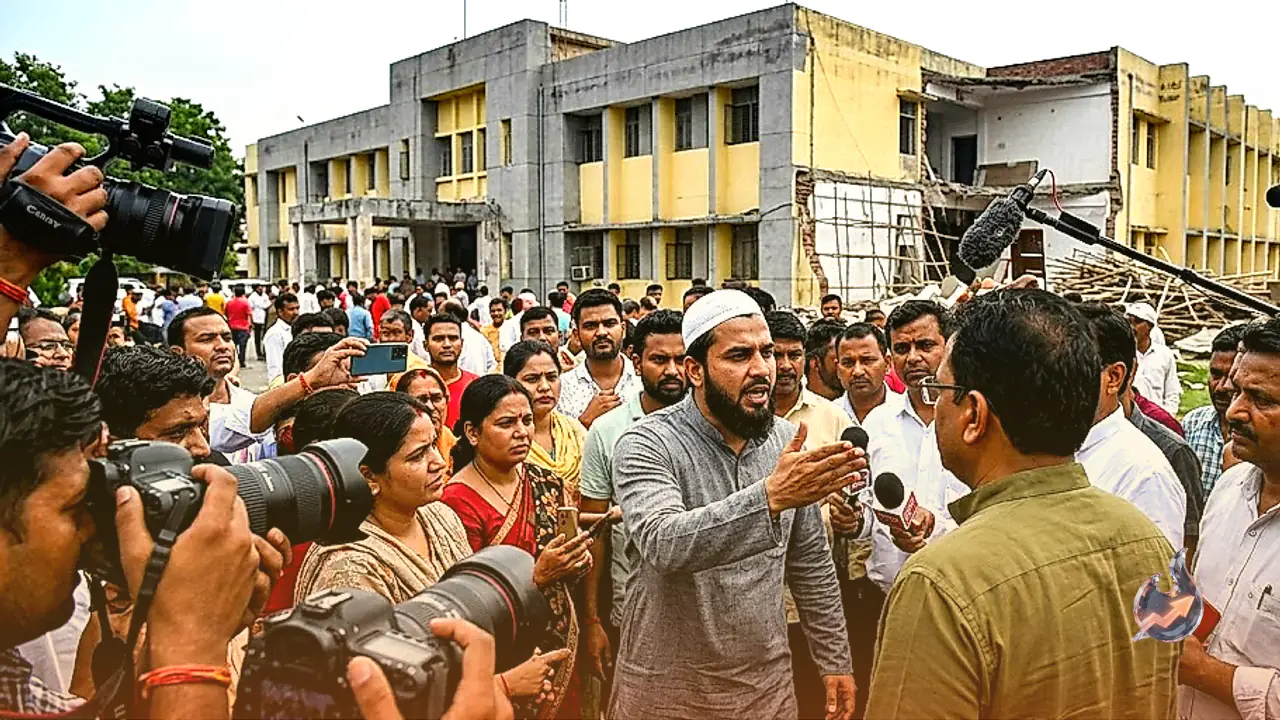

The recent demolition of a mosque situated within the Saharanpur collectorate premises has evolved beyond a mere government enforcement action, triggering a major political battle in Uttar Pradesh. The incident has sparked a direct confrontation between the Samajwadi Party and Asaduddin Owaisi led All India Majlis-e-Ittehadul المسلمين over the undisputed leadership of the Muslim voter base. Following the bulldozer action at the Saharanpur structure, AIMIM national spokesperson Shadab Chauhan unleashed a sharp critique against Samajwadi Party chief Akhilesh Yadav and young party MP from Kairana, Iqra Hasan. This aggressive verbal onslaught has significantly intensified political dynamics across western Uttar Pradesh.
Questions Raised Over Opposition Silence
AIMIM spokesperson Shadab Chauhan questioned the role and political intent of the Samajwadi Party regarding the Saharanpur demolition. Directly challenging SP chief Akhilesh Yadav, he pointed out that the party currently holds 37 MPs and 100 MLAs across the state. When the mosque was demolished in Saharanpur and the minority community faced a severe crisis, he asked where all these elected representatives had vanished. He further questioned whether Akhilesh Yadav plans to bring a convoy of his legislators to Saharanpur or simply remain seated indoors while watching the situation unfold from afar.
Clash Over One-Sided Electoral Support
Shadab Chauhan alleged that the Muslim community has continuously delivered one-sided electoral victories to the Samajwadi Party for a long time. However, whenever sensitive issues arise, such as actions against mosques, disputes surrounding madrasas, crackdowns on minority youth, bulldozer demolitions, or incidents of mob lynching, the voice of the Samajwadi Party noticeably softens. He argued that the party has consistently failed to stand firmly with the community during critical moments of need.
Criticism Directed at MP Iqra Hasan
The AIMIM spokesperson also directed sharp remarks at the role of articulate young MP Iqra Hasan. According to administrative claims, when Iqra Hasan attempted to visit Saharanpur, she was placed under house arrest. Mocking this development, Shadab Chauhan remarked that politics cannot be sustained merely by issuing statements on social media platforms and Instagram or by creating short reels. He emphasized that during difficult times, leaders must step onto the ground and stand shoulder to shoulder with affected individuals.
Absence of Grassroots Protest
Branding Iqra Hasan as a reel master, Chauhan advised her to transition into a genuine grassroots leader. He argued that if an elected parliamentarian was placed under house arrest by the administration, the entire Samajwadi Party machinery should have taken to the streets to stage a massive protest rather than remaining quietly seated. Taking to social media via X, Shadab Chauhan questioned whether Muslims have been stripped of their constitutional right to religious freedom and asked why places of worship repeatedly face demolition under weak and fabricated pretexts.
Battle for Dominance Over the Muslim Vote Bank
This verbal duel is considered highly significant ahead of the upcoming Uttar Pradesh assembly elections in 2027. Political analysts believe a deep electoral strategy underlies these sharp attacks. While Akhilesh Yadav attempts to build a formidable coalition of backward classes, Dalits, and minorities under his PDA formula, Owaisi's party is working actively to convince Muslim voters that the Samajwadi Party fails to support them during crises.
Strategic Significance in Western Uttar Pradesh
Muslim populations play a decisive role in electoral outcomes across districts like Kairana, Saharanpur, Muzaffarnagar, and Meerut. By specifically targeting Iqra Hasan, AIMIM aims to solidify its footprint among young Muslim voters in western Uttar Pradesh. The party is aggressively pushing a narrative that self-proclaimed secular outfits shy away from addressing real issues affecting minorities. While the Saharanpur mosque demolition underlines the firm stance of the state government, the political friction between the Samajwadi Party and AIMIM has created deep fractures within opposition unity ahead of the 2027 polls.