

















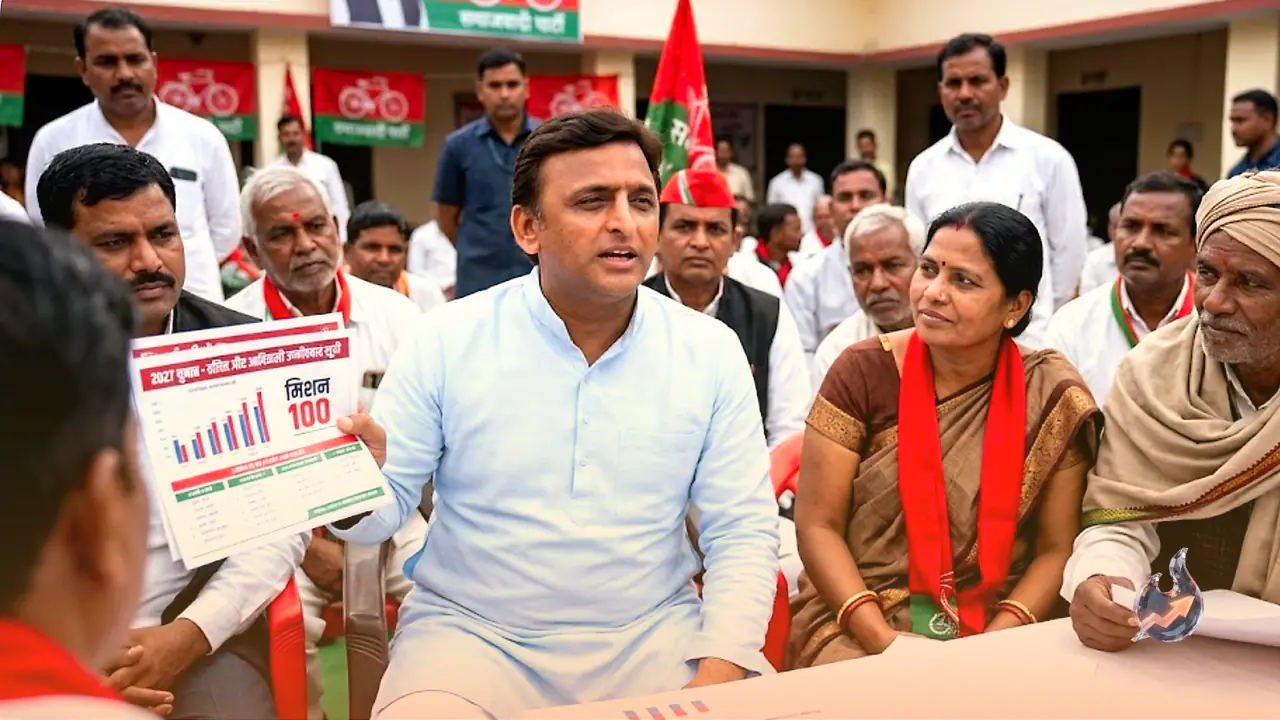

The Samajwadi Party's internal preparations for the next Uttar Pradesh assembly election are stirring things up. Party president Akhilesh Yadav has repeatedly said in interviews that he will not reveal the party's poll strategy, but a significant part of that strategy is now out in the open. According to sources close to the party, Akhilesh Yadav and the Samajwadi Party's think tank have decided to stick with the same PDA formula, standing for Pichhda (backward classes), Dalit and Alpsankhyak (minorities), that helped the party in the 2024 Lok Sabha election, and carry it into the 2027 assembly polls. As part of this approach, the party has drawn up a plan to field close to 100 Dalit and tribal candidates.
The math behind the hundred seat plan
Sources say the Samajwadi Party does not want to confine itself only to reserved seats. The party has decided that it will field Scheduled Caste candidates on 14 general, that is non-reserved, seats as well. If this plan goes through, the 84 seats reserved for Scheduled Castes and the two seats reserved for Scheduled Tribes, combined with these 14 general seats, would take the total number of reserved-category candidates fielded by the party to at least 100. That is why the plan is being referred to within the party as the hundred seat target.
The confidence drawn from the Ayodhya and Meerut experiments
The Samajwadi Party's confidence comes from two results in the 2024 Lok Sabha election. Faizabad, the constituency that covers Ayodhya, is usually considered a general seat, but in 2024 the party fielded Awadhesh Prasad, who belongs to the Dalit community, from there. Prasad, who comes from the Pasi community, won the seat and surprised many. Similarly, Meerut is also a general seat, but the Samajwadi Party fielded Dalit candidate Sunita Verma there. Verma lost that contest to the BJP's Arun Govil by a narrow margin of just 10,585 votes. Within the party, these two examples are seen as proof enough that Dalit candidates can win, or put up a tough fight, even on general seats, which is why there is a plan to repeat this experiment on a much larger scale in 2027.
An attempt to cut into Mayawati's vote bank
Sources associated with the Samajwadi Party say the intent behind fielding Dalit candidates on general seats is clear: to send out a message across the state that the party is a genuine well-wisher of the Dalit community and wants to give it greater representation in governance. The party is hoping that the large section of non-Jatav Dalits who backed the Samajwadi Party in the 2024 Lok Sabha election will continue to do so in the 2027 assembly election. The party leadership believes it is almost impossible to pry Jatav votes away from the Bahujan Samaj Party and Mayawati, so its entire strategy is focused on non-Jatav Dalit votes instead. Over the last four elections, the voting pattern of non-Jatav Dalits has kept shifting. In the 2017, 2019 and 2022 elections, a large section of this group backed the BJP, while in the 2024 Lok Sabha election, most of this community's votes went to the Samajwadi Party.
Trying to shed the Yadav Muslim party image
An internal Samajwadi Party source said, we are working on identifying Dalit candidates who can contest on general seats. Our target is to give the community 100 seats, but that will ultimately depend on finding the right and strong candidates. On general seats where the Samajwadi Party is in a strong position, we could consider giving tickets to Dalit candidates there. A senior party leader explained the thinking behind the strategy, saying the objective behind this decision is to build a narrative that the party is prepared to give the Scheduled Caste community a bigger share than just reserved seats. We did the same thing in the 2024 general election, and it worked in our favour. According to party insiders, another objective behind this move is for the Samajwadi Party to move away from its old image as a Yadav Muslim party.
The numbers from the 2024 Lok Sabha election also point in the same direction. The party contested a total of 62 seats in that election, of which only five went to candidates from the Yadav community. Interestingly, all five of those candidates were from Akhilesh Yadav's own family. The gamble paid off, and a total of nine of the party's candidates went on to win. Besides Sunita Verma and Awadhesh Prasad, seven other Dalit candidates also reached the Lok Sabha as Samajwadi Party MPs.
Why Mayawati's hold over Dalits kept weakening
Over the past few years, the Samajwadi Party and allies such as the Congress have made a determined push in Uttar Pradesh to reach out to the Dalit community and fill the space vacated by the Bahujan Samaj Party. Citing the 2011 census, it is claimed that Dalits make up close to 21 percent of Uttar Pradesh's population, and for a long time, the state's Dalit community regarded Mayawati as its natural leader. But by the time the 2022 assembly election arrived, that picture appeared to be changing. In that election, Mayawati's Bahujan Samaj Party got just 12.88 percent of the vote and could win only one seat, compared with the 2017 assembly election, when the BSP had won 19 seats with 22.23 percent of the vote. In the 2024 Lok Sabha election, the BSP's base shrank further still, the party failed to win even a single seat, and its vote share fell from 19.43 percent in 2019 to just 9.4 percent.
The Samajwadi Party-Congress strategy and the BJP's counter
On the other side, the Yogi Adityanath government's recent cabinet expansion also showed a deliberate BJP attempt to balance social and political equations, strengthening its own reach among non-Yadav OBCs and Dalits as well as other communities. Even so, Samajwadi Party leaders are confident that the Dalit community will back the party and the INDIA bloc in Uttar Pradesh. The party's much talked about PDA formula delivered strong gains in the 2024 Lok Sabha election, when the INDIA bloc won 43 of the state's 80 Lok Sabha seats.
A senior Muslim community leader said Akhilesh Yadav is telling Muslim leaders that the party will stick to the 2024 formula and will not give the community too many tickets. Later, once the government is formed, leaders from these communities will be accommodated through the Legislative Council. Ramji Lal Suman, a Samajwadi Party leader and Rajya Sabha MP from the Dalit community, said the party is confident of getting a large share of Dalit votes. I do not want to speak ill of the BSP, he said, but people in Uttar Pradesh have understood that the BSP will end up helping the BJP anyway.
Why this gambit matters ahead of 2027
With the Samajwadi Party's strategy now out in the open, Uttar Pradesh's political landscape has become more animated. Since the plan is no longer under wraps, rival parties are likely to start working on their own countermoves. Chief Minister Yogi Adityanath's BJP is already working to expand its footprint among non-Yadav OBCs and Dalit communities, while Mayawati is trying to hold on to her traditional support base. Against this backdrop, the Samajwadi Party's social engineering could make the contest between the Samajwadi Party, the BJP and the BSP even more competitive ahead of the 2027 assembly election.