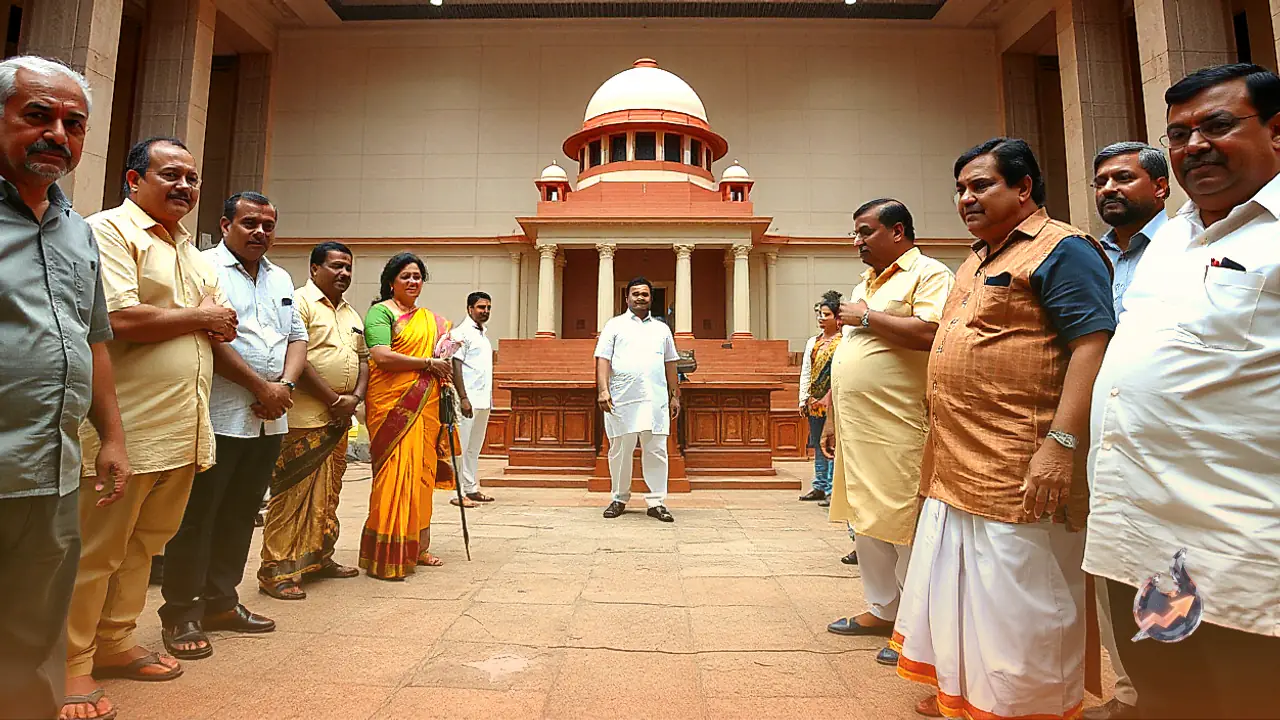






















The Supreme Court of India has raised significant constitutional and legal questions while hearing a petition concerning the Special Intensive Revision (SIR) of voter lists in West Bengal. A three-judge bench comprising Chief Justice Surya Kant, Justice Joymalya Bagchi, and Justice V. Mohana deliberated on the matter following an application filed on behalf of a member of the Trinamool Congress (TMC). The apex court initiated a broader legal inquiry into whether the judiciary possesses the authority to direct fresh elections in assembly constituencies where voter deletions exceed the margins of victory.
Margin of Victory and Voter Deletion Dynamics Across 31 Seats
Appearing for the TMC petitioner, Senior Advocate Kalyan Bandyopadhyay presented a comprehensive compilation of data before the bench. The submission highlighted 31 specific assembly constituencies where the victory margins of the winning Bharatiya Janata Party (BJP) candidates were smaller than the total number of voters removed from the electoral rolls during the SIR exercise. The petitioner contended that such wide-scale voter exclusions directly impacted the final electoral outcomes in these seats.
Addressing the scope of the proceedings, the Supreme Court bench clarified that it would not restrict its judicial scrutiny solely to the 31 constituencies identified in the petition. Instead, the court expressed its intent to examine all pending cases before appellate tribunals across West Bengal. The bench emphasized that a comprehensive review is necessary to ensure the timely and effective resolution of all unresolved appeals related to voter list revisions.
Judicial Powers and Status of Formal Election Petitions
Responding to the arguments, Chief Justice Surya Kant drew attention to the fundamental legal constraints governing electoral disputes. The Chief Justice made an oral observation, asking: "You can file an application on this, but can the court order fresh elections in this manner?" The bench further inquired whether the affected candidates in those 31 constituencies had instituted formal election petitions to challenge the election of the winning candidates.
Senior Counsel Kalyan Bandyopadhyay responded to the query by informing the bench that formal election petitions had indeed been filed in some of the constituencies, though not across all 31 seats. This distinction prompted the court to evaluate whether systemic challenges to voter list revisions can substitute for statutory election petitions prescribed under electoral law.
Evaluation of Pending Appeals and Legal Thresholds
Justice Joymalya Bagchi stressed the critical need to assess the actual number of excluded voters who pursued legal remedies by filing appeals against their deletion. The bench observed that if a voter whose name was removed accepts the decision without filing an appeal, any subsequent challenge to the election result on their behalf remains purely theoretical. Judicial intervention requires concrete proof of active legal challenge by affected citizens.
To illustrate this legal threshold, the bench provided an illustrative scenario. If 100 voters were removed from the rolls in a constituency where the winning margin was 50 votes, and 60 or 70 of those removed voters had filed appeals that remain pending, the challenge to the deletion process becomes a substantial and highly consequential legal matter. The court noted that the status of these pending tribunal appeals would be crucial in determining the impact of voter deletions on electoral integrity.