














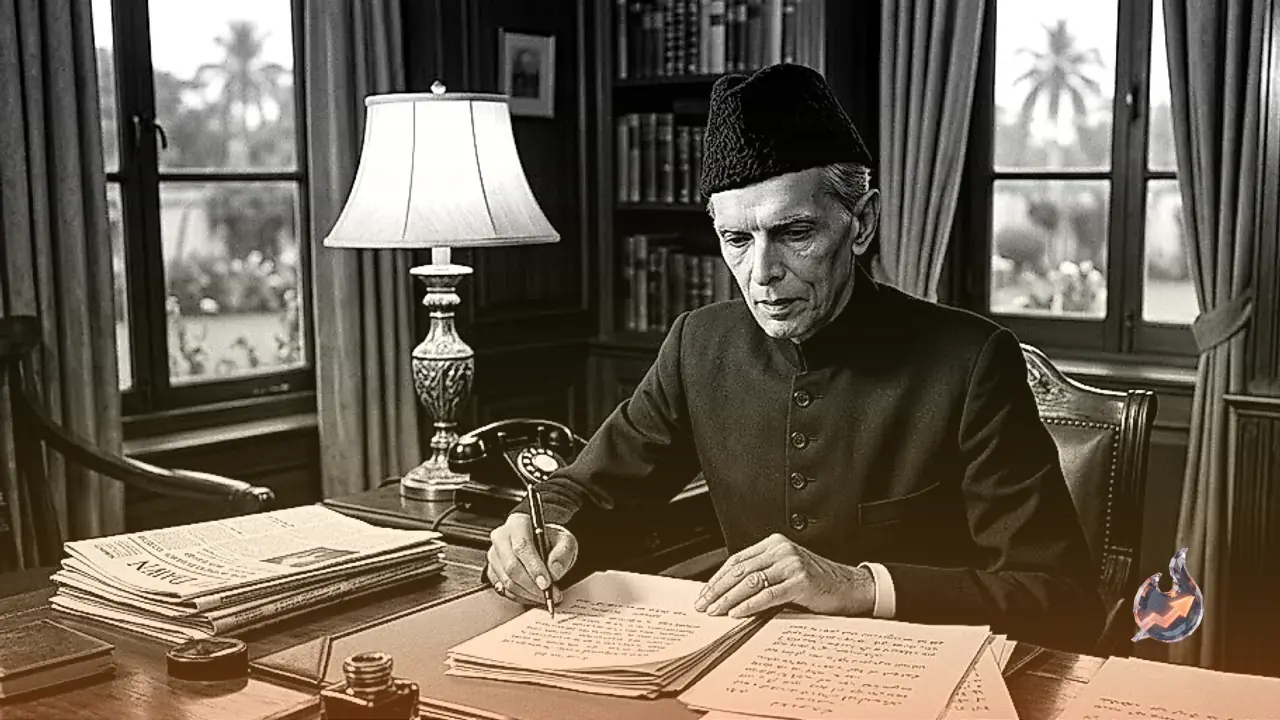

August 9, 1947, marked a critical juncture on the subcontinent where the threshold of freedom was overshadowed by deep apprehension and escalating violence rather than celebration. The partitioning of the country was reaching its final stages, and communal tensions across various districts of Punjab had intensified to horrifying proportions. While preparations for the birth of a new nation named Pakistan were underway, blood continued to flow through the streets of Amritsar and its surrounding areas. Amidst this deeply tense and volatile atmosphere, Mohammad Ali Jinnah, designated as Pakistan's future governor-general, sat in his residence contemplating the future and structural framework of the upcoming country. At that point, Pakistan lacked any official national anthem, and no serious discussions had yet commenced regarding the matter. Suddenly, a young Punjabi Hindu poet named Jagannath Azad crossed Jinnah's mind.
Mohammad Ali Jinnah and Poet Jagannath Azad
Mohammad Ali Jinnah was already an admirer of Jagannath Azad's Urdu poetry and believed the writer could compose a fitting verse for the new nation. Although a fleeting thought crossed Jinnah's mind regarding the propriety of commissioning a Hindu to write Pakistan's anthem, he quickly dismissed the hesitation, prioritizing the creation of a magnificent composition above all else. Jagannath Azad was summoned to Jinnah's bungalow and arrived well ahead of the scheduled time. When Jinnah saw him, he was momentarily surprised, expecting an elderly and experienced poet given the supreme quality of his Urdu verse, only to find a young man of around thirty standing before him. Jinnah instructed him to compose a nazm for Pakistan's national anthem, and Azad, having no pre-written poem at hand, recited a few spontaneous lines from his imagination. Upon hearing them, Mohammad Ali Jinnah remarked that this was precisely what he wanted. Consequently, the responsibility of writing the early anthem for Pakistan was entrusted to a Punjabi Hindu poet.
Mahatma Gandhi Arrives in Calcutta for Peace Efforts
On August 9, 1947, Mahatma Gandhi arrived in Calcutta en route to Noakhali and took up residence at the Sodpur Ashram. During this turbulent period, Calcutta was far from immune to the horrors of Hindu-Muslim tensions and the persistent threat of violence. Mahatma Gandhi firmly believed that the celebration of political independence would only hold genuine meaning if ordinary citizens could coexist in peace and harmony. He prioritized communal amity far above political events and ceremonies, initiating relentless efforts to restore tranquility among the residents of Calcutta.
Surging Refugee Crowds and Railway Station Crises
Under the looming shadow of partition and the fear of violence, thousands of individuals had begun abandoning their ancestral homes to seek refuge in safer territories. Massive throngs of displaced people had accumulated at railway stations across the country, many waiting under the open sky with their meager belongings and young children. The ground reality had deteriorated to such an alarming extent that additional military security was deemed strictly necessary along railway tracks and moving trains to safely evacuate refugees.
Nehru Sends Communication to Liaquat Ali Khan
With only a few days remaining before the official establishment of India and Pakistan, containing the widespread violence across both sides had transformed into the most formidable challenge. Amidst the worsening conditions, Jawaharlal Nehru addressed a letter to Pakistan's prospective prime minister, Liaquat Ali Khan, on August 9, 1947. Through this communication, he expressed profound concern over the deteriorating situation in western Punjab and highlighted the pressing issue of refugee protection and safe transit.
Muslim League Intensifies Administrative Preparations in Karachi
Days prior to the formal emergence of Pakistan, political and administrative activities by the Muslim League in Karachi reached a fever pitch. Crucial deliberations regarding the administrative and constitutional framework of the newborn nation were continuously underway. The constituent assembly of Pakistan was also gearing up to manage its nascent legislative duties. As the designated date for the transfer of power drew closer, the leadership of the Muslim League shouldered the monumental task of establishing a governing apparatus from scratch for an entirely new country.
Press Censorship Imposed Across Punjab
Governor of Punjab Evan Meredith Jenkins, operating from Lahore, promptly ordered the imposition of strict press censorship across the entire province upon receiving reports of brutal riots and bloodshed in and around Amritsar. Consequently, news regarding the severe violence and massive casualties in Amritsar on August 9 could not be published in any Punjabi newspaper the following day. This restrictive measure by the British administration extended beyond merely halting the dissemination of news; its core objective was to conceal the grim reality of the violence from the general public.
Radcliffe Boundary Commission Nears Finalization
By August 9, 1947, the Radcliffe Boundary Commission, tasked with demarcating the new frontiers between India and Pakistan, approached its final and decisive phase. Sir Cyril Radcliffe shouldered the immensely sensitive responsibility of dividing the provinces of Punjab and Bengal. The commission's decisions were destined to alter the lives of millions of people fundamentally. Although the formal announcement of the borders was delayed until August 17, the process of finalizing maps and boundaries was virtually completed by August 9.
Demand for Pondicherry Merger Intensifies
On August 9, 1947, demands for complete liberation from French colonial rule and subsequent integration into the Indian Union gained significant momentum in Pondicherry. The French India Students Congress alongside other organizations made extensive preparations for demonstrations. Local authorities attempted to enforce prohibitions on public gatherings, yet students, laborers, and local residents poured into the streets in protest. Numerous demonstrators were taken into administrative custody, while a general strike by workers underscored the mounting public pressure against French administration.
Dhrangadhra Princely State Decides to Join India
Discussions concerning the historical integration of the Dhrangadhra princely state into the Indian Union, conducted alongside Sardar Patel and V.P. Menon, reached their concluding phase. Observing the rapidly shifting political landscape and ground realities, Maharaja Sriraj of Dhrangadhra ultimately resolved to unite with India.