





















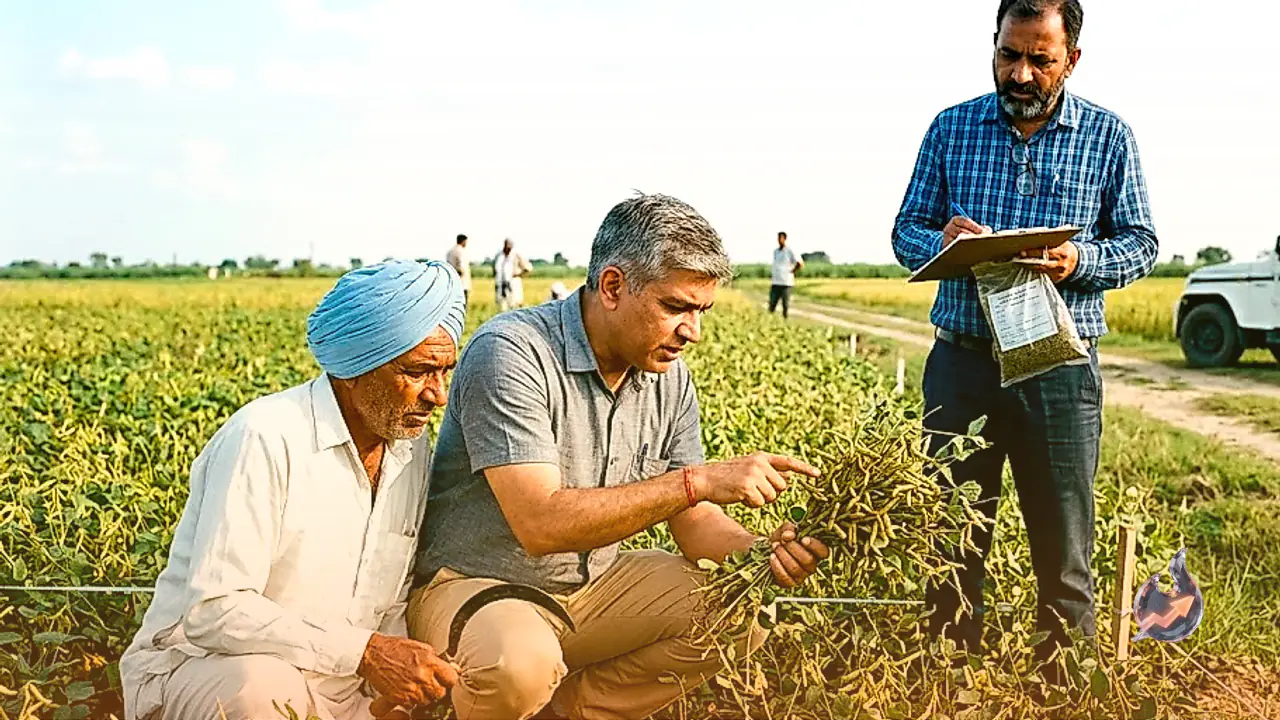

Senior officials from the agriculture department walked through fields in the Sri Dungargarh area of Bikaner district to get a first-hand read on how this year's kharif crops are actually faring. The focus was on moong and moth, the two pulses widely grown in the belt, with officials checking plant growth, the number of pods forming and what kind of yield farmers might expect once harvest begins. Farmers and local field staff were also asked about sowing schedules, how the season's rainfall had affected the crop, and what output they anticipated.
Senior Officers Lead The Ground Visit
Hirendra Sharma, Additional Director of Agriculture (Extension) for the Bikaner division, and Jaideep Dogne, Deputy Director of Agriculture (General), toured several fields in the area. The two officials examined the standing crop closely, trying to gauge how much the season's weather and rainfall pattern had influenced the moong and moth plants. They looked at multiple factors on the ground, including how tall and healthy the plants had grown, how many pods each plant was carrying, and what the likely per-hectare yield could be. Officials also questioned the department staff present about how sowing had progressed across the area and what assistance the department was currently extending to farmers.
Crop Cutting Experiments Also Checked
During the same visit, officials also inspected crop cutting experiments being conducted on the ground by the revenue department. These experiments, carried out as per a set standard procedure, were examined closely, covering everything from how the field and plot are selected for the exercise to how the crop is cut, how the harvested yield is weighed, and how the resulting figures are recorded. Officials instructed staff that the entire crop cutting exercise must be carried out with full transparency and strictly according to the prescribed process, leaving no room for error at any stage.
Why The Numbers Matter
Officials stressed that every figure recorded during these experiments needs to be accurate, since that data forms the basis for estimating the average yield and total production of kharif crops across the region. The results of these crop cutting experiments are used to calculate the average per-hectare yield for the area concerned. Beyond feeding into overall agricultural production estimates, this data also plays a key role in deciding insurance claims filed by farmers under the Pradhan Mantri Fasal Bima Yojana. That is precisely why a representative from the insurance company was also present at the inspection, to keep the claims process transparent from the outset.